Deeply respected for his activism on issues from Indigenous rights and land mines to the environment and Third World debt, Cockburn has undertaken work with organizations including Oxfam, Amnesty International, Doctors Without Borders, and Friends of the Earth. An officer of the Order of Canada, the Ottawa-born artist has been honoured with 13 JUNO Awards, induction into the Canadian Music Hall of Fame and Canadian Songwriters Hall of Fame, as well as the Governor General’s Performing Arts Award.
Between late April and early July this year, Cockburn will be logging nearly 25 new shows of his soul-stirring live performances in the U.S. and Canada. And since those dates only cover a clutch of cities in the Southwest U.S. and in Ontario, it’s reassuring for those of us most mindful of the passage of time that the now-78-year-old artist is charting out another run of North American shows for late fall.
Practically on the eve of this next run of dates that begins on April 24, in San Luis Obispo, CA, Grateful Web was most fortunate to have a personal conversation with Dr. Cockburn about the record and upcoming tour. (This took place on April 9, coincidentally the day after the great 2024 North American total eclipse.) This highly-awarded songwriter and performer – and, in fact, a holder of three honorary doctoral degrees in music – touched upon some his personal creative processes, his way of looking at the world and even a bit of the mysteries of existence – all ingredients in the making of O Sun O Moon.
When I attended one of Cockburn’s shows last year in Cincinnati, Ohio, still early on the 2023 tour, O Sun O Moon was certainly the main entree of songs on the menu that night. Yet, there was a good number of recognizable, fan-favorite songs and a few surprises on offer. Over the year since the album’s release and beginning of the tour, faithful fans of the master musical storyteller and guitarist have had a chance to become more deeply familiar with the new album. And – to my ears and mind at least – it may very well become as cherished as any of his most classic collections.
Although I was introduced to Cockburn’s music in the later 1970s, not long after his first few albums had been released, I’ve admittedly drifted in and out through different stages of his career. While I was off following other genres and more rock-oriented artists, I’d keep my ear cocked for what ‘progressive’ folk artists such as he and British folk-rock pioneer Richard Thompson would be up to next, even if l didn’t always listen to every album in depth. Initially more of an solo acoustic folk songwriter, he pursued a more obvious electric route with backing bands in the ‘80s, and in the MTV era even reached beyond his core audience with videos for such electrified rock activism songs as “Call It Democracy” and “If a Tree Falls”. Of course, some of that period drew me back. Yet, I’ve surely missed a good many things, so even now I feel as if I’m still catching up with Cockburn.
With my incomplete knowledge of Cockburn’s entire body of work, I’ve tended to gravitate toward his more rock-oriented releases, and a personal favorite is his 2002, You’ve Never Seen Everything. This album deftly balances ballads against some modern-rock grooves such as the rap-spiel opener “Tried and Tested”. And while there are moments of sweetness and light in the folk-style songs, there are more experimental moments, too, like the album’s title track – a chilling, nine-minute, film-noir-soundscape with spoken-word narration that takes the listener on a journey through a dark night of the soul. I also tend to listen more for his instrumentals and expressive, jazz-flavored guitar performances than for his lyrical songs, so I’ve also been highly impressed with his all-instrumental albums, 2005’s Speechless and 2019’s Crowing Ignites, which are both journeys of their own.
Recorded in Nashville with Cockburn’s go-to producer Colin Linden, O Sun O Moon seemingly reshuffles the deck on listener expectations – and mine. It’s an album of sublimely crafted acoustic songs, rich in musical textures, air, and light that never once leave one wishing for more electrical current. Through alternating modes of quandary, gravity, celebration, sardonic humor and emotional resolve, his poetic and minimalist lyrics explore questions of life and mortality, love and forgiveness, and our place in the world.
So, yes, personal themes abound on the album, such as making the best of the time one has left in life (“On a Roll”), the spirituality in everyday life (“Into the Now”) and looking ahead to the next adventure (“When You Arrive” – a joyous New Orleans’ waltz that not only serves as the album’s grand finale but is also a rousing live sing-along.)
In any case, the longtime social and political activist also hasn’t shied away from contemporary issues but allows them a space of their own on the album. One such song is the percolating, roots-y, climate-change tune, “To Keep the World We Know”, which he co-wrote with fellow Canadian singer-songwriter Susan Aglukark. And in the probing song about coming to terms with our fellow man and woman titled “Orders”, the perennial humanitarian seemingly answers the biggest question of all – “Why are we here?” – with unflinching directness.
Front and center, of course, is Cockburn’s warm and knowing but not-always-sweet voice, swathed in musical textures that range from soothing and inspirational to ones with more spit and grit. In fact, you might think that his song “King of Bolero” is a fair impression of Tom Waits. His guitar playing is also exemplary, although it never draws undue attention to itself. And both his vocals and instrumentation are kept good company with a fine ensemble of guest vocalists and musicians. Among these are Gary Craig, Sarah Jarosz, Jenny Scheinman, Buddy Miller, Susan Aglukark, Shawn Colvin and Jim Hoke.
O Sun O Moon is a satisfying emotional experience, from start to finish, and if you’re a longtime fan of this veteran songwriter, then you have very likely already moved it upward – if not all the way to the top – on your personal list of favorite Cockburn albums. If you happen to be still largely uninitiated to his musical universe, then this album – with its Zen-like sense of presence, sage wisdom and timelessness – is an excellent place to start your journey.
“One more time,” Cockburn urges his backing singers onward with a glimmer in his voice on the final, life-affirming refrain of “When You Arrive.” And when he plays it live, the whole audience joins in, shedding even more light into all the dark corners. Now isn’t that what friends are for?
In certain areas, in terms of individual spirituality, I’d say I’m an optimist. But in regard to the future of the planet, I’m more inclined to pessimism. The pessimism isn’t [giving in] and saying, “Ahh, what the hell! It’s all going down. . . .” It’s because I have grandchildren and also a young child, and I worry about the future for them.
The pessimism comes in where I don’t see as much being done to offset the threats that we’re faced with. Spiritually speaking, I do think there’s a kind of contest between dark and light, and I think that “On a Roll” is a celebration of the fact I feel like – at least while I was writing that song – that light will triumph. Also, that when I cross that boundary to whatever comes next, I’m gonna find myself in a good place. That’s what the hope really is.
So, yes, it was cleansing, and, perhaps, I also didn’t have so many pressing lyrical ideas at the time. It was fun to make an instrumental album and to think only in those terms. When it comes to writing lyrics, I can’t really force the issue very well. I’ve done it occasionally, and I haven’t liked the results very much. But with instrumental music, I can just pick up my guitar, start fooling around and look for things more actively than I can with lyrics. So it was fun to work on Crowing from that perspective.
Several of the new songs were written in Maui when some of my family, friends and I were there [a couple of summers ago]. We rented a house, and it was so calm with tranquil, beautiful surroundings, and good company. That was, of course, before the tragic fires in Lahaina. The effect of that atmosphere was like it popped the cork and out came all of these songs!
For example, two songs that were like that were “King of Bolero” and “Into the Now”. Another song, “Colin Went Down to the Water”, came about a little differently but also in that setting. There was – as I like to think of it – a certain amount of grace that went into the writing of the songs, very little conscious tugging at things to get them to happen.
The oldest song of this set of songs was “When You Arrive”, and the idea for that had sat around in my notebook a long time. Then, one day, it suddenly clicked, and I thought, “Oh, yeah!” And that’s how it works. I’ve had that experience with songs, from time to time. It’s not like I went back to them every day and said, “What I can do with this?” They’re just there, and then something would invite me back to revisit them, and then there it was. Whether all of this was easier than other albums, I’m not sure. I’d have to think back hard about how those songs came to be.
Even the recording [of O Sun]went pretty well, and that can sometimes be more difficult than the songwriting. One thing on this session is that I suffer from Meniere’s Disease, and my vertigo acts up at times. I’d have attacks of vertigo every day during the recording, and yet it came out all relaxed and cool. And – heh-heh – you won’t hear that on the record. We got lucky with that. It could have been worse! But, it was a very pleasant atmosphere at the studio where we recorded in Nashville. I stayed in a house where you walk across the yard, and then you’re in the studio. It made it all very workable and fun.
The way we approached it was that Gary Craig –my drummer and percussionist – and I recorded everything together. So he acted like a kind of human beatbox or human click-tracking, and he kept me in the right place rhythmically. So we had vocals and guitar, and some form of drums or percussion, and then we added people to that. And the great thing about it for me, in particular, is that I didn’t hang people up [during the sessions] waiting for me to get my shit together. And everybody contributed the most beautiful things.
Jim Hoke, the horn [and clarinet] player, walked in, really prepared, and he did the most amazing and beautiful horn parts. He started laying stuff down, and it was really magical, even though I was feeling like garbage.
Sarah Jarosz came in and sang and played great. And (violinist/vocalist and previous Cockburn collaborator) Jenny Scheinmann – we got lucky with her, because she just happened to be in Nashville at the same time. We had no budget to fly people around. We had to use people we had access to, and Jenny was someone I’ve worked with a lot in the past.
So I didn’t want to get stuck in that. For me later on, that ceased to be an issue and I just started exploring other tunings. That’s especially evident on Crowing Ignites. And there’s a song on this new album that’ s in what I call “E-GAD”. It’s DADGAD (six-string) tuning with the low string left in E instead tuned down to D. That gives you a nice combination of fourths and modal harmonies that you can move with, kind of like [jazz pianist] McCoy Tyner. Y’know, I’m not comparing what I do with what he did. . .
Songs that I’m doing are the ones that people would want to hear. I had to come up with a new way of playing “All the Diamonds in the World”, for instance, and “Pacing the Cage” and a couple of other things that people are always asking for. For a long time, I’d have to say, “No, sorry, can’t do it because my hand won’t make those chord shapes. And that’s one area where using alt tunings can be very helpful.
So, I’ve been doing some of that [re-arranging] and that’s been taking up some of the songwriting energy. But it’s worked, and I’m able to play those songs now. Whether people approve of the change in my guitar [parts], I don’t know. There are a lot of guitar players who’ll come to the shows, and they’ll see that those aren’t the same shapes they’ve seen me do before. But I think the music works now, and hopefully they’ll think so too!
In terms of what the song’s talking about, it doesn’t name people. But the problem [of global warming], of course, is bigger than just calling out people’s names. To single out certain decision makers for a song like that would be pointless, because they’re all screwing it up. Who’s your ‘bad guy’ today? The ‘bad guy’ is the money interests that are financing our politicians and financing their policies. That’s hinted at in the song, but that’s the enemy and it’s how we handled it.
In a way, that happened with “All the Diamonds”, “Pacing the Cage” and “Lord of the Starfields”. They’re all songs that because of the [chord] fingering of the original versions, I could sort of play them, but they didn’t come out well. They were all sort of messy sounding. So I had to come up with new ways of playing, and that made them fresh again.
Having to not be able to play them for a couple of years, at least — it’s been about that long that I’ve had this problem. So people would call out especially for “Pacing the Cage” and I’d really [regret] not being able to do it. I’d say, “I’m really sorry, but I’m working on it.” So that was one that got a rest and then it feels to play it again – feels good. With “All the Diamonds”, I did go through a phase where I hated that song – not as a song, just having to play it. But that was years ago, and I got over it.
Some [older] songs are lighter and they don’t require quite as much from me to perform them. I don’t have to go quite as deep to perform them as I do with “Pacing the Cage”, y’know, to make them meaningful in performance. I’m happy I got a rest with “Pacing” because it’s not a happy song, and I have to go back to where I was emotionally when I wrote the song.
Some people think that it doesn’t, but I think it does. I do think there is darkness in the universe and you don’t have to look far to find it. I can buy into the Christian viewpoint, but I don’t think there are literally Pearly Gates or streets paved with gold. I think that’s a metaphor for something beautiful. And I kind of see it as involving a connection with the Divine and the ruling principle of the cosmos, which is a beautiful and loving presence.
I think when you look at a starry sky and you are moved emotionally by that, what’s moving you is your sense of connection with the bigness of everything. I think bodies get in the way of that, so if you get the body out of the way, then your relationship with that will become more direct, pure and accessible.
What a wonderful rabbit hole to fall into! I As the reader, I was immersed for weeks in Bruce’s music, playing the tracks from all the albums that Dunn delves into, as I read the book. I followed the timeline along with Mark Dunn’s research and exploration of all Cockburn’s albums. This book explores the profound influence and remarkable evolution of Cockburn’s music. A renowned Canadian singer songwriter and guitarist, Cockburn has entertained and educated listeners for over five decades.
Speaking with Mark recently about the book, we discussed the fact that Bruce is like a war correspondent, a journalist observing through his lens of music the times we live in, complimented by the poetry of his complex guitar phrasing. Cockburn digs deep into the pathos of the song.
Mark reflected that: “Bruce is almost always the narrator in these songs, and they are not always about him, but they are always a reflection of his point of view.”
Author M.D. Dunn takes us on an obsessive and humorous quest to track Cockburn’s cultural footprint and reflects on his own early introduction to Bruce’s music and how writing the book became a 7-year quest of immersing himself in the complete catalogue and as Mark says, “There is not a bad album in the catalogue”. The book is interspersed with interviews with Bruce, and meetings and interviews with many of the key players, like the legendary Bernie Finkelstein, close friends, and colleagues of Bruce’s, to get a clear picture of his generosity of spirit, his spiritual journey, his activism, and his love of nature. Black and white photographs from the archivist Daniel Keebler help to illustrate the different life passages of Bruce at home, in the studio, and on the road.
We talked at length about the passage in the book where Mark describes that we all come to Bruce’s music at different times in our lives. For him it was a cassette tape that was unlabeled with no liner notes in a thrift shop when he was fourteen “Joy Will Find a Way” which affected him so profoundly. For me it was “Goin’ To the Country” released in 1970. And so, wherever you come to Cockburn’s music, that is THE album for them. As a Montrealer, I believed we always had the ‘cool’ music first in Canada. Bruce always included French Lyrics on his albums and in his songs, so he was played extensively in Montreal on CHOM FM, the station of global inclusivity and diversity at the time as well as CJFM, the softer rock station of the City.
During our lively conversation, the author and I delved into the place of Bruce’s activism and how much great courage and self-discipline it takes to walk that path and be committed. How in one passage in the book, Bruce wrestles with the thought that the last line of “If I had a Rocket Launcher”, could be seen as a call to violence. He had been in such rage and grief writing that song after witnessing the refugee camps that had been decimated, killing women and children in South America. Cockburn worried that the rage was palpable in that song. Bruce says in the book: “It is still painful to sing that song. I put myself where the song is. It is painful. I don’t like singing it.” The book really delves into the trajectory and platform of his activism and there are interviews with people who accompanied him to Guatemala and Nicaragua that illuminate his integrity and shyness around acclaim for his participation. What Cockburn writes is thoughtful and researched and chosen out of a deep expression of belief in the group he is representing and not for opportunistic reasons.
Following the journey of Bruce Cockburn’s spirituality is also a revelation in the book and now makes so much more sense to me considering the descriptions of the albums created the maturity developmental period in this book’s timeline. The music gives us clues as where Cockburn is on his faith journey. It is wonderful that M.D. Dunn extrapolates the world news as we explore Bruce’s discography. It makes so much sense to me through reading this book, how mature he was as a thinker and an artist for change.
You Get Bigger as You Go Mark and I spoke about the journeys we must all be on and that our choice of music is our companion, our guide, our Gandalf. This book is like that, it opens every moment for discussion and very beautifully speaks to the poetry of Cockburn’s lyrics, as we search our own journey on the timeline for similarities.
I especially like how the author timelines Cockburn’s quest for spirituality. We the reader have the opportunity through descriptions of different albums and interviews to immerse ourselves in Cockburn’s journey. Asked in 2021 his concept of God Bruce says “It’s tricky, I got into a sense of God, the cosmic-ness of God that I think about most often. it’s a little like pantheism. God is in everything. Nothing exists without god’s permission, would be a Christian way of saying it. Having set the universe in motion. It doesn’t mean that “he takes an interest in every single detail. If you can imagine a person. While there is this cosmic thing, there is also a presence in the heart (brings both hands to his chest) that’s inescapable for me. And I want to know more about it. I never feel I know enough about it, that I have a clear enough channel to it. I like the Kabbalist notion of “Ein Sof” which is “The Boundless. In other words, you can say anything you want about God, but you’re never going to cover it. And so, all the images in a way are suitable, but limited. And you must be aware of the limitations of that imagery.”
Dunn writes: Cockburn’s spirituality is often described as ‘bordering on the mystical’. He has read widely and with an open mind, drawing from Christian studies, the Kabbalah, the occult, and Buddhism, among other traditions, to form a faith system that seems fluid and ever evolving but still Christian. Suffice it to say that Cockburn believes in a personal savior that transcends all physical limitation. It’s The Boundless, as he says, Boundless without end.
In conclusion: I highly recommend this book for anyone who loves and lives for the back stories in Bruce Cockburn’s music, and for those who embrace our Canadian perspective. The book is so well written and researched that it was very hard not quote or wish to discourse on every topic. There was so much meaning and integrity of language throughout the whole tome.
M.D. Dunn (you can call him Mark) has written and performed music for more than thirty years and released nine albums as of 2023. A teacher and a poet, Dunn’s writing has been published in the Globe and Mail, the Literary Review of Canada. The Rumpus, Public works Magazine, Contemporary verse 2, and many other outlets. He lives in Sault Ste. Marie, Ontario, Canada, where he teaches writing at Sault College. Find him online at www.mddunn.com.
As the author says: “The book is not perfect, and there is much more work to be done with Bruce Cockburn’s music and its cultural presence. I hope that this small offering might continue and advance the discussion.”
Fermata Press is a micro press for quirky books about music, who are dedicated to giving readers insightful, engaging, and strange books. Contact @fermatapress.com www.fermatapress.com
Join James Toth and Tompkins Square for a Record Release Party celebrating the release of 'Imaginational Anthem vol. XIII - Songs of Bruce Cockburn'.
Cockburn, whose 38th studio album O Sun O Moon came out in May 2023, has always been known for his artistic passion and social and political consciousness. His music has spanned a wide range of influences as well. On his 1984 album Stealing Fire he recorded many intense political songs, including “Lovers in a Dangerous Time,” and “Nicaragua.” The former song had a lyric (got to kick at the darkness till it bleeds daylight) that U2 later referenced in the song “God Part II.” The Irish band reportedly considered covering “If I Had a Rocket Launcher,” but never did.
When it came out, “If I Had a Rocket Launcher” actually received a good amount of radio airplay and was shown on MTV. The incendiary song was inspired by Cockburn’s first trip to Central America that was coordinated through Oxfam in 1983. After visiting a Guatemalan refugee camp in southern Mexico that had been attacked by Guatemalan army helicopters—who untruthfully claimed it was a haven for guerrillas fighting the country’s American-backed dictatorship—he was inspired to write the song. It chronicled what he had seen in Central America and expressed the anger and outrage he felt or what he had experienced and witnessed.
While like their predecessors, the folk singer/songwriters of the ’80s certainly espoused peaceful solutions to political and military problems. But Coburn takes a darker turn here and as he does, each of the song’s four choruses grows more intense.
In the mid-1980s, some Canadian radio stations were reportedly uncomfortable playing that last chorus so the song was faded out in an edited version. The single was not a big hit at the time, having reached No. 49 on the Canadian charts and No. 88 on the Billboard Hot 100. It is one of only two Cockburn songs to ever chart in America.
But don’t let the chart numbers fool you. This song was actually a rallying call to metaphorical arms and its impact and popularity grew over time. (“Lovers in a Dangerous Time” from the album has also been influential and covered by Frazey Ford, Oysterband, Dan Fogelberg, and Barenaked Ladies, the latter scoring their first Top 20 hit in Canada with it in 1991.)
But audience reactions can vary. Cockburn recalled that at one of his own concerts he was scared by witnessing 2,000 Christians at a British music festival in the 1980s enthusiastically singing to the last chorus. “There’s nothing joyful or celebratory about it,” he told the Sun. “It’s truthful, but that’s not a pleasant truth to me. I don’t like reliving it.”
Conversely, when he played Santiago, Chile to support banned artists during the military dictatorship of Augusto Pinochet, a Chilean singer translated each line Cockburn sang into Spanish. “When we got to the end, the audience was on its feet,” Cockburn recalled. “That was also quite chilling. These people had a different perspective on it.”
In August 2009, Cockburn visited his brother Capt. John Cockburn, a doctor who was serving with the Canadian Forces at Kandahar Airfield in Afghanistan. He performed this song for the troops to great applause. On a lark, the commander of Task Force Kandahar, Gen. Jonathan Vance, presented the singer/songwriter with a rocket launcher.
“I was kind of hoping he would let me keep it,” Cockburn quipped to the CBC. “Can you see Canada Customs? I don’t think so.”
Canadian music icon Bruce Cockburn will be in Sault Ste. Marie virtually next month promoting a new book that celebrates his long and remarkable career.
You Get Bigger as You Go: Bruce Cockburn's Influence and Evolution was released in December and has topped Amazon bestseller lists in multiple categories, reaching No.1 in folk and country biographies.
The Sault Ste. Marie Museum will host a launch for the book by local author and musician Mark Dunn. There will be door prizes, book sales, a reading from the book, and music. Cockburn will take questions. The event is free, but space is limited. Reserve a spot through the museum's website, or drop in to the gift shop.
The book is available for purchase in SSM at The Rad Zone and the SSM Museum Gift Shop, through bookstores, and online through Amazon, Chapters, and elsewhere.
Sunday, Feb. 11
2:30-4:30 p.m.
Admission is free, but space is limited
Reserved seating
M.D. Dunn knows a thing or two about writing. And about music.
The Bawating High School graduate went onto Algoma University to get his Bachelor of Arts, and then Wilfrid Laurier University for his Master of Arts. He currently works at Sault College as a professor in the General Arts and Science program.
As a musician, he has released nine albums.
Dunn is an active freelance writer and has published three books of poems, most recently Even the Weapons (BuschekBooks).
His latest, You Get Bigger As You Go, focuses on Canadian singer-songwriter and activist Bruce Cockburn. Cockburn has 17 albums certified gold in Canada, of which three are certified platinum. He has sold more than seven million albums worldwide and has won 12 Juno Awards. His songs range from deeply personal to overtly political, including classics like If I Had a Rocket Launcher, Lovers in a Dangerous Time, Last Night of the World, If a Tree Falls, and Wondering Where the Lions Are.
Bruce Cockburn is considered a Canadian folk icon.
Although Dunn remembers hearing Wondering Where the Lions Are on the radio, it wasn’t until he picked up an early Cockburn album that he began his connection to the artist.
"When I was 14 years old, I found a cassette copy of Bruce's sixth album, Joy Will Find a Way [1975], in a discount bin at Records on Wheels in the Sault," he says.
"I liked the cover illustration as it reminded me of a Cat Stevens album. There was no other info inside, and no internet of course. I fell in love with that album without knowing the artist or how many albums he had."
Dunn’s early exploration of the artist’s catalogue led him to purchasing Cockburn’s World of Wonders [1986]. That album contained the hit, Call It Democracy. At the time, the author remembers thinking of Cockburn’s music as a bit "intimidating."
"I wasn’t ready for it," he laughs.
It wasn’t until the 1990s when Dunn was a burgeoning songwriter himself that he really began digging into Cockburn’s catalogue.
"I deliberately sought out Bruce's albums," he says.
"His lyrics are poetry. So, as I became interested in poetry, Bruce’s lyrics became more relevant to me. His guitar playing was a mystery and it blew me away. Still does."
But it wasn’t just the music that Dunn respected.
"I always admired his humanitarian work and usually identified with his take on things. He is fearless and stands up to bullies, which is something to be admired."
Even then, the thought of writing a book about Cockburn wasn’t something Dunn had on his radar.
"The writing happened organically," says Dunn.
"I interviewed Bruce for a magazine called Canadian Dimension in 2014. He was generous and spoke for about two hours. After that, I wrote a few reviews for other publications about his memoir and album."
In 2015, another chance to interview the singer-songwriter came about.
"I then set about a process of active listening to his entire catalogue. At the same time, I started noticing and remembering that people liked to talk about Bruce. So, I started keeping more notes. By 2016, I had quite a lot of material and realized this might be a longer project."
Dunn told Bernie Finkelstein, Bruce Cockburn’s manager, that he was writing a book about the singer.
"He said that they wouldn't endorse it, but they wouldn’t work against me," says Dunn.
"After a couple of years of interviewing Bruce for various publications and interviewing some of his collaborators, he asked to see a manuscript. [At that time] it was a wacky mess, part fiction with haiku reviews of albums, and way too much personal stuff. But he didn't shut it down and the manuscript grew and became more accessible."
Dunn conducted five formal interviews with Cockburn between 2014 and 2020. He also started keeping notes from the 10 or so Cockburn concerts he attended.
"I talked with lots of fans and have been able to interview many players and activists close to Bruce,” says Dunn. "I also got to hang out a bit backstage and at Cockburn’s sound checks."
Dunn describes his new book of less of a biography, and more of a "beginner's guide and critical appreciation." "I wanted to investigate why and how music affects us so profoundly," says Dunn.
"I have always been obsessed with guitar and writing, and wanted to examine this drive, and focused the pursuit as it manifests in Bruce Cockburn's music. I [also] knew a lot of his biography going in and my book doesn’t add to his personal story. What impressed me is that everyone I spoke with from Bruce's circle, musicians, producers, activists, are geniuses, absolutely brilliant, kind, engaged, and real people. I recognized that many of the people I spoke with had stories about Bruce that haven’t been told a whole lot."
Dunn’s decision to name his book You Get Bigger As You Go, taken from the Cockburn song of the same title off the Humans [1980] album, connects to some of the process of creating this book.
Bruce Cockburn sings, "You get bigger as you go. No one told me. I just know. Bales of memory like boats in tow. You get bigger as you go."
Whether it was intentional or not, the lyric connects Dunn’s experience of writing the book.
"I have begun to see the importance of faith in life. Not necessarily religious faith, but faith that creative impulses are worth pursuing,” he says.
"I have also learned, or noted, that it is important to pay attention to coincidences and to try to stay open to wonder. Cliché, maybe, but there is a good reason for that."
Ultimately, Dunn is excited for people to be able to read the book.
"You never know if what you've done is any good," says the writer. "So, there is a concern that these years were not well spent, but it is also very exciting to finally have it out."
As for having the opportunity to not only write this book, but write about an artist he greatly admires, Dunn is reflective.
"Bruce Cockburn is a gracious and humble person and he said he was touched that people are interested in his music."
You Get Bigger As You Go has had an exceptionally good first week since its release, winding up on many online sales charts.
"The first week of availability has been marvellous," says Dunn. "Initial interest has been propelled by Bruce's popularity and fan base, so we shall see if it has legs."
More information on M.D. Dunn and his book, You Get Bigger As You Go, can be found here.
As Bruce Cockburn's encore faded in the Lobero Theater, a profound sense of awe and respect permeated the air. The 78-year-old Canadian folk icon had just concluded a mesmerizing performance, defying both age and physical constraints, and demonstrating that true artistry transcends both time and circumstance.
Cockburn, taking center stage, presented a figure of quiet resilience; his lean frame bent over his guitar, with a leg thoughtfully propped on a suitcase for support. His experienced hands moved with precision across the guitar strings, eliciting both delicate and powerful melodies. Despite any physical challenges, Cockburn's spirit shone brilliantly. His voice, rich and full-bodied, carried the wisdom and depth that comes with years of life and musical experience.
As the evening unfolded, Bruce Cockburn journeyed through his extensive back catalog, breathing new life into some of his most cherished songs. Classics like "Wondering Where the Lions Are," "Going to the Country," and "Stolen Land" resonated through the theater. The audience, visibly moved, sang along with gusto, their voices blending with Cockburn's in a harmonious tapestry of shared nostalgia and emotion.
Cockburn's interactions with the audience were as enriching as his musical performances. His stage banter revealed the depth of his intellect and commitment to social causes. He spoke with eloquence about his activism, skillfully weaving the themes of his music with his dedication to social justice. Additionally, Cockburn's personal stories added a layer of intimacy to the evening, offering the audience a window into his life experiences and the creative forces driving his artistry.
In a moment of profound poignancy, Bruce Cockburn performed "Lovers in a Dangerous Time," a song that has deeply resonated with audiences for decades. His movements, slow and deliberate, especially while playing the hammer dulcimer, reflected his physical constraints. Despite this, Cockburn's voice soared magnificently, imbued with the enduring passion and conviction that have always been hallmarks of his performances. The contrast between his careful instrumentals and the powerful surge of his vocals created a deeply moving experience, illustrating the timeless impact of his music.
For the encore, Bruce Cockburn welcomed Steve Postell, his opening act, back to the stage. Together, they performed a selection of songs, their voices merging in a harmonious and inviting blend. This collaboration created a warm, engaging atmosphere, captivating the audience. The response was overwhelming, as the crowd erupted into thunderous applause, deeply moved by the performance.
As the final notes dissipated, a wave of gratitude swept through the audience. They had just experienced the artistry of a true musical legend – a man whose spirit and talent have remained untouched by the passage of time. Bruce Cockburn's concert served as a poignant reminder that true artistry is eternal, able to overcome physical barriers and resonate deeply with the human spirit.
Now at 78, Cockburn – whose catalog includes such transcendent love songs as “This is One of the Best Ones” and polemics like “If I Had a Rocket Launcher” – has released a new album, O Sun O Moon, that shares how time takes its toll and slipping the mortal coil, but also invites us “out of the armor and into the now” and exclaims when “push comes to shove, it’s all about love.” He talked about all of it in a far-reaching conversation from his San Francisco home in advance of a solo show at the Lobero Theatre on November 18.
Q. Let’s just jump right in: How do you think your songwriting has changed and evolved over the years?
A. The perspective I have now is as an old guy, and you can probably trace how that’s changed. But not the point of view. Opinions might be different, but it’s more a deeper understanding because when I was young, I didn’t really understand anything… The songs have always just been a product of the time in my life that they appear – triggered by what I encounter that produces a strong emotional response, and what happens in my heart and mind.
Q. So is songwriting a way of processing, a method of making sense of the world and yourself, sorting that through in search of understanding, or more a way of communicating what’s internal?
A. I really only know after the fact… It’s not like I have something burning to get off my chest. But when I go for a long time without writing a song, I do feel choked up and confined. But it’s only with hindsight that I can see that a given song was processing something.
Q. You’ve been praised for the ability, more than most singer-songwriters, to balance between the outer and inner world, and the gritty details and the spiritual essence. Does that resonate? And if so, how do you navigate between them?
A. I’m aware of the degree to which being able to do that pleases me. It’s how I like to see things. I don’t think any good purpose is served by separating the day-to-day from the spiritual. I think they should mix, and they should influence each other, or at least the spiritual should influence the day-to-day. So it’s never very far from my line of thought, and therefore it shows up a lot in the songs no matter what I’m talking about.
Q. What about the permeability of the inner and outer worlds?
A. They’re not distinct at all. The phrase “my journey” sounds so grandiose, but I feel like it’s a thread that’s run through my life from the beginning of being self-aware that the membranes are permeable. The older I’ve gotten, there’s refinement of where I started. Early songs “Spring’s Song” and “Man of a Thousand Faces” I’m asking, “What is this? Where are we? What are we doing?” … I’ve always expressed my understanding of the need for a relationship with the divine. I feel like it’s clearer now, and the weight of it is more evident now.
Q. People tend to want to separate your catalog into political and personal songs. But you’ve shared that there’s no difference to you.
A. They’re all love songs. Even “If I Had a Rocket Launcher” – it’s a cry of pain, not hatred. I was expressing anger, but the last thing I wanted to do was go kill anybody. I wanted people to feel what it’s like to be in a situation like that, which is the point of art. Whether it’s something physical like a refugee camp under attack, or dealing with your own inner processes, you’re still singing your truth so that people might see things in new ways. Otherwise, why bother?
Q. How have you been able to maintain that equilibrium as our world has become even more polarized? You seem to still seek commonality, practice acceptance, and yearn for understanding. Someone else put it that you have a hope for a better world that you can’t shake.
A. It’s more necessary than ever to allow any worthwhile thoughts and feelings about that out to where they can be heard. It’s not in the dialogue that we see around us, which is so fragmented – everybody’s talking at the mirror. I think it’s really important now to offset that in any way available… When an idea for a song like “Us All” comes along I jump on it, because it means something bigger than some of the other ones, which all have their own significance and meaning and importance to me personally. I really want to get that out there and heard… Don’t get me wrong. I don’t have enough self-confidence to think of myself as influencing people, which is an utterly foolish goal anyway. Or maybe it’s a dodge, I don’t want to accept the responsibility. But what I see myself doing is sharing what I have experienced, felt, questioned, and understood with whoever’s willing to listen.
Q. Your new album has the thread of contemplating mortality, but you’ve been doing that for decades, going back at least to “Wondering Where the Lions Are,” which repeats the phrase “I’m thinking about eternity.”
A. It’s just part of the landscape… but you can’t help noticing that the horizon is getting closer all the time … My fear and my hope – the fear leads – is that when I get to that threshold and step over it, or I’m dragged over it, that I recognize the divine when it shows up. What that means in practical terms, I have no idea.
The Canadian Songwriters Hall of Fame musician, whose 22 gold and platinum records have sold nine million copies worldwide, continues his penchant on this 38th album for crafting complex lyrics in marvelously simple, guy-in-a-bar-style language. Their sophistication lies under the surface, with each line honed to sleek essentialism. Cockburn’s impeccable guitar playing is given at this point in his career, but cannot be overlooked—the production elucidates the acoustic elements of his voice and guitar—and on one track, dulcimer—along with those of a stellar group of guest artists.
"Most optimistic? I’d say I have no idea," says Cockburn in an interview with 48 Hills. The rest of his reply displays his typical, straight-off-the-cuff dry humor, followed by practical reflection.
With two exceptions—the song about his friend and one about global warming, written with Inuk singer Susan Aglukark, Cockburn says O Sun O Moon‘s tracks aren’t inspired by real-life people or happenings. The claim is mildly disingenuous. “On a Roll,” the album’s first track acknowledges an aging body’s crumbling infrastructure, a clear reference to the substantial back pain that has Cockburn fighting to get and remain vertical each day. “But in my soul/I’m on a roll,” the song concludes. Cockburn insists the album is not so much disassociation from human loss and environmental devastation as it is attention to internal tunings that have long been present in his music.
"It was the greater focus I’ve had during the last few years: the spiritual side of things that previously has always been there. That’s always been a conspicuous part of the songs, but there’s a point in your life where you feel you gotta go deeper. These songs reflect that intention, and I have no way to measure how deep I’ve got [he laughs], but the songs reflect that process. ‘O Sun O Moon’ and ‘When the Spirit Walks In the Room’ are certainly about the spiritual side."
After not writing songs for an extended period of time, Cockburn spent a summer month hanging out with friends and family in a house they had rented on Maui. “The songs came out of getting up early, before everybody else, and sitting on the porch and looking at scenery and playing the guitar. The imagery in those songs reflect that experience. It’s the essence behind the scenery that’s really what the songs are about. They’re not attempts to produce descriptive landscape."
He refers to "Push Comes To Shove" as "a more straight-up love song," and says "King of the Bolero" just "came out of nowhere. That song started with an idea that came in San Francsico and had sat around in his notebook for a while—and a memory about a comment someone once made about a man of considerable heft whose double chin wrapped “all the way round his neck."
That song most surprised Cockburn, who adds, "but it’s like they’re all a surprise; ‘When the Spirit Walks In the Room’ came in hour. I see those things as such a gift. They feel like a surprise; the ones that have to be worked on and take more time, less so. ‘King of The Bolero’ is so utterly non-autobiographical. It was typical of me back in the day, and reminded me of songs on my first two albums, songs like ‘Happy Good Morning Blues.’ There’s a kind of lighthearted surrealism. How vivid it is surprises me. You don’t have to think about it too much. Once the picture is there, it’s just a matter of painting it in."
The album’s one instrumental piece "Haiku" was written in Maui; its title came from the name of the little village he stayed in.
"It’s another in a long line of guitar instrumentals I’ve come up with over the years. They come from a different process because they’re not triggered by lyrics. They’re triggered by stumbling on something, usually on the guitar. Trying a new tuning and seeing what comes out, for example." In the case of "Haiku,"he was “stumbling” on what became the first phrase of the piece; moving double stops over a drone bass Cockburn has used in lots of songs.
"It was, where can I take this? It just built up from that. I give myself some sort of jamming room in instrumental pieces like this that aren’t so folky. When I wrote it initially, it was, ‘What can I get the guitar to do here?’ Then when it was almost done, I thought it would be nice if it had a bossanova feel to it. If you’d heard the guitar by itself, your imagination wouldn’t necessarily have taken it in that direction, but that’s where it went to for me. I wouldn’t have minded a little more of bossanova, but what we got was good.”
Asked about messaging, Cockburn says, "I wasn’t thinking of messaging so much, as the stuff that’s on my mind isn’t exclusive to me. We’re all thinking about the same stuff, and the older we get, the more proximate that horizon becomes. Mortality’s never been off the radar for me, from the get-go. I’ve always been aware that life ends. If I think about the actual moment, it makes me nervous. But the concept does not. The older I get, the balance shifts; there’s some reconciliation between those two things. The songs are written from the view of an old guy. I invited people to notice."
What does a song do? Willing to admit songwriting is indirectly a way of getting people to notice him and his perspectives, Cockburn makes it clear as to what his songwriting is not.
"It’s not about persuading people, it’s about observing, and wanting to share the observation. We’re seeing protests, counterprotests, horrible behavior all over the place. We don’t thrive in that atmosphere. It would nice if we could all just step back, so there is in the songs that underlying feeling. That said, it wasn’t like I was deliberately thinking I had to say something about spirit or manifestations of the divine. It’s just what came up."
Cockburn’s about to embark on an extensive North American and world tour, which includes appearances December 1 and 2 at Berkeley’s Freight & Salvage. He says the most satisfying songs to play on the road are the new ones—"when I don’t screw them up." "When You Arrive" is a gas, because he plays it as a sing-along.
"It cracks me up every night when I can hear a whole audience singing, ‘And the dead shall sing/To the living and the semi alive.’ People are bellowing it out and it’s really great," he says.
The conversation ends with Cockburn saying he’s holding out not just to live for several more decades, but to reach his 500th birthday while still vertical—and writing songs. But before allowing him to return to his daily life (which includes picking his young daughter up from school), one question remains that the non-traditional Christian musician seems to have never been asked: about his favorite hymns. Also, would he most want to sing them during one’s final hours?
"One of them is partly a favorite by association: ‘A Closer Walk With Thee.’ You don’t hear it often these days, but I walked into church on a day before COVID when I wasn’t playing with the band. I came in and they were playing it. It was so cool to hear it as a swung song. It really worked. Another on is ‘Leaning on the Everlasting Arms.’ It comes at the end, and actually runs all the way through, the Coen Brothers’ movie True Grit. They use Iris Dement’s version of it in the soundtrack. It’s beautiful, partly because of the harsh context in which it comes up in the film. It’s a favorite of mine. I’m trying to get my daughter to learn it.
"‘Peace in the Valley,’ I’ve loved that ever since I heard Elvis Presley do it in the ’50s. I actually do know how to play that one. If I get around to doing my imaginary album with the writing of other people’s stuff, that’ll be on it. It’s a Thomas A. Dorsey song and he wrote it for Mahalia Jackson. Her version, the one they recorded, sounds like they did it the way they felt they should. Maybe I’m biased because I’m so attached to the original version I heard, which was Elvis’. I’d have my daughter do that with me too, because she’d be more reliable."
BRUCE COCKBURN plays December 1 and 2 at The interview live stream will later be available on all major audio streaming platforms (Apple Podcasts, Spotify, Amazon Music, iHeart Radio & many more). You can head out to the podcast section at www.adiveera.com to watch more interviews or click here - https://linktr.ee/adityaveerapodcast
Do subscribe to Aditya Veera's YouTube channel - https://www.youtube.com/channel/UCo6o9P_k7HxkPDdb4gEUJkg
Leave a review on Spotify, and Apple Podcasts and spread the love :)
As he shows on his latest album, "O Sun O Moon," the 78-year-old Canadian singer-songwriter and guitarist still has plenty to say. Cockburn will likely perform many of his new songs when he plays Nov. 3 and 4 at Old Town School of Folk Music, 4544 North Lincoln Ave., Chicago, as part of a nationwide solo tour.
The shows start at 8 p.m. and tickets are available at Old Town's website, oldtownschool.org. I had the privilege of interviewing Cockburn about the album and his career.
Q – It is an honor talking to you. I have had the pleasure of interviewing musicians who cite you as an influence, including Ruth Moody, who is a member of the band The Wailin’ Jennys, which in 2010 performed as part of a tribute concert to you. Is it humbling to be honored by your fellow musicians?
It certainly is. I've had great respect for Ruth and the rest of her gang for years and we've had the occasional opportunity to perform together, which was great.
I take all that stuff with a grain of salt. It is an honor and it feels really good to have people want to sign up for something like that and then perform the songs.
But I don't do what I do to get that sort of stuff. But it certainly is a nice thing.
Q – Have you had musicians come up to you and say that they became a musician because of you?
I don't think I've heard those exact words, but certainly I've heard from people who have said that I had an effect on what they did. That's mostly a third person kind of thing, like it will show up in an article somewhere.
Q – Your song “Lovers in a Dangerous Time” came out in 1984 during the Cold War. Do you think we live in more dangerous times these days or equally as dangerous?
Well, it's hard to make that call. I don't think that the world has ever been free of the kinds of dangers that we see around us, other than the environmental one.
I guess the world has seen climate change before, but not in a way that we're seeing it now and not with the effects on us that we're seeing now, or potential effects. So that's different.
But otherwise, war and mayhem have always been with us as a species. But one thing I think we really have to think hard about is charity and compassion and fairness.
We have to try to resist the temptation to be drawn into positions of rage and hate.
Q – You address some of the problems that society is facing today in your song “Orders” off your latest album. In a previous interview, you talked about the song’s meaning and about the importance of loving each other. Do you see the song as a reminder of that?
When the idea for the song came to me, it seemed like this was something that really needed to be said right now. That and the song "Us All" were ideas that wanted me to put them in songs and put them out there.
That's how it felt.
I wasn't really thinking about it in term of accomplishments, other than survival. But I suppose that's a kind of accomplishment.
I think of that song as a very personal one and I think other people can relate to it in their own personal way. I mean, anybody who's over a certain age will get that song.
Q – Do you think a song like “To Keep the World We Know” can help convince people that climate change is real?
I doubt it. It might, I guess.
I wouldn't rule it out. But I don't think that's the expected effect of a song like that.
For me, I don't think songs by themselves have that power. If people are sort of sitting and wondering about it or giving it some thought and a song like that comes along, it can push them in the right direction./
But if they're resistant to the idea of climate change, then they're just not going to like the song.
Q – In sitting down to make the album, what were your goals and do you think you accomplished them?
The intention is to make the best album that we can. When I say we, I mean me and in this case, Colin Linden, who produced "O Sun O Moon," and whoever is playing on the album. Everybody wants it to be good.
And that's the goal. I make an album when I have enough songs to make an album.
Q – Do you think that a solo tour like the one that you are on allows you to better connect with the audience? I watched a video from your Oct. 11 show at FirstOntario Concert Hall where you ended your show with a new song, “Us All.” It seems like the audience was listening intently to the song.
It's been really great, the acceptance of the new stuff. The show is peppered with songs from the new album and people are responding really well to them.
So I'm happy about that. It seemed like just an obvious song to close the show with.
We spent 2 1/2 hours in this room together and that's a microcosm of the rest of us as well.
Q – On a solo tour, it's just pretty much you and your guitars. Do you think that connects you better with the audience because they are only concentrating on you and your guitars and your songs?
I think so. There are people I hear from who prefer the band shows. They like the energy and stuff like that.
There's elements of a performance that take away from the focus on the song. In the solo situation, it's all on the song.
The attention is on the song and the lyrics. And that's a good thing, in my book.
Q – You've done so much in your life. Do you have any dream projects or collaborations?
Well, the one thing I may or may not ever get around to doing that I would like to do is an album of other people's songs. And I have a small list of those that I might want to record someday.
What I look for is the next idea. It's more about waiting for an idea.
I like touring. It's what I've always done and it's where the songs really become their true selves.
I like doing it, but at this point in my life, it requires more focused energy to get that show done than it used to. I don't have the energy for other stuff very much while I'm doing this or the time, for that matter.
I've got a busy life apart from this.
It's just a question of waiting. I don't really make plans and I never have.
Q – Because you also have an 11-year-old child, right? That must keep you busy as well, I would imagine.
He's [She's] about to turn 12. Yeah, it does. It's part of a generalized life picture that is busy.
He’s written more than 350 songs, releasing 35 albums over a 50-year career, and sometimes, the songs come to him in a dream.
“I wouldn’t say frequently, but it’s not that unusual either,” Cockburn said in a recent phone interview in anticipation of his upcoming show at Rutland’s Paramount Theatre at 7:30 p.m. Friday, Oct. 27.
It’s not the first time a musician has said an idea came from a dream, and Cockburn laughed and said, “It’s a good source of stuff you wouldn’t have thought of otherwise.”
The title track of his latest album “O Sun O Moon” came just that way. And it has a dreamy quality, with its slow, rolling tempo and spoken-word voiceover through most of it. “A dream pregnant with portent,” it begins.
“The chorus came when I was writing down the elements of the dream into a song shape,” said Cockburn (pronounced CO-burn), adding that anything that produces a strong emotional reaction can inspire lyrics. “It could be love or pain or tragedy or rage or whatever it is.”
“Mostly it’s waiting around for a good idea,” he explained. “And I’m referring to the lyrics at this point because the songs start with lyrics, so I have to wait for a lyric idea, and when I get one, I wrestle with it, try to make it into something, and when there’s enough on paper to see where it’s going then I start looking for music to carry it. That’s the general pattern.”
“It’s kind of like scoring a film for me. You have imagery and maybe characters and one can be supported by the music but not obscured by it. That’s the approach I take.”
Sometimes a whole song can materialize in an hour, other times it takes much longer to finish the lyrics or find the right melody. “It’s really unpredictable,” he said.
But it works.
Cockburn made his debut with music for the feature film “Goin’ Down the Road” in 1970, and his LPs “Bruce Cockburn,” “High Winds, White Sky” and “Sunwheel Dance” rose to national prominence.
He’s been compared to Bob Dylan, Neil Young and Jackson Browne, and reminded me of Simon and Garfunkel. Many artists have covered Cockburn’s songs, including Barenaked Ladies and Jimmy Buffett. And after 35 albums and hundreds of songs, Cockburn has a huge catalogue to choose from in coming up with a set list.
“It’s a little tricky,” Cockburn said. “There’s always some emphasis on whatever’s current. In this case the songs from ‘O Sun O Moon’ will represent a significant chunk of the show. But I also feel bound to include songs that people have indicated they particularly like over the years because people will feel ripped off if they don’t hear some of that stuff.
“Whatever space is left over that will get filled with older things that I feel like doing, that seem to fit with the general theme — I don’t think of the shows as having a theme really, but it’s good to have some sort of intellectual and emotional consistency through it, so songs that will fit into that,” he said.
“Older songs might come around that I haven’t done for a long time and then I get excited about doing those, especially if I’ve discovered some fresh way to do it. But most of the time I just like singing the new stuff best.”
At 77, Cockburn hasn’t slowed down, remaining a prolific, inspired songwriter, with musical diversity that embraces folk, jazz and rock. Waiting on the muse has served him well. “Time takes its toll,” he sings in the opening song on his latest album, which came out earlier this year.
What Bruce Cockburn's fingers are doing to the strings of his electric guitar is registered only as the surging of power meters and the blinking of computerized digits on the hardware of the 24-track recording studio. The mute technology of Toronto's Manta Sound merely whirs and shutters, encoding another piece of electronic information onto the tape, but the humans present on this April night are alert to the important musical transformation at hand. As Cockburn squeezes power chords from the neck of his Fender Stratocaster guitar, his manager, Bernie Finkelstein, glances at engineer Gary Gray and grins. "Folk music, eh?" Gray replies, chuckling, "Yeah, folk music." Indeed, the muscular sound is antipodal to the gentle and delicate tunes that won Cockburn his loyal following. Against the band's chopping rock 'n' roll rhythms, Cockburn's guitar stutters frenetically on a new song called Wanna Go Walking. Murray McLauchlan, fellow survivor of the Canadian singer-songwriter brigade, wanders into the studio and gawks at the spectacle of his intent peer summoning up oceans of noise through the monitors. "Hey kid," chides McLauchlan, "don't hurt yourself."
The tight-lipped resolution on Cockburn's face and the confidence with which he handles his guitar and body suggests he is in little danger of self-injury. He is dressed to defy. The accoutrements of the 36-year-old musician could easily adorn a teen-aged member of a new wave band: his white-flecked mane of red hair combed back into a David Bowie-style ducktail, the black leather jacket and sunglasses, the green khaki army pants and white sneakers, the black t-shirt emblazoned Be-BOP SUX. His new music flaunts a similar toughness. The lyrics examine a dissolute world and the travails of "the numb and confused, the battered and bruised. / the counters of cost, and the star-crossed." The music is loud and fast enough that the onetime master of hushed introspection today exhorts his audience to dance.
The change is substantial since he is, after all, a musician whose image of vulnerability once enclosed him as snugly as the Cowichan sweater and granny glasses that used to be his trade marks. To the generation of Canadians that came of age in the late '60s, Bruce Cockburn was a pure indigenous alternative to popular music: the bearded mystic who crafted fragile melodies on his acoustic guitar and sang with a voice as ephemeral as mist about spirituality and the wonders of going to the country. But unlike other precious dinosaurs of the era whose warm granola-nurtured blood froze up in the chill of the '80s, Cockburn has always been responsive to new ideas, although aloof from the whims of musical fashion.
Whereas his previous changes of direction have been gradual, the breakup of his marriage, a move to the inner city of Toronto and a shaking and reaffirming of his Christian faith have instigated the most radical artistic departure of his career. "There's a sort of struggle that's going on with everyone in their 30s where, as Neil Young says, traveling in the middle of the road is a bore, so it's more interesting to head for the ditch," observes Peter Goddard, popular music critic for the Toronto Star. " I think Cockburn of all people - good old High Anglican Bruce Cockburn - went for the ditch and took his leather jacket with him and suddenly became a very virile, handsome man."
The final track on Bruce Cockburn’s latest album “O Sun O Moon” is an old-timey singalong called “When You Arrive.”
Backed by saxophone, clarinet and six backing vocalists, Cockburn plucks out a ragtime rhythm on guitar while delivering the chorus in a gravelly somnambulance, a slight uptick at the end of each line.
It’s a fun song, despite the morbid lyrics. After all, there’s no beating death. It comes to everyone, so you might as well take it in stride. Laugh at the inevitable.
Let’s hope Cockburn sings it Oct. 11 when he performs a solo show at Hamilton’s FirstOntario Concert Hall. Imagine a full house singing along, celebrating our mortality, maybe even hoping there’s something more than … well … just death.
At 78, Cockburn has reason to have such things on his mind. Like the rest of us, he’s aging. Cockburn is on the phone from his home in San Francisco, where he has lives with his wife M.J. and their 11-year-old daughter, Iona.
“Oh yeah, as much as possible and it’s so much fun when it works,” he said. “When everybody gets singing in it, it’s such a great feeling — that the inevitability of it can be sung about in a cheerful way. It’s fun.”
Mortality and morality are two dominant themes in “O Sun O Moon.” Why not focus on the two big M-words? Once you reach a certain age, they’re even bigger than those other M-words, marriage and mortgage. We all have to face what awaits us at the end, and whether we’ve lived a life worthy of its gifts.
“When You Arrive” dovetails nicely with its preceding track, the more sombre “O Sun by Day O Moon By Night,” gospel-tinged hymn chronicling the narrator’s walk to the gates of heaven.
Cockburn is a Christian and the morality of his faith has woven its way through his work since the early ’70s.
“Pearly gates and streets paved in gold? No, not that heaven,” Cockburn responded. “But I think there is … well … I have no idea what it is. All of the attempts people have made to depict it in words or imagery, nobody can really get a handle on it. I like to think that there is something within us that persists, that there is a consciousness attached to that element of perception. There may not be, but I don’t think there’s anything to lose by hoping there is.
“I think we go somewhere. Maybe all I’m really talking about is the dissipation of our energy into the cosmos.”
It’s nice to know even Bruce Cockburn — revered as a virtuoso guitarist and one of Canada’s greatest songwriters — doesn’t have the answer to everything. He is sure of one thing, however: the need to conduct ourselves on earth with love, understanding and forgiveness, even toward ones who don’t necessarily deserve it.
Similar sentiments can be found throughout the album on songs like “Us All” and “When the Spirit Walks into the Room.”
“I was glad to get the ideas for songs like ‘Us All’ or ‘Orders’ to address something that I think is a huge problem, it’s not a new problem, but the manifestation of it as I encounter it now in the United States, is not something I grew up with.
“This divisiveness, I think, has been encouraged deliberately by various elements and it’s very dangerous and unpleasant, so the songs were intended to address that.”
Of course, it wouldn’t be a Bruce Cockburn album without some politics thrown into the mixture and the lead single “To Keep the World We Know,” co-written and sung with Susan Aglukark, portrays a world literally on fire. Despite the song’s lyrics of impending environmental doom, the song carries an upbeat, bouncy melody.
“That was sort of intentional,” Cockburn explained. “Everybody’s aware of this stuff at this point. It’s not like we have to convince anyone. It’s more about the focus. It’s not an angry rant or a mournful lament, it’s let’s get on this, let’s do something. So a hopeful element was appropriate.”
As Cockburn edges toward an eighth decade on the planet — “I hear 80 is the new 60,” he joked — he has no idea whether he has another album in him. He knows, however, he can still perform. And gain some joy from it.
When asked if he felt nervous, up on stage all alone with just his guitars and a microphone to back him, Cockburn chuckles.
“It’s easier than when I was young,” he said. “Then it was terrifying. Now it’s just a little bit frightening and it gets less frightening as the tour goes on. But I like what I do and I’m glad to be able to keep on doing it. I’m grateful for that.”
Mr. Cockburn has released 35 albums, of which, 23 have received gold or platinum certification. He has been honored with 13 JUNO Awards, an induction into both the Canadian Music Hall of Fame and the Canadian Songwriters Hall of Fame, and has been made an Officer of the Order of Canada.
Interview by JR Woodward
We discuss where his “political songs” emanate from before moving on to how art and culture, in relation to economics and politics, can be used to influence society. We touch on religion, then finish with the hope for a better world that he just can’t shake...
My name is JR Woodward and I am a professor of sociology. On the side, I have a quasi-academic blog/podcast and I recently interviewed Bruce Cockburn about the role of art/music in documenting or changing society.
https://www.oursociallandscape.com/post/a-conversation-with-bruce-cockburn
Bruce Cockburn has enjoyed an illustrious career shaped by politics, spirituality, and musical diversity. His remarkable journey has seen him embrace folk, jazz, rock, and worldbeat styles while earning high praise as a prolific, inspired songwriter and accomplished guitarist. He remains deeply respected for his activism and humanist song lyrics that thread throughout his career. On all his albums Cockburn has deftly captured the joy, pain, fear, and faith of human experience in song.
Bruce Cockburn has won 13 JUNO Awards, an induction into the Canadian Songwriters Hall of Fame, a Governor General’s Performing Arts Award, and has been made an Officer of the Order of Canada, among many other accolades. He has 22 gold and platinum records including a six-time platinum record for his Christmas album. Cockburn continues to tour internationally.
A brief overview: Born in Ottawa, Ontario, Cockburn spent an apprenticeship with various Canadian rock bands before going solo and releasing his eponymous debut album in 1970. A string of mostly vocal/acoustic guitar-centered releases followed, with jazzier embellishments added by the mid-1970s. Mostly overlooked in the U.S. during this time, he suddenly broke through with the whimsical, Jamaican-accented Top 30 single “Wondering Where the Lions Are,” taken from his excellent 1979 LP Dancing in the Dragon’s Jaws. Critics made note of Cockburn’s Christian faith, though its impact on his songs was usually indirect. Rather than continue to release albums as a typical “sensitive singer-songwriter,” he made a hard left turn into political commentary in the early ’80s. Outrage at First World militarism and corporate greed spawned tunes like “If I Had a Rocket Launcher,” “Lovers in a Dangerous Time,” and “Fascist Architecture.” Though he added synthesizers and other MTV-era touches, Cockburn remained an acoustic folkie at heart—his fluent and often dazzling guitar playing was always a highlight of his work. In the 1990s, he brought together his spiritual reflections and social justice concerns on a series of memorable albums, with Nothing but a Burning Light and The Charity of Night particularly standing out. Subsequent projects have found Cockburn adept at everything from spoken-word passages to evocative instrumentals, all bound together with a cool yet committed intelligence that seemed at once worldly wise and deeply humane.
One of the most interesting things about Cockburn is how his perspective about life and the role of artist changed as he grew older. As he tells it, the breakup of his first marriage and touring beyond North America forced him to mature out of folkie insularity and open his eyes to the harsher realities of the world. “On the very earliest albums I really sound like a kid from the’60s,” he told me in a recent phone interview. “I hear it in my voice as much as anything. I was inwardly focused then; I paid attention to the spiritual stuff, which seemed appropriate and still does, but I didn’t really understand people at all. I’ve come to understand a lot more about that as time has gone on, and I can hear the difference in the songs.”
As he ventured out of his shell, Cockburn began to see himself as a kind of musical correspondent, reporting from scenes of conflict and suffering and bearing witness with a minimum of preachiness. A trip to Central America under the sponsorship of the charity Oxfam in the early ’80s particularly opened his eyes. Calling what he wrote “documentary poetics” rather than protest songs, he filled albums like Stealing Fire (1984) and World of Wonders (1986) with reportage from Chile, Germany, Italy, the Caribbean, and other locales. Through it all, he tried to be accurate rather than strident about the injustices he saw—a stance even harder to maintain today thanks to the stark political divisions of the moment.
"I think the challenge is to find a non-polarized point of view from which to view it all," he says. “That point of view is available to everybody, but it can be a little tricky to get there, because we all feel the emotional impact of the stuff that’s around us. It requires a certain intellectual rigor—if your own spirit doesn’t get you through, then your brain has to do so. I think it shows up in some of the new songs, like ‘Orders,’ which comments on the current goings-on from a position of not judging or at least not confronting in a hostile way. Hopefully, a lot of people are going to be doing that, because otherwise, we’re in a lot of trouble, even more than we’re in now.”
There are some pieces of musical reportage that Cockburn would file differently today. “If I Had a Rocket Launcher” was composed after he toured a Guatemalan refuge camp in Mexico. Its lyrics were written from the viewpoint of a displaced victim of government terrorism—but listeners have sometimes taken it as a personal statement by the artist. “That song has been greatly misunderstood by many people,” he says. “It’s the kind of song I would only write once—it came out of sharing the time and space with people whose life experience is totally different from mine. I would be very hesitant to risk being misunderstood that way again. I didn’t write it to incite people to shoot Guatemalan soldiers. It was more of a cry of horror at how easy it is to get into that mindset. With that mindset all over the place right now, everybody knows how easy it is and they don’t need me to help them.”
(In 2009, Cockburn performed “If I Had a Rocket Launcher” in Afghanistan, where his brother John was stationed with Canadian troops. The commanding officer presented Bruce with a rocket launcher, which he chose not to keep.)
Cockburn’s particular take on Christian faith has likewise caused some confusion over the decades. His beliefs always had a mystical tinge that emphasized spiritual joy rather than sectarian dogma. When his music became better known in the U.S., he made his contempt for right-wing Moral Majority preachers like Jerry Falwell clear. Always open to insights gleaned from other faiths, he gradually drifted away from church attendance. Though spiritual references never disappeared from his songwriting, O Sun O Moon reflects a renewed interest in Christian worship with fellow believers.
After moving from Ontario to Northern California with his wife and young daughter in 2009, Cockburn began attending the San Francisco Lighthouse, a non-denominational Protestant church whose inclusive message resonated with his own outlook: “I hadn’t gone to church in decades, but I was led to this church and to a renewed focus on the spiritual realm. It partly has to do with age—the approach of that horizon is something you can’t ignore.”
Intimations of mortality are found throughout O Sun O Moon, offered with a mixture of awe, acceptance, and wry humor. Particularly haunting along these lines is “Colin Went Down to the Water,” a hymn-like tune inspired by a tragic incident: “It’s about a friend of mine. We’d made plans to get together in Maui. I phoned him when I arrived—it was Wednesday, and we were going to meet for a drink the next Monday. On Saturday, I got a call from a mutual acquaintance. He told me that Colin had drowned in a scuba diving accident. I went back and listened to a voicemail he’d left me: ‘Hello, Bruce, this is Colin. Welcome to heaven!’ He wasn’t a close friend, but he was a good guy and hearing that was strange and moving.”
Cockburn embraces his status as a musical elder with grace and a definite ocular twinkle. These days, he sports a long snowy-white patriarchal beard worthy of Father Time (or David Letterman). At a June 2023 solo acoustic concert in Greensburg, Pennsylvania, he came on stage with the aid of two canes and remained seated during his set. As fans shouted out requests, he explained that there were certain songs his arthritis kept him from playing, “If I Had a Rocket Launcher” among them. That noted, Cockburn more than acquitted himself on guitar during a set that featured tunes from his earliest albums as well as his most recent work. Switching from six- and 12-string guitars to dulcimer and dobro, he moved easily among the eras and phases of his complex and sometimes paradoxical career. Reaching back to one of his earliest LPs, he sang “Everywhere I go, the blues got the world by the balls,” lyrics that seemed accurate when he first recorded them in 1973 and are probably even more so today.
If not closure, Cockburn seemed to be finding unity in the disparate phases of a half-century’s worth of music-making, looking forward and glancing back simultaneously. When we spoke, I asked him if there was something he might say to the Bruce Cockburn of 1970. “Don’t be so fearful,” he quickly replied. “I would say that a lot of the stuff you think is really important doesn’t matter that much.” This led to advice for beginner artists: “Keep your integrity. You can entertain people and be truthful. You can say, ‘I’m going to write a song that rhymes with whatever so I can have a hit’ and that might work, but it won’t work for you for long.”
Bruce Cockburn has made his unique blend of heavenly aspirations and gritty poetic reportage work rather well for over 50 years. Between the lions and the rocket launchers and beyond, he has covered a lot of ground as well as considerable inner space. He remains a traveler between worlds and a messenger who speaks multiple spiritual languages. “With songwriting and performing, there’s that leap where you hope you’re giving people something that suits them,” he says. “I’ve been doing it long enough that you’d think I would have got it by now. But you never quite get it. There’s always something to learn.”
Bruce Cockburn will be performing at McCabe’s Guitar Shop, 3101 Pico Blvd., Santa Monica on November 17, 2023.
“There are issues that didn’t used to be there. Arthritic fingers take a little more babying and fussing with to get them to work than used to be the case,” he explains, regarding the “time takes its toll” lyric.
“I don’t have the energy I had when I was younger, there’s no doubt about it.
“And yet I feel like I have a better understanding of my relationship with God,” he continues, on a roll as it were. “I also feel like everything is lighter. There are real things to worry about in the world. But the way in which we concern ourselves changes over time. The things that used to be a great source of stress now are more like shaking your head and saying ‘Well, there you go.’”
Cockburn launched his musical career in 1970, and of his more than 30 albums, 22 are Canadian gold or platinum. A member of the Canadian Music Hall of Fame, he is best known for his songs “Wondering Where the Lions Are” (1979) and “If I Had a Rocket Launcher” (1984). His music flits from folk to pop to jazz to indigenous influences, and his lyrics range from love songs to Christian allegories to impassioned songs about political prisoners and climate change.
Cockburn’s current tour, in which he plays solo without a backup band, brings him and opener Dar Williams (another singer-songwriter, herself frequently a headliner at mid-sized venues) to Variety Playhouse June 18. Cockburn’s scheduled 2020 Atlanta concert was scrapped because of the pandemic, so the last time he played here was 2018.
Asked in a recent telephone interview why he is touring solo this time, he chuckles and chooses honesty. “I get to take home more of the money,” he says. “That’s not the only reason for doing it this way, but it counts.
“The solo experience tends to be a little bit more emotional for me,” he elaborates. “There is an exchange of personal energy between all of us in the room.”
In his eighth decade, his lyrics are pared down, but with plenty of wisdom embedded. “What will go wrong will go wrong/ What will go right will go right/ Push come to shove/ It’s all about love,” he writes in a love song to his wife, M.J.
“Orders,” one of the stronger new songs, is a take on the Golden Rule in which he lists all the people he is ordered by God to love, no matter how hard it is, including “the one we think we’re better than.”
“It took a lot of time to write that one. I don’t remember what triggered the idea. I wrote pages and pages and pages listing all the possible people we have to bite the bullet and love. Then it was whittling it down to a manageable size.”
But the biggest recurring theme is mortality.
“The whole album’s about death pretty much,” he says. “But I even feel lighter about that. Not about tragedy or pain or people dying when they shouldn’t. That’s all real and not something you can take lightly. It’s tragic when it’s a school shooting, but when its someone who has had a full life. … You have a life; you have to leave it at some point.”
He says he is comfortable pondering his own mortality. “When the moment comes, I’m probably going to be panic stricken like everyone else.” Again with the chuckle.
“But contemplating it from where I’m currently looking, it’s not that scary. It’s gonna be what it is. I have some concerns about what I’m going to encounter afterward. It could be what I imagine, or it could be nothing. But as that horizon gets closer, it just feels natural.
“My relationship with the divine is front and center in my life,” he continues. My fear, if there is a fear, is that I will come face to face with God and not recognize Him.” He drops another chuckle into the conversation. “I hope to get past that.”
Interview with Bruce Cockburn produced by Mitch Pollock.
Granted, his fame is greater in his native Canada than in the U.S. There, he’s regarded on equal footing with fellow Canadians Leonard Cohen and Gordon Lightfoot as a major singer-songwriter. (Cockburn has lived in San Francisco since 2009). But he has had an appreciative U.S. following ever since he scored a hit single in 1979 with the gently catchy “Wondering Where the Lions Are.” It may be, he has said, the only top 40 song ever to contain the word “petroglyphs.”
His other songs — particularly “Lovers in a Dangerous Time,” “If I Had a Rocket Launcher,” “Pacing the Cage” and “Waiting for a Miracle” — have become recognized here through either album rock airplay of his own versions or covers by such artists as Jerry Garcia, Shawn Colvin, Barenaked Ladies, Judy Collins and more. Though written earlier, “Lovers in a Dangerous Time” and “Pacing the Cage” drew increased attention during the worst of the pandemic.
It really is a distinguished, accomplished career in retrospect. But at age 78, he’s not looking backward. On his new record, O Sun O Moon, his 38th studio album, he begins with a bluesy, soulful rocker built around this memorable refrain: “Time takes its toll/But in my soul/I’m on a roll.”
It seems a pretty upbeat notion, driven along by a hot electric guitar solo by Colin Linden, who also produced the record. So CityBeat’s first question to Cockburn during a phone interview is if the song is meant as a motivational statement for the audience that has aged along with him.
At first, he laughs, then addresses the inquiry with the kind of serious introspection that has been a constant in his career. “I think I’m talking to myself as much as to you,” he says. “But that’s all right if they (his audience) think that. We all hope people will pay attention to the album.”
“On a Roll” is a good example of how his songs can make you think and, for that matter, how much thought goes into the songwriting. Positive as that refrain seems, the verses aren’t morale boosters. An example: “Howl of anger, howl of grief/here comes the heat with no relief/social behavior/beyond belief/throw those punches, drop that ball/commit to nothing, excuse it all/here comes the future/here comes the fall.”
The song’s seeming positivity relates to Cockburn’s searching, questioning, non-violent view of Christianity, to which he’s long been devoted. “Looking around the world, it’s in a mess and that’s nothing new,” he explains. “In the Trump era in America and then post-Trump, the notion of bad manners sort of vanished, along with the notion of good manners. So there’s a reference to that and all these other things going on — this external chaos.
“But inside, well, I’m getting older — that’s time taking its toll,” Cockburn continues. “But at the same time, I feel like I’m getting closer to the relationship with the divine that I want and hope for. I can’t really define that relationship very well for you, but that’s been a theme of mine from the get-go, so it’s a hopeful statement on a personal level in spite of all the crap going on around us.
“It’s probably not for everybody, but I don’t think I’m alone on this,” he explains about his religious belief. “As the horizon approaches, you start thinking about what’s on the other side. I don’t want to meet God and not recognize him. That matters to me. That’s the driving principle behind my ongoing efforts to get that relationship in good shape.”
(Cockburn expresses those thoughts even more directly on the new album’s strong closing song, “When You Arrive").
Born in Ottawa, he took an early interest in music, especially jazz, and went on to study composition at Boston’s Berklee School of Music in the mid-1960s before dropping out. He then found his way into rock and folk.
As his career and following developed, so, too, did his concern with war and economic inequities. One of his most memorable and controversial songs, 1984’s “If I Had a Rocket Launcher,” came about after Cockburn visited a Mexican refugee camp for Guatemalans fleeing the brutality of their country’s military government.
The song shocked fans who regarded Cockburn as firmly non-violent; others saw it as a rallying call to arms against government-sponsored violence.
It's a song Cockburn still finds a need to explain today — it’s about him being glad he didn’t have a rocket launcher handy. “The word ‘if’ gets overlooked a lot when people think about that song,” he says. “One of the things I was trying to say is that the enemy — in this case, the Guatemalan military — was inflicting horrendous abuses on its own citizens and forfeiting any claim to humanity by their actions. I was outraged by those things, and my outrage was motivating the song. I don’t think it was an appropriate response really, but I wanted to share with my peers how easy it is to get into that state of mind.”
When Cockburn includes the word “love” in his songs — and he does so on four different O Sun O Moon tracks — he doesn’t do it casually or as a songwriting cliché. His vision of love somewhat parallels his vision of beauty in life. On one of the new album’s loveliest ballads, the quietly hymnic “Us All,” he sings, “I pray we not fear to love/I pray we be free of judgment and shame/Open the vein/let kindness rain/rein/O’er us all.”
“Every now and then, something in your life triggers this sense of being part of the human picture — that feeling to me is love,” Cockburn explains. “When I think about what love is, it’s the glue that holds the universe together, or at least it allows us to tap into our sense of belonging in the universe.
“The love that we can share with other people is a manifestation of that. It’s kind of love at the local level, you might say.”
Bruce Cockburn plays Ludlow Garage at 8:30 p.m. June 16. Info: ludlowgaragecincinnati.com.
There is truth in the statement that some things get better with age. Case in point, Bruce Cockburn’s new album O Sun O Moon serves up a heaping helping of musical goodness.
Recorded in Nashville, this is Cockburn’s 38th studio release, and from the get-go Cockburn reminds us that he still has plenty to say. His brilliant guitar playing is complemented by a crew of superb musicians, and this has allowed him to experiment with some different styles over the course of the 12 tracks.
The album starts with “On A Roll” and Cockburn plays a bluesy lead guitar riff that immediately captures attention. He reminds us that he’s still here with the lyric, “time takes its toll, but in my soul I’m on a roll”. As with every track on O Sun O Moon, the production is first-rate, allowing every nuance to be heard.
“Push Comes to Shove” is the third track on the album, and this lovely acoustic number has a distinctly ‘Parisian café’ vibe. However, Cockburn reminds of his environmental activism with lines like, “I could sail what’s left of the seven seas”. The effect is poignant and bittersweet.
The most unusual song on this release, as also acknowledged by Cockburn, is “King of The Bolero”. Over a backdrop of New Orleans-style horns and a woozy clarinet line, it paints a vivid picture of an old barroom musician using imagery that Cockburn had in his head for years and finally decided to set to music. It is a standout, and if it makes its way into his live shows, it will quickly become a favourite.
The album closes with another jazzy number, “When You Arrive”. The lyrics describe Cockburn feeling his age, but also accepting the fact that he is getting older. His talents as a lyricist are on full display here, including a great line that says, “You’re limping along like a three-legged canine, backbone creaking like a cheap shoe”.
O Sun O Moon reminds us why Bruce Cockburn has had such a successful career, but amazingly, especially after 37 previous releases, that he also has something new to say. This is a fantastic album, from start to finish.
BRUCE COCKBURN: Canada’s Revered Singer-Songwriter And Activist – A Journey Through His Soulful Lyrics & Life Reflections
by Sandy Kaye - abreathoffreshair.com.au
29 May 2023 - My special guest today is the remarkable BRUCE COCKBURN a celebrated Canadian singer-songwriter and virtuoso guitarist whose music has been enthralling listeners for more than half a century. Bruce's work is characterized by its profound exploration of spirituality, love and nature offering a thoughtful perspective on the world around us. His songs are celebrated for their eloquent lyrics and enchanting melodies which are deeply rooted in his personal journey and experiences. From his early days as a folk-rock artist in the 60s to his current endeavours Bruce continues to inspire and captivate audiences with his timeless music.
LISTEN TO THE PODCAST!!!
The key moments in this episode are:
00 00 02 – Introduction
00 03 21 – Bruce Cockburn's Music Career
00 07 10 – Political Songwriting
00 11 09 – Pursuing Music Passion
00 14 42 – Songwriting Process
00 19 20 – Bruce's Journey to Christianity
00 24 25 – Wondering Where the Lions Are
00 33 10 – Changes in Bruce's Music
00 36 40 – Bruce's Interest in Aid Organisations
00 38 12 – The Beneficiary of the System
00 44 20 – Canadian Music Hall of Fame
00 45 50 – Rarities Album
00 48 06 – The Frontman
00 50 49 – Bruce's Career summarised
I hope you enjoy my chat with this incredible musician and amazing human.
https://abreathoffreshair.com.au/
Sandy Kaye
All About Love
by Rupert Loydell - internationaltimes.it
27 May 2023 - Review: O Sun O Moon, Bruce Cockburn (True North)
There was talk a little while ago, of Bruce Cockburn’s new album being like some of his (much) earlier work. For some of us that hopefully meant a resurrection of the Tom Verlaine-esque guitars on parts of 1978’s Further Adventures of, or the acidic despair and social observation of divorce album Humans and its follow up, the even grittier Inner City Front. But actually what it turns out to be is a return to the kind of music Cockburn made even before those: O Sun O Moon is a laid back singer-songwriter album, exquisitely arranged and produced, with vocals and acoustic guitars to the fore.
Cockburn is 78 and still going strong. He’s been making albums since 1970, I’ve been seeing him in concert since the late 70s; I even wrote my undergraduate dissertation on his work. Every time I think I might not worry about listening to new Cockburn albums any more he releases one that tries something different and re-energises my interest. At times that has been a renewed political engagement, at others a change in his band line-up, producer or just the fact he manages to succinctly capture the moment.
O Sun O Moon is a surprise turn away from political and social satire or commentary to a more personal, and also seemingly more straightforward, blues and folk based music, where texture and arrangement are the focus. It’s subtle, enticing music that isn’t afraid to remain stripped back but also welcomes clarinet, upright bass, accordion, glockenspiel, saxophones and marimba into the mix as and when required.
Cockburn sounds relaxed and slightly gruff vocally throughout, quiet and contemplative, whilst the album sounds as though it was recorded next door. It’s warm and enticing, with love – be that romantic, spiritual or sexual – often posed as not only the answer but a command from above:
The pastor preaching shades of hate
The self-inflating head of state
The black and blue, the starved for bread
The dread, the red, the better dead
The sweet, the vile, the small, the tall
The one who rises to the call
The list is long — as I recall?
Our orders said to love them all
The one who lets his demons win
The one we think we’re better than
A challenge great — as I recall
Our orders said to love them all
(‘Orders’)
There’s also what reads as more zen acceptance than despairing resignation, as long as his lover is there:
What will go wrong will go wrong
What will go right will go right
Push come to shove?
It’s all about love
The sight of your smile fills my heart with light
(‘Push Come to Shove’)
Overall there’s sense of what-will-be-will-be and contentment. Wars and politics aren’t bothering Cockburn much at the moment, he’s not angry but more concerned with domestic routine (he has moved from Canada to San Francisco, and has a teenage daughter) and ageing gracefully. In fact dying gracefully. ‘O Sun O Moon By Night’ is a reflective song that looks backwards in time and forwards in hope:
Pain brings understanding
Your mistakes will set you free
To sink into the spirit?
To clear your eyes to see
O sun by day o moon by night?
Light my way so I get this right?
And if that sun and moon don’t shine
Heaven guide these feet of mine?
To Glory
whilst the final song, ‘When You Arrive’ starts with the lovely lines ‘Breakfast is Mahler and coffee? / Dinner’s Lightnin’ Hopkins and rye’, but notes that
You’re limping like a three-legged canine
Backbone creaking like a cheap shoe
Dragging the accretions of a lifetime?
But you ought to make another mile or two
before optimistically suggesting that the dead will welcome him in the end. (Yes, I know it says ‘you’re limping’ but I read it as poetic license.):
And the dead shall sing?
To the living and the semi-alive
Bells will ring when you arrive
Cockburn is an astonishing musician, performer, songwriter and political activist. Over the course of 38 studio albums he’s charted the ups and down of life, relationships and friendships, faith and doubt, embraced the urban and rural, pointed out political lies and encouraged revolutionary fervour. He’s visited and documented refugee camps, war zones and tropical paradises, campaigned for various causes and charities, turned nature into mystical visions and kept making great albums. This is one of them.
~from Rupert Loydell - internationaltimes.it
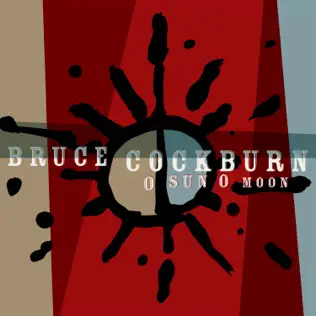 O SUN O MOON - REVIEWS
27 May 2023 - So many reviews!! All fantastic. They are listed on O Sun O Moon album page, and also many are reprinted on both this site and brucecockburn.com
Interview with Legendary Canadian singer/songwriter Bruce Cockburn on new album “O Sun O Moon”
by Rudyblairmedia.com
18 May 2023 - Legendary Canadian singer/ songwriter Bruce Cockburn [ http://brucecockburn.com ] has not just released a new album but also back on the road with a tour. Rudy Blair Entertainment Media speaks with the multi Juno Award winner about his thoughts on the late Gordon Lightfoot, his tour, the story behind one of his greatest hits “Wondering Where The Lions Are” and his latest album “O Sun O Moon” featuring the single “Colin Went Down To The Water” https://bit.ly/3WgWVxd
WATCH THE ZOOM VIDEO INTERVIEW
~from rudyblairmedia.com.
 Bruce Cockburn - Reflections on Gord & New album ‘O Sun O Moon’
by Mulligan Stew Podcast - Terry David Mulligan
7 May 2023 - The Stew is with Bruce Cockburn..bringing stories of his 38th album O Sun O Moon. Plus memories of Gordon Lightfoot and his place in the music of the World and especially Canada.
LISTEN to the Podcast
The Podcast is the complete interview with Bruce Cockburn on the release of his 38th album O Sun O Moon. And his thoughts on the music of and the loss of Gordon Lightfoot.
Bruce Cockburn - Poignant Infinity
by Anil Prasad
2 May 2023 - Bruce Cockburn has consistently upended rock and pop expectations across his long, storied career. The Canadian singer-songwriter, guitarist, and composer has released 35 albums since embarking on his journey as a professional musician in 1967. His material is often infused with deep meaning, including informed and complex perspectives on humanitarian concerns, politics, war, and spirituality. And he combines those views with sophisticated, melodically-driven music that’s enabled it to resonate with people from all walks of life and generations. The numbers speak for themselves. He’s had 22 gold and platinum albums, in addition to 30 charting singles in Canada, the US, and Australia.
Cockburn’s songs aren’t driven by backseat observations of the world. His activist and spiritual leanings have been front and center in his life for decades. He’s a devoted Christian but doesn’t communicate about his path from an evangelical approach. Rather, he lets his actions and outcomes inform his output, focusing on how adhering to positive Biblical teachings have value to everyone, not just Christians.
He’s spent a great deal of time working with Amnesty International, Friends of the Earth, OXFAM, and The David Suzuki Foundation—just to name a few organizations—in their pursuit of critical relief efforts. Cockburn has also been outspoken on issues including climate change, famine, native rights, and third-world debt. In addition, he has spent time in Cambodia, Iraq, Mali, Nepal, Mozambique, Nicaragua, and Vietnam to contribute first-hand to solving the issues those regions face.
His incredible life story was captured in his detailed and evocative autobiography, Rumours of Glory in 2014. A nine-disc box set of the same name was also released that year, chronicling his musical evolution.
At age 77, Cockburn continues propelling forward with his new album O Sun O Moon, and a lengthy tour to support it. The recording is about this moment in time, for Cockburn himself, as well as humanity writ large and the many struggles it faces. It explores the intersections of political manipulation, how spirituality is abstracted from its intentions to drive greed and tribalism, and generational responsibility for stewardship of the planet. Perhaps most importantly, it offers an outlook on keeping one’s own psyche intact during these times.
Cockburn spoke to Innerviews from his home in San Francisco, where he moved in 2011. He reflected on the inspiration for key tracks from O Sun O Moon within contexts ranging from the personal and existential to the global and societal.
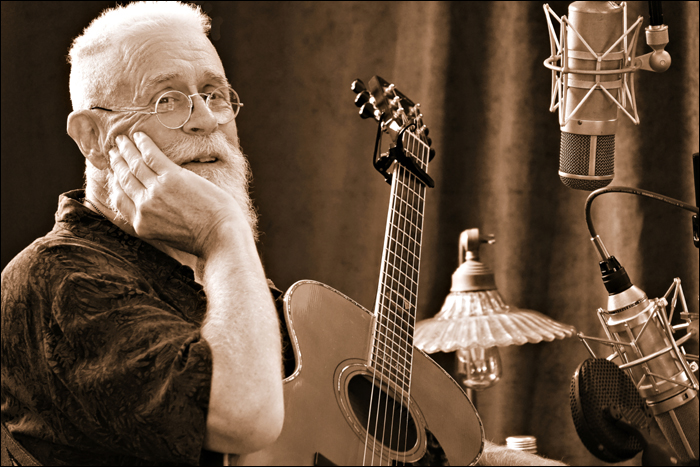
To me, the new album is about priorities, focus, and spirit. What’s your take on the bigger picture it explores?
I think you've described it well. I suppose the focus comes from age more than anything else, but it's also age in the time we're living in. That latter aspect of it is normal for me. Pretty much all of my songs are responses to what I encounter. I mean, unless they're fantasies. There are a couple of those in existence. But basically, my songs reflect the period of time in which they were being written and, in this case, that's the COVID-19 and Trump era, with all this stuff that we've had flung at us.
You’ll hear me exploring myself as an older person in that context. There's a lot of death on this record, but it's not really specifically death itself. Rather, it's the anticipation of the approach of that horizon and the kinds of feelings and thoughts that it engenders. The song “When You Arrive” is about that, but in my mind, it’s a kind of joyful song. Perhaps, darkly joyful or ironically joyful. I don’t see this as a dire thing, but it’s an important thing, worthy of attention.
The song “O Sun by Day O Moon by Night” also reflects a positive perspective on our inevitable departure. Tell me about the peaceful view it communicates.
Well, I think the negative perspective is everywhere. We entertain ourselves by watching thousands of departures over our lifetime on TV and elsewhere. But for me, it isn't another step. I don't really know what's going to happen. My own belief is that I will be at least faced with an opportunity to get closer to God. What does closer to God mean? That's pretty vague. I don't believe in the Pearly Gates, although the dream in the song you just referred to kind of goes there. Rather, I see all that as symbolic and so I don't really know what it's going to be like.
At the very least, the energy that is contained in your body is going to go out to the universe and you do literally become part of everything. I mean we are now too, but we don't know it because we feel like discrete creatures, but at the point of death, there's a big change that happens.
So, either way, I think the manner of going is the part that scares us and the part that is too often tragic, and sometimes horribly inflicted on us. But the result of the departure I think can be approached with joy, or at least with kind of joyful anticipation. Not that I'm in a hurry or anything, but I think since it's inevitable, death is as much a part of life as birth.
“On a Roll” captures a productive, yet realistic worldview at age 77. Talk about the drive and determination it illustrates about you at this moment.
The adventure continues. I don't take any of it for granted. I do think that it's going to hit the wall at some point. The hands are going to stop working or something else will happen, but for now, I'm able to keep doing this stuff and I think it might have partly to do with having a young daughter. So, I'm experiencing parenthood again in a deeper and more meaningful way than I did the first time around. She’s 11. I also have an older daughter who’s 46. So, I’m coming at it from a whole different perspective than when I was younger. It’s much more welcome and less fraught this time around, even though the world seems to have more to be fraught about as parents, now. Even though I don't feel like a particularly young guy, I'm experiencing a lot of aspects of what it is to be a young adult in this culture.
I also get a lot of energy from the people who listen to the songs, and those who come to shows. I like playing for audiences and I like the travel and always have, so that hasn't changed.
I feel like I've been led through the life that I've had and that continues, and I don't really try to second guess it. I don't take it for granted. It could stop anytime, but I don't know, it's a cliche to say, “I’m living in the moment,” but it has something to do with that.
And also, I feel like the journey isn’t over yet. I could see how you could get there. I think if I were by myself at this age and didn't have a loving family to be in, that might be pretty depressing. Depression sucks up energy like nothing else. I think a lot of people do get depressed because the energy levels go down. They have for me too, but that's offset by fresh things happening, so I guess it's easier to deal with.
“Orders” explores how religion continues to be twisted to serve negative agendas, despite many of them stating we’re supposed to embrace one another, regardless of differences. What are your thoughts about how music can help transcend the socio-religious divides of the world?
I'm not confident that music can change anything, but it would be nice if it did of course. You can never carry that notion too far because you don't know. I do hope that people will be encouraged by “Orders” and what it has to say. It’s one thing to sit there and say, "Oh yeah, we're supposed to love thy neighbor,” but Christians have been failing to live up to that for 2,000 years. And there’s no reason to think we won't keep on failing at that. But it doesn't hurt to be reminded every now and then, that's what we're supposed to be doing.
Christians are under orders to do this, and we should be paying attention to that. And then you start thinking, "Well okay, well what does that mean? Who do I have to love?" And “everybody's” too vague, so I just started giving examples in the song.
After decades of songwriting, what are your thoughts about making messages like that universal, without being didactic?
It's a balancing act, because it’s easy to slip into preaching, and I've been accused of that at times. It's always concerned me, and I feel like I've always had to make an effort not to go there. When you just say some things out loud, it sounds like you're preaching just because of the nature of the material you're spouting. People don't always want to hear my opinion about things true or not. Of course, I think what I’m saying is true, but others might not agree. I do think you’re much more likely to be heard by people if they don't think you're preaching at them.
If you go to church or another religious institution, you expect to be preached at. You've volunteered for that, and it's fine. But outside that context, it's usually on an unwelcome thing. So, what I try to do is just share what I think and feel, and as long as people understand that that's what it is, then they can take it or leave it. They don't need to feel preached at. I've been blessed with an audience over all these years that's willing to listen to this stuff and to varying degrees absorb it, and I'm totally grateful for that.
You emerged as a professional musician in the late ‘60s and early ‘70s, when activism and confronting difficult truths was more common. There’s a lot less of that these days. What’s your view on that shift?
You could also include the word "fashionable" in that. In the '60s, a lot of people were sounding off because it was fashionable. When it stopped being fashionable, they stopped doing it. Not everyone and the real artists, in my view anyway. The ones who haven’t died have kept that up. They maybe had a different emphasis because times change, and we all change to some extent with them. At least our sense of how we fit in things tends to change.
The media, and radio—which is almost weird to talk about anymore—has relatively little importance in any area, except for the obvious pop stuff. I listen to rock stations when I'm driving my daughter to school because that's the music that she likes to listen to. There's some good stuff in there. Some of it’s not very good, and none of it really addresses much of what I think is worth addressing.
But then I think when I was a teenager, and even before that. I wanted to listen to Elvis Presley and Buddy Holly, and they weren't talking about anything very important either. It was a little grittier, at least with Elvis' songs, because he covered so many great blues artists, or at least drew so much from that world.
Pop music's always with us. ABBA's had a resurgence. Who could have imagined that? Back in the '70s, that was kind of a pet hate of mine. Not ABBA specifically, but that part of the music world they represented. I had no use for it at all. They were making effective pop records that were really successful and that's fine. Taylor Swift is also doing that, but I think she’s a better songwriter than the people in ABBA. I hope as she matures, that maturity will apply to her songwriting, because I think she’s good at it.
There are many capable songwriters that perhaps aren’t living up to what I imagined their capacity to be. But that's my imagination talking. Really, I don't know. Once in a while it seems like there's been a window in which radio has accepted other kinds of music other than very produced, commercially-directed kind of stuff. And then the window closes after a while when the radio station changes hands and the new owners want more money, or when somebody discovers that they can make more money doing something else.
I've been lucky that I've been around for a couple of those windows to open and close again. Each time one opens, the audience gets a little bigger and, in my case, it seems like most of the people that have been drawn into my thing have stuck with me.
“To Keep the World We Know” addresses climate change and the idea of looking beyond ourselves. Explore its origins.
The actual song came about because Susan Aglukark called up and wanted to write a song together, and I thought it seemed like a good idea. We had a good time working together on it. The title was mine, but the idea of the world being in flames was hers. We’re seeing all this drought and wildfires all around the world, and it just seemed like something worth writing about.
You think about the future differently when you're the parent of a young child. I think it’s because there's an emotional investment in the future that you can’t ignore. With my daughter, the topic comes up tangentially from time to time. There’s no particular agenda. It's about just paying attention to what's going on. We talk about it a lot in terms of what she encounters, more than what I encounter. I have a perspective that is different. I'm considerably older than my wife as you can imagine, and so her perspective and mine are also different from each other, but I think mutually complementary.
So, I hope that what we can offer to our daughter is to be useful and that each of our excesses can be tempered by the other. Hopefully, we come up with some sort of reasonable advice and a reasonable context for our daughter to grow up in.
O Sun O Moon has an instrumental titled “Haiku,” and you’ve done two all-instrumental albums in recent times with Speechless and Crowing Ignites. How do instrumentals communicate in a unique way for you?
I think if you have lyrics, you hope if a person's paying attention to those lyrics, they'll be drawn into whatever it is they’re about. When you listen to music that does not have lyrics, that doesn't happen and you're free to feel whatever the music brings out in you.
I've always felt like there was a sense of space that went with instrumental music that doesn’t typically happen with songs with lyrics. If I listen to Bob Dylan, I'm thinking about what he's saying, as well as savoring the music and whoever's playing on the record. But if I listen to Japanese flute music or Bach, I'm not doing that. Rather, I'm allowing myself to be transported to wherever that music takes me. For me, that's often a kind of deliciously-wistful poignant infinity. There's a sense of that physical space almost. It's imaginary, but it feels physically combined with time stopping. If you're seriously listening to something, time stops. Those are the powerful effects I really notice with almost any kind of instrumental music.
Tell me about the choice of musicians on the album and the approach you took when recording them.
I really had a great time listening to what everybody brought to it, and I could do that partly because of the way we recorded. We first started with just me and Gary Craig playing drums and percussion, and once we had that down, we brought everybody in to add to it. So, it was fun to get the songs initially recorded, but the great thing about that was I had the luxury then of sitting back and not worrying about my own performance while listening to what everybody else brought in.
Colin Linden, who produced the album, had a great part to play in the choice of musicians, but we talked about it a bunch beforehand as we've done with previous albums. The core band included Victor Krauss on bass and Gary on drums on most of the tracks. Colin came up with Jim Hoke on marimba, clarinet, and sax, and Jeff Taylor on accordion and dolceola.
Jim brought so much to the recording in terms of horn arrangements and marimba playing. It was my idea to have marimba. I've always been a fan of Martin Denny and it seemed like some of these songs would suit that kind of sound, and it worked out.
We also have Sarah Jarosz on mandolin, Jenny Scheinman on violin, and Allison Russell, Shawn Colvin, and Buddy Miller on harmonies. I think this was the first time I’ve worked with Buddy, though I’ve met him many times. So, it was great to get him on the album.
It was really cool and a lot of fun to build the album up the way we did it. I kept getting pleasantly surprised by the results.
This wasn’t the first time I’ve worked this way. The albums I did with T-Bone Burnett, including Nothing but A Burning Light and Dart to the Heart, started in a similar way. For Nothing but A Burning Light, many of the songs were done with just me and a programmed, electronic drum track initially. Then we’d replace the fake drums with the real ones. It’s an easier way to get things done.
With Bone on Bone from 2017, we recorded that all live with the band, in the exact opposite way. We put the band together, got everybody in the studio, and just played, with some overdubs.
Either approach can work. If you’re dealing with a lower budget, the approach we took for the new album is good, because you don’t have to pay for people to wait around while you figure out what you’re doing.
We did have a decent budget for this album. But it felt like the approach we took was a better way to spend the money, and it works just as well, creatively. It’s different, though. You don't get the same sort of spontaneous interplay that you might if you were actually playing live. The lucky accidents are less likely to happen, but on the other hand, you have more control over what happens, too.
Provide some insight into your creative process.
I still just love the guitar. So, sometimes when I'm playing, an idea will come that wants to be an instrumental piece. A riff or ideas that come one after the other can become the bones of an actual composition, and then I'll chase that down and come up with something else for it. So, over the years, there have been quite a few occasions like that.
Writing instrumentals is different from writing songs where it's all about lyrics. I like the sense that instrumental music offers something open to the listener’s interpretation. And playing the piece offers something similar to the performer, without being pinned down to specific lyrical ideas. It feels freer in a way. It’s nice to have instrumental things to do.
Of course, I like writing songs, too. When I write a song, I tend to structure things more formally and I tend to write the guitar parts into the song as a composition. So, I kind of play the same way through it, allowing for the occasional solo in the middle of the song. With the instrumental pieces, I still play them the same way, probably, but there's more of a feeling that this could go anywhere, especially when you get to play it with other people. You just think, "Yeah, we're jamming now. This is good."
What are some of the key challenges you face in your creative process these days, and how do you transcend them?
The challenges are mostly physical. I’ve got arthritic fingers and sore feet, and whatever stuff that goes with being older. Eventually, those things might become impossible to get past. They are obstacles, in a way. Some of the older songs that are very simple I can't play anymore because my fingers just won't make the shapes I need to make. But that's minimal. I foresee there will be a point where the songs I can't play start outnumbering the other ones, and then it's probably time to retire, but we're not there yet.
The only other thing that I might put in that challenge category is having to come up with new stuff all the time. Having to do so is a choice, of course, but I don't want to keep writing the same song. The more I write, the less room there is to come up with new stuff it seems. As much as we can add onto ourselves or subtract from that, as the case may be over time, you're still essentially the same person you were when you started out, and you feel the same way about a lot of things and have the same vision. So, how do I say whatever it is I want to say without repeating myself excessively? Some repetition is going to show up. So, that comes into it in the writing of a song. Sometimes, I'll catch myself at it. I'll write a line, I think “Yeah, that's cool,” and then be like, "Wait a minute, I said that 20 years ago." And so, the question becomes, "Okay, well how can I say that in a fresher way?" I'm always still just figuring out how to write a good song.
When you perform solo, you occupy your own unique universe, surrounded by an expanse of instruments and technology. Describe your setup.
Solo concerts are mostly what are coming up this year. I have multiple guitars, because there are multiple tunings. I don’t want to inflict retuning over and over on the audience. I like being able to pick up ready-to-go guitars and just play. I also like the diversity of sounds. There’s the 12-string and dobro, which bring different sounds to the shows. They offer sonic relief from hearing the same kind of guitar sound throughout the night.
It’s a comfortable setup. I have cables, and little bits and pieces of stuff on a table near me, so I don’t have to hunt for things in my pockets or kick the water bottle over to get to them. I’ve also got a little collection of effects pedals to add variety to the mix.
With the acoustic solo shows, it’s about keeping the sound of one guy’s voice and guitar from being too monotonous over the course of the evening. The outcome is also a product of what happens between me and the audience, too, not just the physical stuff on the stage. It’s as much about what the audience gives back, and what I’m able to give back to them as a result.
I use in-ear monitors, because they’re better for my ears, and much more controllable for whoever’s mixing the house sound. They let me hear what the audience is hearing. I need to have that perspective, to have a sense of what I’m throwing at people.
Do solo concerts offer a greater level of freedom compared to ensemble shows?
In theory, they do offer a little more of that. I tend to do things the same every night once I settle on a set that works for me. The shows tend to be the same night after night, with minor exceptions. But theoretically, that freedom exists, if I were not as inclined to want to stick to a pattern. But that's my nature. I'm just more comfortable when I'm not fretting over whether I'm going to make bad choices as far as the order of the songs go, or just forget what I know.
For the first decade I played solo, I was more spontaneous. I had a list of all my songs on top of my guitar, and I would just look down at that list and think, "Okay, well this one has the capo here and it's in this key and it's up-tempo, and I just did a couple of slow ones, so I guess I'll do this one now." But that was very stressful sometimes, because sometimes you just look at the list and go "What do I do now?" So, I like it better when I've got some sense of flow. I can change it if I want, but when there's a planned show, my current approach works better for me. It’s also better for the lighting person. I can tell them what to expect and set up cues accordingly. It’s helpful to have things organized like that when I have a band, as well.
This is just my way of doing things. I tend to have a greater need to have the set structured. I can easily imagine being in a band where you didn't do that. I've seen Colin Linden play with his bands where he'll just turn around and yell out a song title and then they'll play it. But these days, I feel it's more practical to have a set list.
You’ve witnessed myriad technological transitions in the music industry across your career. What’s your perspective on its current ability to effectively compensate musicians, and the directions it appears to be heading in?
“Effectively compensate” are the key words. It’s one of the basic ingredients of human existence, and it's certainly true in the music world. Lately, it’s an issue because of streaming and the fact that it doesn't really pay royalties. That's a concern and it has made life harder for musicians. In a sort of good way, it's put the emphasis on live performances, which is okay because I think that's when the music is at its most real. But yeah, it would be nice if the various powers that are working on these things could successfully persuade the streamers to pay up.
The music scene has changed totally and it's still in flux. I don't think it has settled anywhere yet. All of a sudden, we're getting AI imitations of famous people. There was an actual virtual pop star in Japan a few years ago. This stuff has been written about in sci-fi books before, but it’s actually happening, and there’s going to be more of that.
Who actually needs humans when you can create a holographic image of somebody that just sounds really great singing and doing whatever? But it won't replace us in the short term, at least. As I heard myself saying that, I was thinking of the old music union guys in Ottawa that were very upset when people started using synthesizers. They felt they would take jobs away from musicians, but it hasn't really worked like that. AI probably won't either, but things are changing all the time. I'm not interested enough in the electronic side of things to want to explore that.
It's not that you can't make good music with machinery. You can, but it's not the same as when people do it. With AI, its function may change too. All of society is moving in the direction of standardizing, unifying, and homogenizing everything. But of course, in our movement in that direction, we're also dealing with elements of chaos, such as mass shootings, war, and pandemics that work in the opposite direction. Politicians use the fragmentation for their own gain. It's hard to say if music's going to reflect all of that and where it's going to go. I have no idea. I won't be around to see it.
I mean things never stop. They’re constantly in motion and they’re never going to land anywhere, as long as we’re people with some capacity for imagination. Things are going to keep moving forward and changing. What I do know is things are hard now for musicians. I wish it was easier for musicians to make a living playing music, especially young ones getting started.
Those of us who've been around for long enough to have an audience are not in as difficult a situation, but if I were starting out now, how would I get heard? Where would I go? I could put stuff out online and maybe I'll get lucky, and somebody will notice it. But millions of other things are coming out at the same time. You can find good stuff online, but there’s a lot of amateur attempts that you have to weed through to get to the good stuff, unless where you know what you’re looking for.
Do you plan for the long term with your career or is it more of a case of going with the flow?
The songs on the new album have been in progress for the last couple of years, and it’s just about to come out. So, it's going to be the focus for the short term. It’s not new for me to be in this position because I don't really plan ahead with respect to songwriting at all. Once in a while, I have the feeling that I want to go in a particular direction, but that is usually really just about a particular song. Should it be focused on electric guitar or acoustic guitar? What kind of music do these words want? But in terms of the big picture, I'm not much of a planner. Right now, we've got gigs booked across the next 12 months, and that's about as far ahead as I'm taking it. We’ll see what happens creatively between now and then. The field is wide open.
~from www.innerviews.org - Anil Prasad
NEW FROM BRUCE COCKBURN: ‘O SUN O MOON’
by Ickmusic
1 May 2023 - In 53 years of writing and recording, there’s been an undercurrent of spirituality in the music of Canadian Bruce Cockburn. He’s always had a knack for painting a picture of his Christian faith in a way that doesn’t hit you over the head, using the beauty and mystery of the natural world to illustrate the wonder of it all (just listen to my all-time favorite album of his, Dancing in the Dragon’s Jaws, and you’ll know what I mean).
His innate kindness and empathy for his fellow humans has always drawn me to him. Bruce Cockburn is one of the good ones (and criminally underappreciated in these United States, but I’ll digress).
With O Sun O Moon, due out May 12th on True North records, Bruce’s spiritual side steps out of the shadows and, well, “Into the Now.”
Bruce Cockburn will turn 78 this month, and after a tough collective few years for all of us, Bruce brings out themes of faith, mortality, love, conflict and climate in this beautiful collection of songs.
Recorded at on/off band member, album producer & pal Colin Linden’s backyard studio in Nashville, the album features some quality guests – from Buddy Miller and Sarah Jarosz to Shawn Colvin and Allison Russell ( have you heard Nightflyer? - https://www.youtube.com/watch?v=RNJgwj8d9eo ).
From the get go, Bruce faces that ticking clock and his faith head on with “I’m On A Roll”:
Pressure building left and right / Timer ticking, just out of sight / I’m taking shelter in the light
Time takes its toll / But in my soul / I’m on a roll
The powerful “Orders” addresses the oft overlooked yet plain and simple mantra of “Love thy neighbor”:
The sweet, the vile, the small, the tall The one who rises to the call / The list is long — as I recall / Our orders said to love them all
Not an easy concept to adhere to, is it? But nonetheless, as Bruce illustrates so well throughout the record, it’s the foundation of his faith.
With the backing of Shawn Colvin’s beautiful voice, the sweet, laid back front-porch feel of “Push Comes to Shove” continues the message: “push comes to shove / It’s all about love.”
In July 2021, Bruce vacationed in Maui with Dr. Jeff Garner, the lead pastor of the San Francisco Lighthouse church, which Bruce attends. In addition to helping lead a Sunday service,
Bruce spent some quality time writing tunes. The first song he wrote is my personal favorite, “Into the Now,” www.youtube.com/watch?v=1jaBq-Z18Ls
which has been a staple of his solo acoustic show ever since (I was lucky enough to see him play it in Scottsdale last year). It’s a Cockburn special: timely, poignant lyrics, a chorus that varies each of the first three times before tying all together exquisitely at the end; strung together words like: “Light as the feet of birds hunting on sod / Love trickles down like honey from God”; Sarah Jarosz on harmonies and mandolin. I mean, come on (!), it gets no better.
Another Maui-written song, “Colin Went Down To The Water” was released to streaming services a few weeks back. Featuring background vocals by Allison Russell, Buddy Miller and Colin Linden, the spiritual call and response of the song instantly connected with me (listen below).
The third Maui song is “King of the Bolero,” where Bruce channels a raspy, bluesy vocal to tell the story of a nightclub guitarist who’s “Got a double chin all the way round his neck / And a pot belly in the back.” Not a flattering image, and it makes me wonder who inspired this (internet sleuthing tells me the nightclub in the the Maui Grand Wailea Hotel is the Botero lounge. The Colombian artist Botero is mentioned in the song. Did Bruce write this while taking in some entertainment at the Botero? Hmm…).
Bruce’s resonator guitar, Gary Craig’s xylophone, Viktor Strauss’s bowed bass and Jenny Scheinman’s gorgeous violin usher in the sublime “Us All” (also available on the streaming services). It’s a hypnotic, mournful plea to “let kindness reign for Us All.”
The welcome sound of Bruce’s dulcimer rings in “To Keep the World We Know,” a sobering take on climate change, sung with indigenous Canadian artist Susan Aglukark (who sings in a native Inuit language called Inuktitut). An important message; and rhythmically reminiscent of Bruce’s great 1977 tune "Arrows of Light." https://www.youtube.com/watch?v=2GfCrNp0nTI
The closing songs of O Sun O Moon bring it all back to the theme of faith & mortality in their own unique ways. The penultimate tune is the prayerful “O Sun By Day O Moon By Night,” featuring spoken word verses building to a joyous chorus prayer with gospel-soaked background vocals:
O sun by day o moon by night / Light my way so I get this right / And if that sun and moon don’t shine/ Heaven guide these feet of mine / To Glory
The album finale, “When You Arrive,” culminates in a singalong chorus featuring the full cast of previously mentioned characters. With a sauntering, New Orleans style rhythm, the repeated chorus brings to my mind an image of Bruce and the gang second-lining lazily down a French Quarter street, shuffling contently off into the distance – firm in their faith – and ready for whatever may be waiting around corner.
Pre-Order O Sun O Moon.
My Top Shelf Bruce Cockburn playlist on Spotify.
~from Ickmusic Review of O Sun O Moon
Haiku - an instrumental
single release
20 April 2023 - Give it a listen Haiku from the soon to be released O Sun O Moon on May12.
On A Roll - from O Sun O Moon
lyric animation by Kurt Swinghammer
1 April 2023 - My third lyric video for the excellent new album from Bruce Cockburn. On A Roll features a signature Gary Craig groove and tasty slide playing from Colin Linden with Bruce on dobro. It’s a good time to listen to an elder.
WATCH & LISTEN to ON A ROLL:
Colin Went Down To The Water - from O Sun O Moon
lyric animation by Kurt Swinghammer
20 March 2023 -
WATCH THE LYRIC VIDEO BY KURT SWINGHAMMER
Us All - from O Sun O Moon
lyric animation by Kurt Swinghammer
7 March 2023 - The first lyric animation by Kurt Swinghammer of Bruce's single Us All from O Sun O Moon.
WATCH & LISTEN:
US ALL
Bruce Cockburn Reaches for the Heavens with New Album, O Sun O Moon
Set for Release May 12
by True North Records
6 March 2023 - “Time takes its toll,” sings the 77-year-old Bruce Cockburn on the opening song, “On A Roll,” his 35th album, O Sun O Moon, out on May 12 via True North Records. “But in my soul / I’m on a roll.”
Revered Singer-Songwriter & Activist Bruce Cockburn Reaches for the Heavens with New Album, O Sun O Moon, Set for Release May 12
Bruce Cockburn has enjoyed an illustrious career shaped by politics, spirituality, and musical diversity. His remarkable journey has seen him embrace folk, jazz, rock, and worldbeat styles while earning high praise as a prolific, inspired songwriter and accomplished guitarist. He remains deeply respected for his activism and humanist song lyrics that thread throughout his career. On all his albums Cockburn has deftly captured the joy, pain, fear, and faith of human experience in song.
O Sun O Moon is his first vocal album since 2017’s Bone on Bone. It’s also only the third album Cockburn has released since writing his memoirs (2013’s widely acclaimed Rumours of Glory), after which he felt creatively spent. He doesn’t feel that way now. A lot has happened in the zeitgeist in the last six years, and the renowned singer-songwriter has plenty to talk about. While he addresses political calamity on “Orders,” and climate change on “To Keep the World We Know” (featuring popular Indigenous Canadian artist Susan Aglukark singing in Inuktitut), Cockburn largely focuses on spiritual connections, forgiveness, and love — in ways that perhaps only a performer of his experience can do. Except that Cockburn has always done that, from his 1970 debut onwards.
What will go wrong will go wrong
What will go right will go right
Push come to shove
It’s all about love
• From Push Comes To Shove, Words & Music by Bruce Cockburn
You can listen to the track, Us All, on YouTube or on
iTunes. You can pre/purchase this album at True North Records.
O Sun O Moon finds Cockburn again working with his close friend Colin Linden as producer, who doubles on guitar, along with Janice Powers on keyboards and Gary Craig on drums, the album features bassist Viktor Krauss, drummer Chris Brown, accordionist Jeff Taylor, violinist Jenny Scheinman and multi-instrumentalist Jim Hoke. Cockburn’s guest vocalists include Shawn Colvin, Buddy Miller as well as mellifluous singers Allison Russell, Sarah Jarosz and Ann and Regina McCrary, daughters of gospel great Rev. Samuel McCrary, one of the founders of the Fairfield Four.
Bruce Cockburn has won 13 JUNO Awards, an induction into the Canadian Songwriters Hall of Fame, a Governor General’s Performing Arts Award, and has been made an Officer of the Order of Canada, among many other accolades. He has 22 gold and platinum records including a six-times platinum record for his Christmas album. Cockburn continues to tour internationally.
He’s on a roll.
Tracks:
On a Roll 3:31
Orders 4:44
Push Come to Shove 4:12
Colin Went Down to the Water 4:41
Into the Now 4:15
Us All 4:40
To Keep the World We Know 3:30
King of the Bolero 5:24
When the Spirit Walks in the Room 4:15
Haiku 4:01
O Sun by Day O Moon by Night 3:50
When You Arrive 4:33
~from Mark Pucci Media
LISTEN to: Us All
WATCH: Us All with animation & lyrics by Kurt Swinghammer Us All
A chat from the road
by Judy Craddock
7 March 2023 - Bruce Cockburn has every reason to be proud of his work, but it’s hard to get him to boast. He’s grateful for the attention he’s gotten, as it allows him to reach more people, but when pressed, his reply is, “If I’m proud of anything, it’s my songs. I think I’ve written some good ones.”
He doesn’t dwell on it.
He’s also grateful for his career-long relationship with Canada’s True North Records, and his manager Bernie Finkelstein. We agree that it’s a rarity. He can be proud of that.
Bruce is calling from his tour stop in Saskatoon, with the final leg taking him back to the US before taking a break.
I asked him about the most recent album, Rarities, and how he made the difficult choices of what to include on the release.
The covers were all done for various tribute albums in the past, and he wanted to include them on this record. Covers of Mississippi John Hurt, Pete Seeger, and others who have been his heroes made the cut. He emphasizes just how much Mississippi John Hurt was a hero. The Mississippi Sheiks cover, “Honey Don’t Let the Deal Go Down”, is one of his favorites, as well as “Grinning Moon.” “I like what I did with the guitar on that.” Again, he’s not boasting. It’s more of a confident, contemplative tone.
“Waterwalker Theme” was originally used in a Canadian film, and while he didn’t think it needed to be put on an album in the past, it did end up on this one. “I think the song stands on its own.”
Time changes our perspective.
• •
Judy: Do you want to do more writing for films?
Would you ever want to be the subject of a documentary?
[laughs] Being the subject of a more extensive documentary, (than following him around on tour), would be a little weird. If I like the director though, I might consider it.
Directors, get your ideas together! Is it important for you to express your passion for social and environmental issues in a way that gives us hope?
It’s really situational… the hope part is not, though. I think hope is an important thing to hang on to, for all of us. I’d like to be able to include that, if I’m going to be critical of something. The subject matter of those kinds of songs just kind of comes up. I’m in a situation or read something that sets off some kind of emotional reaction. Then songs come out of that.
“If a Tree Falls in the Forest” grew out of that reaction to hearing a radio documentary on the destruction of the rainforests in Borneo. I couldn’t not write the song after that exposure.
On the Christian undertones in your past work, are you still comfortable expressing your faith, especially in our current divisive environment?
Well, I think the forces of darkness have done a very good job of creating that [divisive] state, and it’s kind of in us anyway to be like that. We’ve had a long time to get over tribalism and the paranoia that goes with that, and here it is coming right back again. Donald Trump was an effective instrument of that process.
All you can do is fall back on what you understand to be true. For me, the spiritual thing is not about dogma, and it’s not about tribalism. The message of Jesus is anything but tribal. The stuff that people attach to their faith, or their alleged faith in him, is cultural bullshit, basically.
I found myself playing in my Bay Area church’s music program before the Covid lockdowns. It was nice for me, because I got to play electric guitar and play other peoples’ music, which of course I don’t get to do much of on tour.
I hadn’t gone to church for decades… went initially because my wife had started going. The minute I walked through the door, it was just a room full of love. Nobody knew me from Adam. I’m just an old guy that walked in, and they had gotten to know my wife. Then they needed a guitar player one day, and somebody heard that I play guitar, and so I did. It was anonymous, comfortable, and nothing at stake.
Let’s talk about the new album coming in May. Does it have a name?
The album, O Sun, O Moon was recorded in Nashville at Colin Linden’s studio and mastered in New York. I’m curious as to how people will respond. It’s all new material.
Bruce Cockburn in the studio, Nashville, Tennessee, 2022
A few of the new songs are sprinkled into the shows now, but when Bruce tours in June, there will be much more of the new album featured. How has your expression of social issues changed as our world has changed?
There’s hope, but I feel like we’re making progress in the wrong direction. I’m quite concerned… not for me, because I won’t be around when the shit hits the fan. My young daughter and my grown daughter and grandkids, they’re all growing up in this world that we’ve created, and it doesn’t bode well. The hope is that we can mitigate the disaster so that it won’t be so bad.
You recently became an American citizen. How has that changed your perspective?
I swore the oath of citizenship, and I meant it. I carry the best interests of the country in my heart, as best I can. It’s kind of a pain, really [laughs] because now I have to decide who to vote for. It’s hard to find anybody good out there. As much as I feel loyalty to both the States and Canada, too, I feel like I belong to the world. All of us do. It’s about each other and the planet, more than it’s about nationality. It’s important to keep that consideration in sight.
With the increase in ways to consume music, and the sheer volume of what’s available to listen to, do you feel the pressure to appeal to a younger ear?
[laughs] I kind of like the idea that my audience is not all sitting around growing cobwebs with me. It would be nice to think there is some fresh blood coming in, but I don’t know how I could appeal to a younger audience.
Radio is now much less eclectic than when you were growing up.
It would be nice to think my audience is not dying with me, but most likely that’s what it is.
A fan in my community would like to know who or what inspired “Child of the Wind”?
It was actually the first song that came after a long dry spell at the end of the ’80s. “Maybe it’s over,” I thought. I decided that 1990 would be a sabbatical year. For Christmas of 1989, I went down to Tucson and stayed at a dude ranch with the woman I was seeing at the time and my daughter who was 12, I think. We’re in the middle of all these saguaros and it snowed on Christmas day. With that incredible landscape and all the snow coming down, that song came to me. I was right. The sabbatical was the right idea! The imagery of course, what was all around….
Bruce clearly remembers that day as something really special, as he trails off a little.
Gemini is an air sign, and although I don’t particularly believe in astrology, the wind has always been an element that fits, and in this case, it does.
With so much time on the road, anyone you’re reading right now?
Cormac McCarthy’s The Passenger, a gift from my daughter, is currently on the bus. A very dark view of life, but so beautifully expressed. I’m a big fan.
I don’t do very well with non-fiction. I like the things that kick my imagination, and that’s found more often in fiction, in my experience.
What advice would you give to beginners in the business?
I don’t have much insight into how anybody starting out gets beyond the starting out stage. People make records in their bedrooms now. I got lucky — not really, but it’s a convenient way to say it — just hanging out, and being able to do what I do.
At this point, Bruce reminisces about his early days in high school, playing at an Ottawa coffee house with his high school buddy, and the difference between performing alone and being in a band, where there was someone to blame when things went wrong.
From maybe 1962 onward, I was in bands and the folk scene. Things took the shape they did.
And the advice?
Stay true to what you’re doing, and I would have said, up until recently, don’t sell your publishing, or at least don’t give it away.
[Cockburn did sell his publishing when he moved to the US from Canada. It’s complicated, but it was a good decision. He owns all his new material.] Radio airplay is much harder to get now, compared to your early days.
People don’t turn to the radio for music the way they once did. Talk radio is a bigger draw now. I listen to what my young daughter is listening to as I drive her to school She’s a big Taylor Swift fan, and her favorite artist is Lewis Capaldi. That’s what they hear on the radio. Unless you’re doing hip-hop or dance music, how do you get heard on the radio? I don’t know.
This writer, as a former radio host, knows that’s a whole other chapter.
• •
What I do know is that Cockburn walks his walk. He stays true to himself, remains humble, and is watchful of the world. I’m confident that songs will continue to be sparked by those observations. He’ll tour in June 2023 with a new album and engaging stories.
Oh Sun, Oh Moon is due out in May on True North Records.
~from link19.com
Listyn KC presents an Evening with Bruce Cockburn and "Stealing Fire"
Interview / Q & A
28 February 2023 - Join us Saturday evening, March 25th for our Special Guest artist co-host, Bruce Cockburn. Tickets on sale now!
We are excited for this very special Listyn KC event when Bruce will be joining us for an exploration of his music, his influences, and some special recordings. After our interactive lead up of stories, played recordings, and Q&A with Bruce (approximately 2 hours), we will be listening to the entirety of his classic 1984 album "Stealing Fire" on our world-class, six-figure, Listyn KC stereo. Bruce will not be playing, but we will be experiencing his music through the magic of recordings and he will be sharing his thoughts, memories, and stories.
For more info HERE
UPDATE: Visit the archive March 25 for links to photos, videos and a review of this event.
Bruce Cockburn’s lyrics, voice ring as true today as in 1972
Folk legend celebrates five decades of making music
by Alan Small
10 February 2023 - Other than modern microphones and guitars, a tidy Letterman beard and a walking stick, Bruce Cockburn’s concert setup likely hasn’t changed much since he began touring in the early 1970s.
A stool, a box to rest his left foot and a music stand graced a mostly empty Burton Cummings Theatre stage at his sold-out 50th-anniversary concert Friday night that cast a musical spell on the crowd.
His voice has stood up to the test of time, too, and whether he sang tunes he wrote in 1971 or 2022, the 77-year-old’s vocals remained far smoother than most artists his age who continue to tour.
What’s really changed since 1970 is that Cockburn has an overflowing sack of songs he’s written and recorded that have become standards in the folk-music lexicon.
Many of the topics he’s written about, such as the fragility of our environment, remain as topical in 2023 as when his self-titled debut album came out in 1970.
”You’re going to hear some old stuff, some new stuff… stuff from the Pleistocene period,” he joked after playing After the Rain, from 1979, and a relative newbie, Night Train, from 1996. “Perhaps this is late Roman Empire.”
While many acts young and old can get a musical lift from accompanying musicians or amplifiers that can drown out a guitarist’s flub, Cockburn allowed himself no such crutch Friday. He strummed a pretty cool six-string, and during Night Train grooved as relentlessly as a locomotive.
Cockburn kicked it up a notch later with an instrumental, The End of All Rivers, showing off some mighty finger-picking on a steel guitar that was mesmerizing.
He heartened back at many moments of his life during the show, whether it was his first trip to Central America with the charity Oxfam, or his worries about whether he’d lost his touch after he spent a couple of years writing his memoir, Rumours of Glory, in 2014.
“Are you still a songwriter?” he recalled saying as he looked at himself in the mirror at the time.
Fortunately for us, a documentary about Canadian poet Al Purdy wanted a song from Cockburn, and he was able to create 3 Al Purdys from the perspective of a penniless man who remembered Purdy’s verses, which was a highlight from Cockburn’s opening set.
The setlist ranged from 1971’s Let Us Go Laughing, from Cockburn’s second album, High Winds, White Sky, to a new tune early in his second set, When the Spirit Walks in the Room, which he began performing in concerts last year and will be part of an upcoming album of new works.
It will add to Cockburn’s trove of more than 350 songs he’s recorded since 1970, and When the Spirit Walks in the Room fits well among many Cockburn classics that speak to equality and how we’re part of a global community.
“You’re a thread upon the loom / When the spirit walks in the room,” he sang during its chorus.
The show had an intermission, letting Cockburn and his crowd stretch out after an hour-long opening set.
“Time to check on the babysitter… or the old folks’ sitter,” he joked for the crowd, most of whom have followed him his entire career, which includes seven appearances at the Winnipeg Folk Festival, the show’s presenter.
There was also room Friday for Cockburn’s hits such as Lovers in a Dangerous Time, and he can still hit the high notes that helped make the song a radio staple when it came out in 1984.
While some of Cockburn’s topical songs from the past still resonate today, songs such as Stolen Land, which he wrote about the Haida in 1987, ring even truer today. The lyrics are almost ripped from current events: “Kidnap all the children / Put ‘em in a foreign system / Bring ‘em up in no man’s land / Where no one really wants them.”
It earned whoops and applause as loud as Cockburn’s famous hits, including Wondering Where the Lions Are, one of the evening’s closers.
Alan.Small@freepress.com
Twitter: @AlanDSmall
~from winnipegfreepress.com
Canadian legend Bruce Cockburn is coming to Kelowna this weekend
by Stella Wood
2 February 2023 - Sitting down for a morning chat with Canadian music legend and member of the Order of Canada, Bruce Cockburn, it felt like I was meeting Canadian royalty. I felt a soft smile and a small chuckle as I awkwardly admitted that I had forgotten the time because I had prepared for our interview way too soon, and then decided to read another chapter of Prince Harry’s book SPARE. We took a moment to chat about it. Cockburn admitted he wasn’t one to read or even want to read celebrity sensationalism, but under the circumstances he said he felt empathy for the prince and surmised that “he looks like a nice guy who fits into a fell in love with a pretty girl and now got a bad deal because he wants to tell his side of the story.”
Cockburn expressed relief that his own tabloids were gentle waves compared to the tsunami of invasive gossip this royal couple is having to endure.
As we moved through talking points and his own current affairs, I got the feeling that this 77-year-old Canadian multi-platinum artist isn’t resting on his laurels, but continues to create new music and looks forward to a 20-year date to begin concert tour of the US and Canada stopping at the Kelowna Community Theater to perform on Sunday February 5th.
This tour was set to take place in 2020 with 100 dates to celebrate 50 years as a recording artist and to coincide with the release of a greatest hits album curated from his record 34 discography. But due to a worldwide pandemic, this tour has been canceled until now.
The greatest hits double album contains 30 songs in total, taking the listener on a chronological journey from his first single, “Going to the Country” (1970) to the final song on disc 2, “States I’m In” (2017 ). ) and presents his range of musical styles – from folk, blues, gospel, jazz and hints of funk, reggae, pop and rock.
Each song has a liner note written by Cockburn himself. We talked about those memories that surfaced as we jotted down paragraphs of memorable anecdotes about each song. He also confided that a brand new album with fresh music and lyrics will be released in May – proving Cockburn continues to be a tour de force in the record music business with no warning of a slowdown.
Bruce Douglas Cockburn was born in Ottawa, Ontario. on May 27, 1945. Interested in music as a young boy, he studied clarinet and trumpet at school, but didn’t focus on guitar, piano, and music theory until he was 14. While studying guitar-based jazz composition at Berklee College of Music in Boston, Cockburn realized music was his future, but the path he was on was the wrong one.
After two and a half years of school, he moved back to his hometown and “fell in love” with a couple of musicians; One of them is Peter Hodgson (best known today as Sneezy Waters). “Sneezy opened up a whole new world of folk guitar playing for me that I didn’t know existed, and we played a lot together,” says Cockburn.
“Making music with these guys, listening to Dylan, the Beatles and other writers of the time, and my love of writing poetry was the intuitive realization that this was the path I needed to take,” Cockburn said.
By the late ’60s, Cockburn had enough songs to make his first record and had to ditch that music so he could “empty his vessel and fill it with more” because he naively thought that was how the creative process worked.
As luck would have it, he met his friend Gene Martynec in a Yorkville coffee shop and confessed he was itching to make a record. Martynec’s band, Kensington Market, had recently disbanded and he wanted to get into the production side of music so they hatched a plan to work together knowing ex-manager Bernard Finkelstein wanted to start a record label, aka; True North – the timing was perfect and the stars aligned.
The budget was achievable because Bruce didn’t want a huge production and costly extras, he just wanted his art on vinyl.
Cockburn’s eponymous debut album was released in 1970 through True North Records and remains the only label Cockburn has ever released music through.
A career that continues with accolades including induction into Canada’s Walk Of Fame (2021), Canadian Songwriter and Canadian Music Hall of Fame (2017), winner of the Folk Alliance’s People’s Voice Award and 13 Juno Awards from more than 30 nominations. Dubbed “the voice of our conscience,” Cockburn consistently highlights environmental, social and indigenous issues and puts his lyrics where his heart beats, supporting diverse causes and supporting the work of Oxfam, the UN Climate Control Summit and the international campaign to ban landmines, among other things.
He has traveled to Mozambique, Nepal, Vietnam, Baghdad and Guatemala and conducted fact-finding trips. He has nine honorary doctorates and is a member of the Order of Canada. I asked him about these awards and honors and in response he says, “They’re humbling and gratifying, but they’re not the reason I succeed…but the validation feels good!”
Bruce tells me he’s been to Kelowna many times and that the Okanagan has always been a popular destination, adding, “It’s such a beautiful route, I love it there.”
~from canadatoday.news.ca
Bruce Cockburn looks forward to Saskatoon stop on tour
“I'm really looking forward to being on the road, and looking forward to getting to Saskatoon. It's been a while."
2 February 2023 - Canadian music legend Bruce Cockburn has been writing and performing songs for more than 50 years. His current tour, following a digital release of Rarities, brings him back to Saskatoon for the first time in many years.
Ahead of his performance, he chatted with the StarPhoenix about his music and his career.
Q: What is most important to you about your music, and what keeps you going?
A: Well, keeping going is not challenging, other than coming up with new ideas. I like what I do and I want to keep doing it. But the older I get, the longer I have to wait for ideas for things that I haven’t already thought of. (Laughs).
From the point of view of the music being out there, the important thing is for it to be as high quality as I can make it and to offer something. I don’t think art has to necessarily be about anything, but when you put words with a song, then, generally speaking, they are about something. So, it’s important to me to have those words be saying things that are meaningful and that are expressing those things in a way that works artistically, and also in terms of people’s ability to grasp what’s being said.
Q: Why did you decide to release Rarities as a digital album?
A: The idea was to put out a collection of these songs that were included, originally, in a box set we did when my book came out a few years ago (Rumours of Glory, 2014). We’ve added two more songs for this release.
A few years have gone by and it just seems like a good idea to make stuff available to everybody. I like the idea of people hearing the songs, especially a couple of the obscure demos of songs that were never recorded. They come up pretty well.
Q: How does it feel to have had so many of your songs covered by other artists?
A: Well, it’s gratifying, of course. I mean, it’s nice not to exist in a vacuum. The idea that somebody else heard something that they could relate to well enough to want to sing it themselves, that’s a nice feeling.
Q: Do you have a favourite cover?
A: Michael Occhipinti, Toronto jazz guitar player, has done beautiful versions of my stuff. I think if I had to pick one, it’d probably be that. They’re instrumental versions, for the most part. He kind of deconstructs the songs and rebuilds them, using my elements, but in a way that still comes out sounding respectful of the original material, which is quite a challenge and makes it very interesting for me to hear.
Q: What do you look forward to most in live performances?
A: Oh, the feeling that grows between me and the audience. I mean, when everything works right — which it does more than half the time, and maybe more than that, even — what you get is the sense of sharing with this group of people. In a big hall, that group of people loses its sense of being made up of individuals and becomes a collective personality that you engage with from the stage. When the connection gets established, it feels really good. And I think it’s probably the same for the audience. That’s the nicest effect of the shows for me.
Q: Is there a performance that’s especially memorable for you?
A: When we started touring with the second attempt at the 50th anniversary tour in 2022, there were some shows early in that tour that really stood out — partly because audiences and me, both, were very excited about being out after being cooped up for a couple of years. There was a sense of adventure about it that was a bit unusual. There was such a sense of the lid being off and people getting away with something, and it was really great. It was a nice thing to be part of.
Q: With no sign of stopping anytime soon, what’s next?
A: Just a bunch of touring. We have a new album that’s going to come out in May, (then) there’s more touring to follow that. I don’t look much further ahead than that.
~from thestarphoenix.com
Bruce Cockburn looks back at career with release of Rarities collection
The latest from celebrated folk rocker Bruce Cockburn is a study in changing styles and guitar chops
by Stuart Derdeyn
1 February 2023 - With a career spanning five decades, 35 albums and 400-plus songs, how did Bruce Cockburn narrow down the dozen ditties that make up his new Rarities’ record?
“It’s like turning over old mouldy newspaper clippings, looking through a scrapbook that’s been in the back of a drawer and discovering,” said Cockburn. “Some, like Grinning Moon, from the early 1990s, instantly and clearly takes me back to the mood I was in when I wrote it. But Bird Without Wings, which is the oldest one on the album, is so far in the past that the edges are well worn off of the memories.”
Most of the material on Rarities was previously only available on his Rumours of Glory limited edition box set. The album is not only a career-spanning collection by the Ottawa-born, 13 time Juno award winning artist, it’s also a tour of his considerable talents on the guitar, perhaps highlighted by the advance single theme for Waterwalker. The title track theme from a 1983 NFB film directed by Bill Mason, the tune is a study in atmospheric guitar riffs layered one upon the other with only a few seconds of breathy singing from Cockburn.
The Officer of the Order of Canada says his instrumental chops have really developed over the decades. But he still sees his playing as a more sophisticated version of what he started off trying to do in the mid-’60s.
“It didn’t really develop the way it has until the early 1970s, and has grown since,” he said. “Being fairly well-educated in jazz and classical theory with trumpet and clarinet as a kid, plus guitar lessons beginning at age 14, I was always interested in a wider variety of more complicated music than many of the people I hung out with. Ultimately, a lot of what I’ve done is take principles of playing like Mississippi John Hurt’s fingerpicking where he does both lead and rhythm and apply it to much more complex stuff because I have been exposed and educated in it.”
Bird Without Wings displays Cockburn’s developmental approach fusing disparate styles into a sound signature. He recalls exactly where the initial inspiration for the track came from. In some ways, you can hear that this was a performer who had realized dreams of being a rock-‘n’-roller weren’t going to happen, but something else could.
“I was listening to a Jesse Colin Young, I don’t remember which it was, that had a particular fingerpicked riff I thought would fit well with the lyrics of the song,” he said. “By the end of high school, I was more fascinated with writing music for large jazz ensembles than rock ‘n’ roll and went to Berklee School of Music to pursue that. But with the great songwriting coming out from Dylan, the Beatles and the Boston folk scene, I became steeped in that and dropped out to return to Canada and start playing in a group.”
So began a career that has a trove of gold and platinum-certified recordings and such frequently covered classics as Lovers in a Dangerous Time and Wondering Where the Lions Are, among other tunes. As he prepares for the coming solo tour in support of Rarities, a trio of key recordings are also being re-released on 180 gram black vinyl — 1996’s Charity of Night, 1999’s Breakfast in New Orleans Dinner in Timbuktu and the 1970 Bruce Cockburn debut that began it all.
“There is a lot to choose from to play on the tour, including songs from Crowing Ignites, which didn’t get the usual support arriving at the time it did in the pandemic,” he said. “There are the reissues and also a brand new album we’ve just finished due for release in May called Oh Sun, Oh Moon. It’s a bit confusing trying to figure out what to do with it all.”
The new material includes a climate change song co-written with Inuk singer/songwriter Susan Aglukark, as well as a few songs he has been performing recently on tour as they seemed topical.
“I’ve been doing a few last year on tour as well which are an attempt to address the lack of civility and compassion that we see all around us of late,” he said. “In terms of instrumentation and general sound, I think the new album certainly drew upon the fact it was done at Colin Linden’s studio in Nashville and drew upon the incredibly deep talent base of musicians there. It’s full of some really lovely playing and Allison Russell sings on a few songs.”
Cockburn has been focusing on solo performances in recent years, keeping the band gigs to only a specific few where it “made sense.” He doesn’t so much plan these events as having them just “come out.” Fans have come to know that any setting they see this artist perform in will be a win.
sderdeyn@postmedia.com
twitter.com/stuartderdeyn
~ from vancouversun.com
Bruce Cockburn Checks In
The Q! Midday Show with Scott James
1 February 2023 - Bruce checks in with theq.fm
Saskatchewan Weekend with Shauna Powers - CBC
Bruce Cockburn reflects on over 50 years in music
29 January 2023 - Many of us have loved the music of Bruce Cockburn for decades, and his earlier tunes still stand the test of time. They're sometimes angry, like If I Had a Rocket Launcher, sometimes intimate, like Wondering Where the Lions Are. And they're almost always poetic. Cockburn had to delay his 50th anniversary tour because of the pandemic, but he's on the road now and that brings him to Saskatoon on February 9th. Host Shauna Powers speaks to Bruce about the path that brought him to this moment.
Give a listen to this fantastic interview!
Bruce Cockburn looks back, moves ahead
by Fred Cameron
25 January 2023 - One of Canada’s finest musicians, Bruce Cockburn is difficult to define. His unique blend of folk, rock, jazz, and blues has led Cockburn on a musical journey that has spanned seven decades and produced 22 gold records, countless awards and accolades, and 9 million albums sold.
A 2020 tour was booked to celebrate the 50th anniversary of his self-titled debut but was cancelled due to COVID; however, Cockburn’s now returning to town. He’s now unsure how to describe the tour, as he says at least one of the shows is being billed as a 50th anniversary show but he points to December’s digital release Rarities as well as his upcoming album O Sun O Moon, coming out on May 12, as being equally important to the tour.
Cockburn says that audiences can look forward to hearing at least a couple of songs from the upcoming record, which he says sounds like a typical ’70s Cockburn album in a lot of ways. However, he adds a disclaimer to avoid misleading fans who know those records.
“I think of it as being in the same world as In the Falling Dark or Further Adventures Of or something of that era—not musically at all but not not musically either,” says Cockburn. “The songs don’t sound like the songs from back then exactly, but the way we approached putting the album together was more like that. That’s a little obscure, but you’ll understand what I mean when you hear it.”
Long recognized for his political presence, Cockburn says he has never really thought of himself as an activist but he recognizes that the world around him shapes his writing. The issues that we’re surrounded by are all the same ones that have always been with us, except, Cockburn says, a lot of those issues are a little closer to the tipping point.
“War isn’t new in the world and the destruction of the environment isn’t new in the world. Our culture has pulled it all together,” he says. “Everything that happens everywhere affects everybody. The same themes are showing up on the songs from the new album.”
Cockburn says that if you can’t speak to each other coming from a place of tolerance and respect, you can’t get anywhere because you just fight with people.
“We’re seeing it increasingly,” he says. “It’s partly the internet; It’s partly Donald Trump; it’s partly the pressure that everyone’s feeling from the threats we’re faced with. There’s fear of nuclear war now after most people were able to avoid thinking about it for a long time. It’s always been there but I guess what I have to say about those things is coming out in song right now.”
These days Cockburn is living in San Francisco as a full-time dad to an 11-year-old daughter, which shapes his days.
“We’re up at 6:15 and I get her to school and then do whatever I’ve got going on that day, which at my age is usually medical,” he says. “Nothing major but ongoing stuff that I think everybody my age deals with.”
Cockburn says that being a father influences his feelings about the future.
“I’ve had a life, quite a lot of it actually,” says Cockburn. “It might not affect me but that horizon is obviously approaching. Any of us can look at that horizon and think, ‘I’m not gonna be around for that so I’m not gonna worry about it,’ but that’s never been my approach. Especially now, with grandchildren and children who are going to have to deal with it. It lights a little fire under you.”
~from nexusnewspaper.com
A Little More Conversation with Ben O’Hara-Byrne
Bruce Cockburn on music & memories
20 January 2023 - Listen to the conversation! [Bruce is about 26 minutes in)
FOR BRUCE COCKBURN, THE JOB IS TO TELL THE TRUTH OF THE HUMAN EXPERIENCE
COUNSEL OF ELDERS - BY LYNNE MARGOLIS
13 January 2023 - Fifty-five years into a career that has earned him superstar status in Canada, singer-songwriter Bruce Cockburn is in a reflective mood. In November, he released Rarities, a digital collection of songs previously available only in his very limited-edition Rumours of Glory box set, plus four tracks plucked from tribute compilations and remastered, one very early demo (“Bird Without Wings,” from 1966) and a track heard only on the Japanese version of Life Short Call Now (“Twilight On the Champlain Sea,” featuring Ani DiFranco). He also reissued audiophile-quality editions of his self-titled 1970 debut album, 1996’s Charity of Night and 1999’s Breakfast In New Orleans, Dinner In Timbuktu.
The San Francisco resident, 77, also became a U.S. citizen in November, a development he calls “quite exciting.” (His wife and 11-year-old daughter are American-born.) In January, he’s kicking off another tour, during which he’ll likely perform tracks from an album he just finished recording. He plans to release the still-untitled work sometime in 2023.
BGS: So what prompted the Rarities release now?
Cockburn: It just seemed like a good time. When my book [the 2014 memoir, Rumours of Glory] came out, we put together a 10-CD box set with all the songs discussed in the book. And there was one disc of rarities. This record is basically the same record, except there’s a couple of extra songs, and there were only 1,000 copies of that box made, so the idea was to get these obscure things — some go back to the ‘60s even, so that is historical stuff, and some live performances and some film music that was never released elsewhere — into wider circulation.
Bird Without Wings
On “Bird Without Wings,” I was struck by the self-doubt of some of the lyrics, which doesn’t surprise me in someone’s early work. I wonder if you would still write a song like that today?
That’s an interesting question. Probably not, not exactly that. I mean, I recognize the person. But my life has been through a lot of changes since then. Back then it was so personal, I hardly ever sang it in public. But a band called 3’s a Crowd recorded it. I didn’t particularly like their version; it was a little too processed for my tastes. That album was produced by Mama Cass and I’m assuming she applied the techniques that the Mamas & the Papas used to get their harmonies, and it might have suited them, but it didn’t really work with that band. In my view, anyway.
You bring up an interesting point regarding how you feel when somebody records your song. Some artists are like, how I feel about it is how big the checks are when they arrive.
Well, that’s a factor, too. It’s not a simple thing. They were more or less friends of mine, so it was a bit awkward. They may have felt that I was less their friend after they heard what I thought of their version, but I wouldn’t be as bothered now, either. When I wrote that song, I’d probably just turned 21. As well as being too personal to sing for people, it was so personal that any sort of departure from my concept of how the song should sound was really hard to deal with. That’s not the case now. I have opinions about different people’s versions of my stuff, but I’ve heard a lot more things happen to my songs since then. Some better, some worse. I’d be more charitable now.
When Folk Alliance International gave you its inaugural People’s Voice Award — created to recognize “an individual who unabashedly embraces social and political commentary in their creative work and public career” — in 2017, you noted it was the first honor you received in the United States. It seems like acknowledgement in this country has been uneven for you.
Yeah. There’s an audience that allows me to tour. But I mean, we had significant radio play in the ‘80s (with) “Wondering Where the Lions Are” and “If I Had a Rocket Launcher” and other songs; as long as it was triple-A radio, my records got played. To the extent that there are some of those stations left, and sometimes on certain shows on public radio, I’ll show up. But it’s certainly not what it once was. I think that it’s partly being not from here. If I were in the pop world, that wouldn’t be an issue because it’s all global. But in the more esoteric area that I operate in, that’s made a difference. The profile in Canada is a lot higher.
But every now and then. … We’re in the process of making a new album, which we recorded at (producer) Colin Linden’s studio in Nashville. I had shipped a bunch of gear there and went to the depot to pick it up. There’s a young woman doing the paperwork, and the supervisor comes by and he looks at the name on that paperwork and he looks at me and he goes, “You’re Bruce Cockburn?” So he turns to all these people in the office, and he’s going, “You gotta hear this guy! He’s one of the greatest musicians in the world!” It was a lovely feeling to hear somebody getting so enthusiastic about it. For me, in this country, that’s quite rare.
Does that ever get old?
Are you kidding? I mean, if people are importuning you because they want something, that gets old fast. But the fact that people are appreciating what they know of what I do? That’s a wonderful thing.
Here’s a quote from the story I wrote about your Folk Alliance award. “When he became known as a political writer, as opposed to previous tags of Christian writer or ‘the John Denver of Canada,’ [Cockburn] said, ‘I had not thought much about the effect of the political aspect of my songwriting; I’d always felt, and I still do, that the job is to tell the truth of the human experience as we live it. I’ve never been interested in protest for its own sake, or in ideological polemicizing. Just fucking tell it like you see it and feel it. If you don’t see it and feel it, write about something else. Songs need to come from the heart or they don’t count for much.'”
It seems like it should go without saying, but it apparently doesn’t.
As somebody who has written political songs, do you feel like those songs still have an impact, or can still have an impact?
Well, they do, in a limited way — assuming that it’s a good song to begin with; that it has something about it that people are going to be tweaked by. It really depends on the fertility of the field on which it falls. If there’s a body of public sentiment around an issue, and a song touches on that, and speaks to that, it will have an effect on people. It’ll help maybe reinforce their feelings and their willingness to get involved, or it may provide a kind of rallying point. But without that, it has no power. It’s really about the people more than the song. But there’s no question that a song like “We Shall Overcome” became an anthem that moved a lot of people who maybe wouldn’t have been so moved were they not invited to sing along with a song like that.
In this era, it’s harder to imagine something like that happening, and I think we’re worse off for it. But what’s your impression as the person on stage or in the studio, or in the room with the pen and paper?
I don’t know. You quoted me there and I kind of stand by that. I think it’s always worth doing. If you see yourself as an artist in the broadest sense, or maybe in the classical sense, let’s say, someone who practices an art as opposed to somebody who gets on TV — not that you can’t be both — but if you see yourself that way, it’s just the job. Sing about what you’re moved by, what you see around you and feel around you and feel coming at you.
For me, the elements of that change with passage of time. But I’m still pretty much the person that I started out being, at the core. I’ve always been playing to a minority audience because of that, and I think that’s what anybody who’s trying to do something real should expect. Once in a while, somebody doing something real cracks through, or there’s a window that opens in terms of the public and the media’s willingness to expose stuff that doesn’t conform to the norm. But those windows are usually not open for long.
Let’s talk about the new album. Anything you want to tell me about the songs you’re writing today?
There’s a lot of spiritual content — not explicitly Christian, although I consider myself a Christian. But I think the impulse to experience something on the spiritual level is universal, and more power to anybody that can go there. That’s partly a reflection of age, too; these are concerns that are larger than some other ones at this point in my life. But there are songs that have topical content; there’s a song called “To Keep the World We Know,” about global warming, that I’ve co-written with an Inuit artist, Susan Aglukark, a Juno Award-winning Canadian. But mostly, they’re personal, which is typical of me.
What about the three rereleases? Why those?
It was the 50th anniversary of True North. It was my 50th anniversary as a recording artist and my first album was the first album on True North Records. So they put out a commemorative thing. This is a better-sounding pressing. And then to go along with that, those two albums from the ‘90s are ones that I particularly like as an example of what I do. Those albums have never been on vinyl. That was the exciting part; there’s something really nice about vinyl. Not just the sound but the tactile thing, the big-format cover and all that.
There’s a couple of songs that are obscure; “Grinning Moon” would have fit on those ‘90s albums. I’m not really sure why it wasn’t included, but I think it’s a pretty good song. There’s another called “Come Down Healing” that includes verses that were recycled into other songs on Charity of Night. There was something about the song that didn’t work for me at the time, but when I listen to it now, it’s pretty good. I like the idea of these being out there and not being completely lost.
That gorgeous guitar intro on “Grinning Moon” really grabbed me. And on “Come Down Healing,” the imagery, the guitar work and the urgency — and I love the lyrics: “Sometimes darkness is your friend”; “On the seven cooling towers of the cancer apocalypse/on the 7 billion dreaming souls.” And to think that you’ve had that song around for this long and it still feels current and important.
This shit doesn’t go away.
That’s why we need people like you, to make sure we know.
~from thebluegrasssituation.com
 Finally Comes the Poet
Bruce Cockburn in conversation with Jeffrey Garner - San Francisco Lighthouse Church
31 December 2022 - Watch & listen: https://vimeo.com/785460373
Bruce Cockburn chats with Terry David Mulligan
at CKUA Radio Network about his latest 'Rarities' album release
10 December 2022 - Two Words. Bruce Cockburn.
Having sold more than nine million albums worldwide, acclaimed songwriter, performer, author, and activist Bruce Cockburn is a member of both the Canadian Songwriter and Canadian Music Hall of Fame, a winner of Folk Alliance’s People’s Voice Award, as well 13 JUNO Awards.
Bruce Cockburn has written almost 400 songs. Released 34 albums over a 50 year span. Who better to gather up his rarities and present them as partners with his hits? The man has rarities.
Go here for more info on Rarities.
LISTEN:
Ep 235 | Rarities – Bruce Cockburn. A life in Music
Related links:
Ep 235 | Rarities – Bruce Cockburn. A life in Music
MulliganStew.ca
CKUA Radio
Acclaimed Singer-Songwriter Bruce Cockburn Announces November 25th Digital Release of Rarities
Along With Three Career-Defining Classic Albums on Vinyl from True North Records
FOR IMMEDIATE RELEASE
September 28, 2022
Contact: Mark Pucci (770) 804-9555
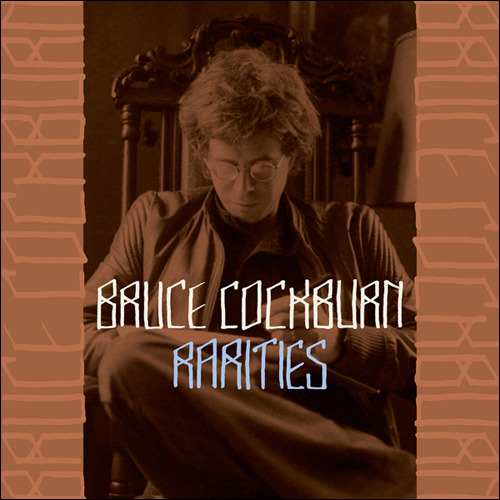
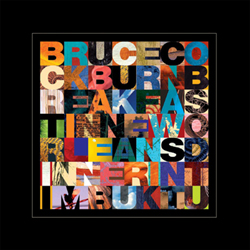
1970 Self-Titled Debut Album, 1997's The Charity Of Night & 1999's Breakfast In New Orleans, Dinner In Timbuktu to be issued individually on 180 Gram Black Vinyl.
Listen to Waterwalker Theme | Pre-Order Digital Album & Vinyl Re-Issues
Having sold more than nine million albums worldwide, acclaimed songwriter, performer, author and activist Bruce Cockburn is a member of both the Canadian Songwriter and Canadian Music Hall of Fame, a winner of Folk Alliance's People's Voice Award, as well 13 JUNO Awards from more than 30 nominations.
WATERDOWN ON - On Rarities, Bruce Cockburn is finally sharing twelve rarely heard recordings with digital music consumers that were previously only available within the Rumours of Glory limited-edition box set, along with four remastered tracks that appeared on tribute compilation albums dedicated to Gordon Lightfoot, Pete Seeger, Mississippi Sheiks and Mississippi John Hurt.
Released on True North Records, Rarities will be available on November 25, 2022, on all digital platforms including Apple Music, Spotify, YouTube Music, Amazon Music and Deezer. An advance single, the theme song from the 1983 Bill Mason-directed National Film Board film, Waterwalker, is available to stream now, along with pre-order and pre-save links for the digital album, and details on the musicians, studios, producers and recording dates for the tracks, all of which can be found
here.
Also found on Rarities are two songs not on the original limited-edition CD, Rumours of Glory: "Twilight On The Champlain Sea" featuring Ani DiFranco, originally intended to be on Life Short Call Now and used on the Japan-only release, and 1966's "Bird Without Wings," the oldest Cockburn demo from his personal vault, later recorded by Ottawa's 3's A Crowd and produced by The Mamas & the Papas' Mama Cass.
On the same day as the Rarities album is released, Cockburn and True North Records are releasing three albums on 180g black vinyl - 1996's Charity of Night, 1999's Breakfast In New Orleans Dinner In Timbuktu and the 1970 debut album Bruce Cockburn, all of which can also be pre-ordered here.
Bruce Cockburn - Rarities - Track Listing:
Juan Carlos Theme
Waterwalker Theme
Avalon, My Home Town
Wise Users
Going Down The Road
The Whole Night Sky (Alternate Version)
Grinning Moon
Song For Touring Around The Stars
Come Down Healing
Mystery Walk
The Trains Don't Run Here Anymore (Re-Mastered)
Ribbon Of Darkness (Re-Mastered)
Turn, Turn, Turn (Re-Mastered)
Honey Babe Let The Deal Go Down (Re-Mastered)
Twilight on the Champlain Sea featuring Ani DiFranco
Bird Without Wings
Bruce Cockburn 2023 Tour Dates
For further information, contact: USA - Mark Pucci - Mark@markpuccimedia.com
Canada & ROW - Eric Alper eric@truenorthrecords.com
Bruce Cockburn & Ticket Links - http://brucecockburn.com
From Bruce Cockburn To Youth - A Very Private Message
by JACK BATTEN - 1 JANUARY 1971 - Maclean's
24 October 2022 - This article/interview was written in 1971.
WHEN BRUCE COCKBURN and his wife Kitty drive about the Canadian country-side and into the cities in their camper-truck, bound for Cockburn’s singing engagements at colleges and in coffeehouses and on television programs, they take as their constant companion a large, bounding, handsome, part-lrish wolfhound mongrel dog. One day not long ago, a man on a street in Toronto stopped to pat the dog and asked his name. Aroo, Cockburn answered. Why do you call him that? the man went on, not sure whether to laugh or to doubt. “Because,” Cockburn said, wearing his customary grave expression, "that’s what he answers to.”
It has been the fate of Cockburn (pronounced Coburn) to find his young career analyzed in terms of Gordon Lightfoot’s more seasoned success. Critics do not quite describe him as the young pretender to the throne of Canadian folk writer-singers that Lightfoot has occupied these last half-dozen years, but they at least make the careful point that Cockburn, who is 25, is traveling in precisely the path laid out earlier by Lightfoot, who is 30. On the surface, the comparison falls into neat place. In the past year, Cockburn has experienced the sudden rush of attention that Lightfoot went through in 1965. His first album is running away in sales, averaging one thousand a month, a figure for a folk album rivaled in Canada only by Lightfoot’s own. He is a packed-house draw at college concerts, and other singers, including Anne Murray, are hurrying to record his songs. And his fame is creeping beyond the predominantly young folk audience through Goin’ Down The Road, the financially triumphant and award-winning Canadian movie for which Cockburn wrote and sang the evocative sound track.
Still, there is a quality about Cockburn that separates him from Lightfoot, indeed from all other Canadian composers and singers. The quality is privacy, a sense of quiet, exclusive completeness that ex-ists within his own head. And for this, Cockburn is beginning to speak to an extraordinary number of young people who are, like him, quite simply retreating into their own quiet preserve of thoughts and inclinations. Where Lightfoot, for instance, is social and aggressive, Cockburn is personal and hushed, exploring deeply for perhaps the first time in Canadian song a young man’s inner country. This introspection of his leads him to write lyrics that aren’t always immediately accessible, that demand time and attention bordering on intimacy to grasp. It almost takes Cockburn’s kind of intelligence — quick but thoughtful, slightly eccentric, poetic intelligence — to travel with him into his songs. But more and more young Canadians in his audience are willing to make the trip. To them, Cockburn is a new and special messenger, and the message is privacy.
Cockburn’s father is a radiologist in Ottawa, and the home that he and his wife made there for their son Bruce and his two younger brothers is solid, conventional, religious (United Church), loving, athletic and not particularly musical. There is, though, Mr. Cockburn’s piano playing. “He plays by ear in the key of F,” Bruce says. “He does everything with an old-time stride bass, and I used to think it was terribly square when I was a kid. I’d put it down. But now I can hear the good in it and I like the feeling he gets, not the songs, but the feeling. I like it.”
Bernie Finkelstein of Toronto, who became Cockburn’s manager on a handshake a year ago, figures that occasionally in Cockburn’s early career he was beat (Finkelstein’s word). What he means is that club owners, promoters and managers, not understanding Cockburn’s talent, presented him in ways that, at best, canceled out the talent. Finkelstein confesses that at first he, too, missed Cockburn’s appeal, that in fact many people do not initially understand his songs and singing, and that because of the early experiences — being beat — Cockburn is cautious about his career. Gene Martynec, an exceptionally gifted Toronto guitarist and the producer of Cockburn’s records, agrees that Cockburn is resistant (Martynec’s word) with his music. Martynec says that he himself learned to approach the recording of Cockburn’s songs on soft shoes (more Martynec words) and to concentrate as producer on creating a pure atmosphere in which Cockburn’s music would shine through crystal clear.
The sense of guardedness in Cockburn that Finkelstein’s and Martynec’s experiences express is subliminally constant in any contact with Cockburn. He has erected his personal line of defenses against misunderstanding, and the first is a wall of serenity. For a stranger to talk to Cockburn is, in the beginning, before Cockburn accepts him, rather like communicating with the Dalai Lama: the subject is a cheerful and likable but remote figure.
When all else fails, Cockburn has a talent for simply withdrawing. One day recently, he was in the recording studios of Eastern Sound in Toronto cutting his second album of songs to be released this month. He was working on a tune called Sun Wheel Dance, a spirited, complex instrumental without voice that will be the album’s title number. He had played eight takes of the song, and on each either Martynec or Cockburn had detected tiny imperfections inaudible to all but the fussiest ears. Cockburn was preparing to play it again. “Wait a minute,” he suddenly said to the control booth from inside the studio where he sat alone, "I’m getting boggled.” He slid off his stool, and, in a corner of the studio, stood on his head in a perfect yoga position. It lasted for several minutes. Then he returned and played a matchless take.
Cockburn started guitar lessons at 13 and piano lessons at 17. As an Ottawa teenager, he wrote a young people’s church service and worked in high-school rock bands. But through all his adolescent experiences, he felt no inclination to make his life in music. Then his parents in-sisted that he get a higher education, and he decided that the least painful route was a course at the respected Berklee School of Music in Boston. Before Berklee he bummed his way to Europe where he lived with six English dope peddlers in Copenhagen, sang at hootenannies for uncomprehending but appreciative Swedes in Stockholm and performed in a threeman street orchestra in Montmartre until Paris police threw him into jail. He spent a couple of semesters at Berklee, not working hard enough but absorbing lessons in composition and theory at his classes and in blues and jazz after classes. He left before graduation to join an Ottawa rock band called Children. "The trouble was that we were enthusiastic but awfully naïve,” says Cockburn. “We didn’t know how to play together or live together and we ended up destroying each other.” After Children, Cockburn worked in a series of bands for three years, the Esquires, Olivus, Flying Circus, 3’s A Crowd. He says, “I went through a lot of aspects and learned about playing in different musical atmospheres. I was always committed to the bands at first, but often I would be the one in the end to break them up by leaving. I was discovering that I had to do my music by myself.”
Kitty was the girl who sat at the corner table in the Ottawa after-hours club and put a hex on Cockburn. Then they got married. The two events were separated by three years, but anyone watching them together, seeing them fall naturally into affectionate communion in any situation, actually alone together, can’t imagine either of them ever finding any other partner in the world. They are beautiful in each other’s company. Kitty is long-haired and slender, and her body exudes a kind of bony elegance, like a much younger Katharine Hepburn. She has generous features that all click right into place and a hushed way of entering and leaving a room, not at all the sort of girl you would expect to whip up a hex, but that’s the way Cockburn remembers it. “She used to get her boy friend to take her to a club where I was playing with a group we called the Heavenly Blue, and I was conscious of someone over at the side hexing me, just giving off some feeling. So naturally I began to note who it was — Kitty — and we met.” Kitty, at the time, was poking away at art school and at Carleton University, and then, as she says, she went with Bruce. They’ve been together for four years, married since December 1969, a circumstance that, Kitty points out, amazes many people in their age bracket and business who are atuned to much more ephemeral relationships between the sexes.
The amazement mildly interests Bruce and Kitty.
In his conversation and his songs, Cockburn sidesteps clichés, but when he comes to describe the act of song-writing, he falls back on one. It’s a “mysterious process” is what he’s driven to say. “I know how the songs gradually turn over in my mind when I’m working on them, but there’s a very subconscious process going on that I can’t explain. Before I got into song-writing, I didn’t think I had anything to say. But a poet in Ottawa named Bill Hawkins encour-aged me to try writing. He’s an amazing guy. Once he was named Young Man Of The Year by the Ottawa Chamber of Commerce, and actually he was completely subversive of everything the Chamber of Commerce stood for. I started by writing the music for his lyrics, and then I tried both words and music myself. My first was a rock and roll thing called Baby, You’re Not Leaving Me Out, Baby, I'm Heaving You Out. It was about as terrible as it sounds. But the more I wrote the more I discovered comments I had to make. For three or four years I found I was really writing two kinds of songs — songs for the different bands I was playing with and songs that were meant just for me. The first were awfully pretentious, but the personal songs sounded much better, and that discovery helped me see I had to be alone in music. I don’t write songs very quickly. I carry notebooks with me and write lines and verses in them all the time about things my head gets into. And sometimes the words sit there for months going through changes. Then, after a while, it gets necessary to write a song. I feel constipated. I have to get a song down, and usually within two or three days of that feeling I produce a song. This is where the mysterious process comes in — I can’t explain what happens in my head at these stages. What’s even stranger in a way is that sometimes I haven’t any idea what the song is really all about, until I’ve been singing it for months. Sometimes it’s a person from out of an audience who comes up and points out to me what it is I’ve written. When that happens, it stuns me.”
The association of Cockburn with the Canadian wilderness is lengthy, intimate and, as a recurring theme in many of his songs, crucial to any understanding of his music. He dresses like a splendid survivor of Robin Hood’s merry men, in russet colors and leather jerkins, boot-high moccasins and swirling scarves, and in his moments away from music he and Kitty camp out, stroll in the woods and meet nature up close. “I’m going to the country," he sings in one of his most popular and most happy songs, ‘‘Sunshine smile on me." He first encountered the country as a child visiting his grandfather’s farm near Ottawa, but it was a boy’s camp in Algonquin Park that “got me into the woods,” he recalls. “One summer I had a job at the camp, the only straight work I’ve ever done. I washed out the giant porridge pot every day. It was disgusting, but it didn’t beat my feelings about being in the woods. If it didn’t, nothing could.” Here is a weird phenomenon: older people who meet Cockburn — people over, say, 40 — expect him to produce the answers to the perplexing, troubling, awful life they’re stuck with. Maybe it’s the calm he radiates. Maybe it’s his wise and young face. Strangers ask him hard questions. When Cockburn appeared as a guest on the Elwood Glover CBC-TV show from Toronto in the late fall, the questions came, and so did the answers, sort of.
Glover: Do you think there’s any indication that we’re going to have a better life?
Cockburn: I really doubt it. The way things are going, you can’t get any better except in a material way. The machines get bigger all the time and do more things. But people are awfully screwed up despite the machines.
Glover: What Is success to you? Are you successful?
Cockburn: I don’t know. The act of communicating with people is the most important thing and, on the occasions when I communicate, I feel successful.
Glover: But what about money? You must be doing very well financially now?
Cockburn: Ummm, well, we had to borrow something to get down to Toronto from Ottawa for this show. But I’m not concerned about money.
A polite voice from out of the slight gloom of the War Memorial Auditorium in Guelph, Ontario, about tenth row centre, asks for a request. “Sing something from your movie,” the voice calls, belonging, you can make out, to a boy in his late teens. “From Goin' Down The Road. If you would.” It’s been the same request for the last six months, and Cockburn, alone on a stool in the spotlight, looks patient. “I’m sorry,” he says into the microphone in a soft and final voice, "I don’t sing those songs. When I wrote them, I wrote them to express the point of view of the people in the movie. It isn’t my point of view. It isn’t me. So, you know, I can’t sing them here.”
~from macleans.ca
“BIG CIRCUMSTANCE” HAS BROUGHT US HERE
An Interview with Bruce Cockburn - Mockingbird Magazine by BEN SELF
19 May 2022 - The following appears in the Success & Failure issue of The Mockingbird magazine.
Despite growing up in what he calls “a typical 1950s Canadian middle class household” in suburban Ottawa, Bruce Cockburn has done his share of wandering. He first became a star in the Canadian music scene in the early 1970s, winning the JUNO for Folksinger of the Year three years running. In 1974, he converted to Christianity and went on to release several albums with overtly religious themes. Among the best of these was In the Falling Dark (1976), which includes stirring songs of faith like “Lord of the Starfields” and “Festival of Friends.” While he never quite embraced the label of a “Christian” musician, and has often struggled with the legalism and reactionary politics of much organized religion, the push-and-pull of Christian faith has remained a central thread in Cockburn’s work and life.
Following the dissolution of his first marriage the in the late 70s, Cockburn made a conscious decision to “embrace human society” and moved to Toronto, Canada’s largest city. His musical style soon became heavier and grittier, and his lyrics darker and more politically-charged. He was also deeply impacted by his travels abroad, especially an intense Oxfam-led trip to Central America in 1983. These influences culminated in a “North-South trilogy” of albums that included the bracing hit Stealing Fire (1984), which featured two of his career’s biggest singles: “If I Had a Rocket Launcher” and “Lovers in a Dangerous Time.”
After an exhausting decade that ended in a period of writer’s block, Cockburn reinvented himself again in the 1990s, shifting back to more acoustic, introspective material. His output from the period included deeply meditative albums like The Charity of Night (1997), which captures the world-weary wisdom of middle-age in songs like “Pacing the Cage” and the final track “Strange Waters.” The latter, for example, functions like a grungy, latter-day psalm:
You’ve been leading me
Beside strange waters
Streams of beautiful lights in the night
But where is my pastureland in these dark valleys?
If I loose my grip, will I take flight?
Now in his mid-seventies and settled in San Francisco, Cockburn is still asking the deep questions and watching for those “inexorable promptings” of the Spirit, or what he sometimes calls “Big Circumstance.”[1] To the delight of his fans, he continues to tour and release new studio albums, including the soulful Bone On Bone (2017), for which he won his 13th JUNO award, and the rich instrumental album Crowing Ignites (2019). Below he shares about both his musical and his religious journeys, his complicated relationship to success, along with insights on the creative process, and much more.
Mockingbird: To get us started, I’d love to hear a bit about your musical origins. What kinds of things did you listen to growing up?
Bruce Cockburn: Well, the first music I remember being aware of was the stuff my dad used to play. When I was born, I think he thought that he would educate me, so he enrolled us in the record of the month club. Every month we got a nice classical album in the mail, and we’d have to sit and listen to it. Some of them got listened to only once, some of them more than once. But he kept them, and I was able to rediscover those records when I was older.
Anyway, later on I heard all the stuff that was on the radio at that time — Bing Crosby, Perry Como, Bobby Darin — as well as the first rock-n-roll. It was listening to that first rock-n-roll when I first got really interested in music. I was a huge Elvis Presley fan.
M: Is that when you started getting into the guitar?
BC: Yeah. The explosion of rock-n-roll all started around 1956 or so, and I started playing guitar in 1959. My parents were initially concerned about the association of the guitar with rock-n-roll — and the association of rock-n-roll with leather jackets and switchblades — so they were worried. But they said, “Look, we’ll support your guitar lessons if you promise not to get a leather jacket and grow sideburns.” And it was easy to make that promise. Like, what the hell! I couldn’t even grow sideburns.
So I started taking guitar lessons, which exposed me to jazz and Les-Paul-style pop country guitar. Then I started studying composition on my own, and I eventually got more into folk music — country blues and ragtime, that kind of stuff. That period of anybody’s life tends to be so full. There’s this accumulation, this constantly shifting exposure to things, because you’re young, and you’re soaking it up like a sponge. By the time I got out of high school, I wasn’t good at anything, but I had a very well-rounded view of musical possibilities.
After that I went to music school in Boston for a year and a half, before dropping out. But I came out of that with an even broader view. By then it was the 60s, and we were listening to Bob Dylan, the Rolling Stones, the Beatles. And jug band music. Anyway, all of that went into me and formed this big musical soup out of which, eventually, songs came.
M: When you first started playing in bands in the mid-60s, you were playing mostly psychedelic rock. But then your initial solo work from the early-to-mid 70s was totally different. It seemed to have a kind of earthiness and acoustic purity that, at least to me, evokes the wild spaces of eastern Canada. Does that resonate at all?
BC: Yeah, I’m glad you could hear that in the music. One of things that maybe distinguishes a lot of Canadian songwriting from American songwriting, say, or British songwriting, is that sense of space. I think you can hear it in Leonard Cohen, in Joni Mitchell, in Neil Young — it’s there even in his electric stuff, I think.
In the 70s, I was focused on the natural world and the spiritual doorway that that seems to represent. I loved the way in which one’s own spirit feels enlarged. You find yourself in a setting where human presence can be either ignored completely or just isn’t there. From my experience, the soul expands, seems to touch the spirit of the wilderness. And that was a big part of my childhood — spending summers in Algonquin Park, canoe-tripping, portaging over horrible mud patches, surrounded by that wild Precambrian shield landscape.
M: You had a conversion to Christianity around 1974, which of course showed up very prominently in your songwriting. But you once said something interesting about that time in your life: “I was trying to figure out what it meant to be a Christian now that I’d made this move, and the first thing you try to do is to find what all the rules are, and then you try to obey them. That makes you kind of a fundamentalist… But in the end I was completely unsuccessful at being a fundamentalist.” What did you mean by that?
[Click through for the rest of this interview]
For more on the theme of Success & Failure — plus a Bruce Cockburn starter playlist - order the print version of our magazine
or subscribe!
~from mbird.com/the-magazine - by BEN SELF
Bruce Cockburn at The Music Box
by BRAD AUERBACH - entertainmenttoday.net
12 May 2022 - A jewel who has generously been shining and reflecting light for 50 years gave a mesmerizing performance at San Diego’s Music Box. His fans have grudgingly accepted that he may have attained a level of recognition far below his true stature, but they sing his praises consistently and new believers are added to the fold. The number of awards Cockburn has quietly accepted will withstand the test of time (as will his donation of monetary awards associated with the awards). The issues with which he publicly grapples are fascinating on an intellectual level and compelling on a musical level.
His much delayed 50th anniversary tour is finally underway and it raises the wonderful question of why legacy artists tour. The money can be nice but in the case of consummate artists like Cockburn inevitably, invariably there must be that ineffable need to share your art with others. And thank goodness Cockburn does that.
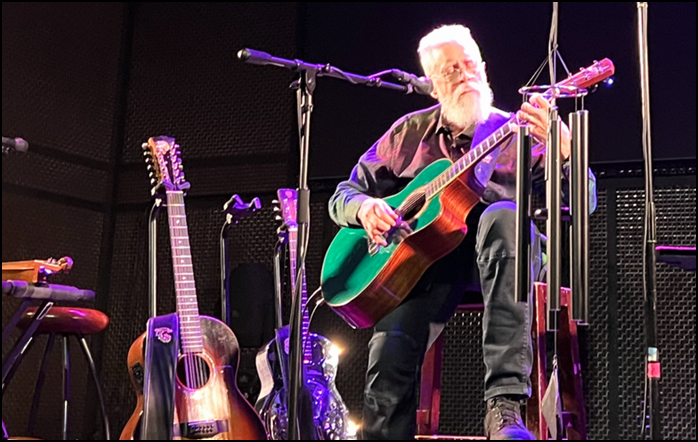
An admittedly adoring audience welcomed all of the songs he played, which included a generous sampling of four new songs (with rumors of a glorious batch of additional songs sufficient to fill out an album by autumn). With one of the deepest catalogs of any of his fellow Canadian artists, Cockburn had much from which to choose. Several in the audience noticed that his recent performance was even better than the prior show he had in San Diego, back in 2005, at the smaller Belly Up.
As arguably one of the best guitarists from north of the border, from perhaps anywhere, Cockburn’s dexterity on the fretboard was jaw-dropping. His voice was impossibly still supple and evocative after all these years.
Cockburn has long explored the dichotomy between his evolving Christian religious conviction and the darkness and pain in the world. “If I Had a Rocket Launcher” captures this dichotomy very well, but its large band arrangement would be saved for another day.
This solo acoustic evening offered the ambitious nakedness of just us, the singer, his song and his guitar. All of his thought-provoking lyrics are buttressed by incredibly inventive melodies. Often, as in the brilliant “Wondering Where the Lions Are,” the jubilant sounding melody is juxtaposed by the darker lyrics. This dichotomy also underlies the most brilliant part of Brian Wilson’s work, for instance.
Cockburn switched between several acoustic guitars and presented wonderful versions of “Pacing the Cage” and “Dust and Diesel.” Both songs unwrap the perplexing, complex nature of the world. Both songs presented his observations of the difficulties presented with how mankind walks through the world. “Stolen Land” and “If a Tree Falls” push the darkness front and center. For the latter song, Cockburn deployed a National steel guitar with a loop to haunting effect. His foot would occasionally punch a set of wind chimes, adding an ethereal tone.
One of the four new songs (each written in his new home of San Francisco) entitled “Us All” captured a universal perspective:
Like it or not, the human race
Is us all
History is what it is
Scars we inflict on each other don’t die
But slowly soak into the DNA
Of us all
But it would be folly to conclude that the evening was all about doom and gloom. A joyous new song was written in Maui called “Honey From God,” and it was revelatory. Likewise, his love song from the eve of Y2K “Last Night of the World” was quietly jubilant.
I am put in mind of a poignant scene buried in the middle of a film called “Year of Living Dangerously.” Our hero, bewildered by the squalor confronting him is counselled by his guide about how to handle all the pain and darkness.
That advice and counsel is echoed by what you will see on Cockburn’s website:
“Part of the job of being human is just to try to spread light, at whatever level you can do it.”
~ from Bruce Cockburn at the Music Box - by Brad Auerback - entertainmenttoday.net
Photos from Bruce Cockburn’s 50th-anniversary tour and his Canada’s of Walk of Fame star
by Ross MacDonald - A Journal of Musical Things
27 April 2022 - It is not often that a concert starts with a standing ovation; however, that is exactly how Bruce Cockburn‘s show at the National Arts Centre in Ottawa started off. But then again, Bruce Cockburn is folk/rock royalty, with over 50 years as a professional musician, countless album sales, 13 Juno awards, and being a major influence to many of today’s folk and rock guitarists. And Bruce has been much more than that, as an environmental activist and proponent for the rights of farmers and indigenous peoples throughout the world; notably Oxfam (famine and poverty relief) and SeedChange (formerly USC Canada: farmer and human rights advocacy).
As Bruce began the evening, he joked that this is his second attempt at starting his 50th-anniversary tour (there have been a lot of re-starts to touring around the world the last couple of years). He released his debut self-titled album in 1970. He also spoke about how in his youth going to summer camp in Algonquin Park, spending a great deal of time canoeing, which he said was synonymous with nature.
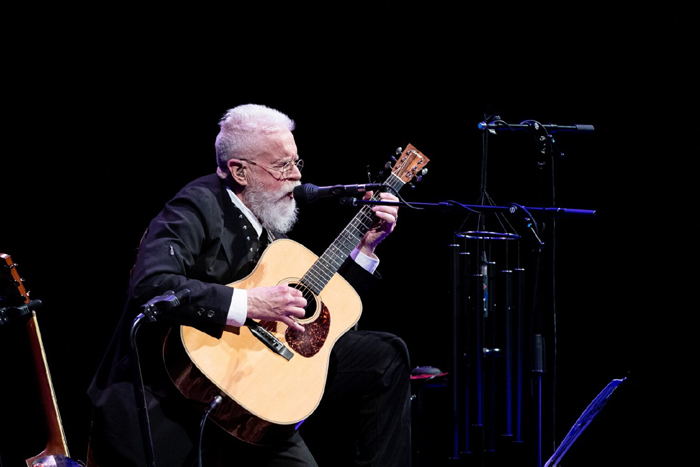
The concert started with an instrumental ‘Sweetness And Light’, off his latest 2019 album Crowing Ignites. The song had riffs that harkened back to some of his music from the 70’s. It was a stripped-down evening with just Bruce alone on stage with his acoustic guitar (except for one song with lap steel guitar), and on some songs playing chimes with his foot.
But Bruce put on a spectacular show of his craft, simultaneously picking and strumming his guitar, stretching out his fingers on the fret-board playing bass and high notes at the same time. And his voice hasn’t changed, powerfully hitting all the high notes in all his songs. The fans showed love for Bruce’s new singles, but were especially ecstatic to hear long-time favourites ‘If A Tree Falls’, ‘Lovers In A Dangerous Time’, and everyone was singing along to ‘Wondering Where The Lions Are’. And of course, the evening closed with an even longer standing ovation.
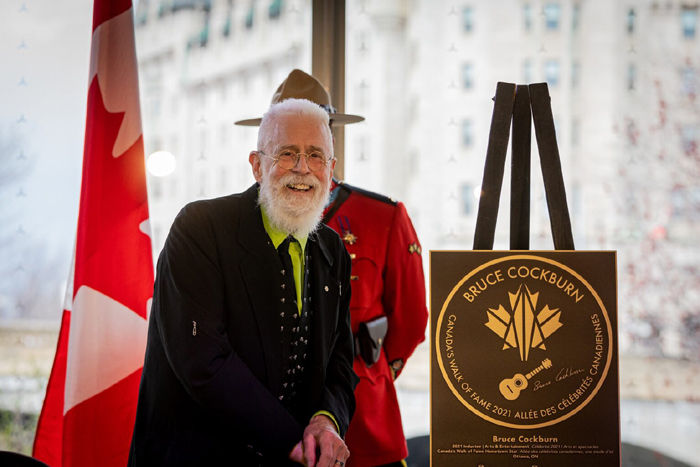
On Monday 25 April, the National Arts Centre hosted a special event for Bruce Cockburn. In November 2021 Canada’s Walk of Fame inducted Bruce, along with ten other prominent Canadians. Unfortunately, it was a virtual ceremony due to the COVID pandemic. So the Walk of Fame took the opportunity to honour Bruce with a Hometown Star in his home town of Ottawa.
Bruce was joined at the ceremony by his family and long-time friend, manager, and founder of True North Records, Bernie Finkelstein. Also in attendance was another Ottawa music icon Sneezy Waters. As part of Bruce’s induction, the Walk of Fame will be making donations to SeedChange and Unison Fund (counselling and emergency relief services to the Canadian music industry) on Bruce’s behalf.
At the ceremony, up and coming First Nations singer-songwriter Mary Bryton Nahwegahbow sang the national anthem in English, French, and Anishinaabemowin. She later sang ‘Lovers In A Dangerous Time’, no easy feat in front of the iconic Bruce Cockburn, who seemed moved by her beautiful rendition.
Canada’s Walk of Fame is in Toronto, but Bruce’s Hometown Star plaque will be mounted at 521 Sussex Drive, where Le Hibou Coffee House once stood, Ottawa’s unofficial headquarters of performing arts in the 1960-70’s where Bruce started his career. A fitting tribute to one of Canada’s greatest troubadours.
~ Click through for more photos! - A Journal of Musical Things
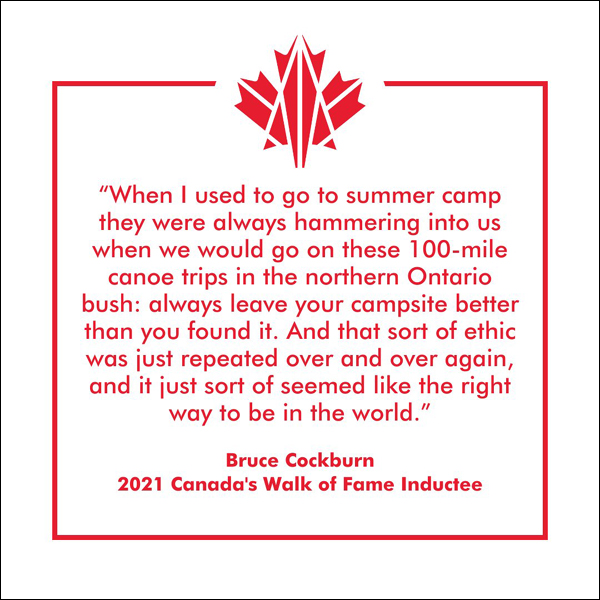
Related: More photos and videos here - https://brucecockburn.com/2022/hometown-star-award-celebration-canadas-walk-of-fame/
Setlist, photos & videos! here
 Canada’s Walk of Fame
@CWOFame
18 April 2022 - Did you know that Bruce will be in Ottawa on April 25th for his Hometown Stars event?
(Presented by @CineplexMovies)
Monday, April 25, 2022
National Arts Centre, 1 Elgin Street, Ottawa
12 – 2 PM
Video clip: Inductee, Bruce Cockburn explains how Canada helped to nurture his success!
Video clip: "Is there anyone from your home town that played a roll in who you've become today?"
Video clip: "Did you have any Canadian idols or heros growing up?"
~from Twitter - @CWOFame
Bruce Cockburn reflects on his Ottawa roots: "I look back with fondness"
By Lynn Saxberg - Ottawa Citizen
22 April 2022 - Bruce Cockburn is back in hometown Ottawa for a few days, primarily to perform a solo concert at the National Arts Centre on Saturday.
While he’s in town, the legendary singer-songwriter-guitarist will be honoured during a ceremony at the NAC on Monday marking his recent inclusion on Canada’s Walk of Fame. Though he says he’s always been ambivalent about fame, the recognition is sweet.
“I do feel like I’ve contributed something to Canadian life over all these years so it feels nice,” the 76-year-old said in a wide-ranging interview that also touched on growing up in Ottawa, his political awakening and the crowd reaction that’s making him increasingly uncomfortable.
Here’s more from the conversation, lightly edited for length:
Q: You’re on tour after a long stretch of pandemic-related shutdowns. What’s that like?
A: When we started in December, there was a tentative element around it like nobody was too sure there wasn’t going to be some major interruption. But on the other side of that coin, the audience vibe is fantastic because you’ve got a bunch of people in a room looking at each other going, ‘Holy jeez, we’ve got a bunch of people in a room, and we’re not quaking with fear.’ People are just really glad to be out at an event, I think.
Q: The tour celebrates the 50th anniversary of your first solo album in 1970. Where were you when it came out?
A: I was living in Toronto. I remember the day the album came out, it got sent to CHUM FM, which was this new freeform FM radio that everybody was listening to. They got hold of the album and played the whole thing from beginning to end, and every time I went into a store in Yorkville, I could hear my friggin’ voice coming at me, and it scared the bejeebers out of me. I thought I’d never have privacy again. It was completely in my own head. No one in the store knew what I looked like, but it was a terrifying feeling. I had this vision of the future that was quite dark. And then, of course, it turned out to be correct in a way, but not at all dark.
Q: How do you think growing up in Ottawa influenced your musical path?
A: It’s hard to pin down a specific element, but where it starts to matter is the middle of high school when I was playing enough guitar that I could actually do it in front of people and not be embarrassed. In Grade 11, I was in a class with Peter Hodgson (later known as Sneezy Waters) and he was another guy who played folk guitar. Peter and I got chummy right away with guitars and he introduced me to Sandy Crawley and the three of us spent a lot of time playing and listening to music. Then he introduced me to the scene around Le Hibou, and it took off from there.
Q: What was that scene like?
A: It was really seminal for me. I wasn’t writing songs yet, or I hadn’t tried to really, but we were appreciating songwriting in the folk world, as well as the pop world, like the Beatles and Stones. We were excited by that stuff, and still thought of ourselves as folkies. Then I went away to Boston to go to school and came back and joined The Children, and it went on from there. I think the Ottawa scene benefitted from a very fertile atmosphere and it was less competitive than Toronto or Montreal. It was a good place to learn your craft. I look back with fondness on that.
Q: People say that growing up in the nation’s capital gives one a political awareness, too. Was that the case for you?
A: I was aware of what was going on in the world around me, but I think it had more to do with my parents. We didn’t listen to the news religiously or have discussions of world affairs around the dining table, although we did sometimes. I kind of grew up with a degree of concern for people’s wellbeing but I was not very politically engaged in that era.
Q: When did that change?
A: It wasn’t until I started traveling west in Canada in the ’70s. That’s when I started meeting Indigenous people, and it was a real eye opener for me. I was a new Christian in those days and there was all these abuses that had been committed in the name of Jesus and the church. I was horrified by that, and it shows up in some of the songs from that era, and it went on from there, expanded to other countries and other situations.
Q: One of your most hard-hitting songs is If I Had A Rocket Launcher. Are you playing it these days?
A: I have been playing it in the shows but I’m wrestling with it a little bit right now actually. I stand by the song, and it fits to some extent what’s going on in Ukraine, although I certainly wasn’t thinking of Ukraine when I wrote it. What bothers me is when people cheer. They cheer the chorus, and especially the last line of the song. It’s never a whole audience that does that, it’s always one or two voices. It gives me the creeps every time because it’s somebody celebrating the horror. They don’t mean it that way but that’s what they’re doing. So I don’t know if I’ll keep singing it or not.
~from https://ottawacitizen.com/entertainment/bruce-cockburn-reflects-on-his-ottawa-roots-i-look-back-with-fondness
For Bruce Cockburn, 50 years of songwriting and performing ‘is an incredible gift’
By Terry Pender - Record Reporter
18 April 2022 - KITCHENER - Bruce Cockburn is writing new songs, touring and making plans to record his 38th album. For Canadian folk-rock legend Bruce Cockburn the songwriting gets harder but he’s still finding the words and music after more than 50 years.
Twice delayed because of the COVID pandemic, Cockburn plays Centre in the Square April 21 as part of a 50th anniversary tour. “It feels really good to be back out working after a couple of years of not,” said Cockburn. “It does feel kind of noteworthy. It is half a century, it is fun to be out and be able to celebrate that.”
Soft-spoken and humble, the 76-year-old could not stop writing and performing even if he wanted to.
He certainly doesn’t have to keep at it, after winning 13 Juno Awards, an induction into both the Canadian Music Hall of Fame and the Canadian Songwriters Hall of Fame, the Governor General’s Performing Arts Award and being made an Officer of the Order of Canada.
“The motivation is the same as it was in the beginning: there is an urge to put feelings and thoughts on paper and make them into songs. And an ongoing urge to play the guitar,” said Cockburn.
His first album was released in 1970, and he was shocked to hear a new station called CHUM FM play the whole thing. These days he’s shocked at how little Spotify and others streaming services pay musicians, but that’s another conversation.
“It’s still what I do,” said Cockburn. “The ideas are harder to come by. How many ideas do you have in your life that are worth sharing with people? It becomes harder to avoid repetition as time goes on, but the motivation is just as strong.”
A few months ago he released “Bruce Cockburn’s Greatest Hits, 1970-2020.” “Most of the songs were not really hits, we wish they were hits,” he said, laughing. He personally selected the tracks for the double CD, including fan favourites from live shows, the ones he likes most and the hits from his 37 albums.
“If you are around long enough, you become an icon,” said Cockburn, chuckling. “It is not something I ever aspired to, it is just as result of doing what I love and having people interested in it for long enough.”
Raised in Ottawa, Cockburn started playing guitar in high school and performing at a coffee house called Le Hibou during the 1960s. It was part of a folk circuit that brought a young Cockburn to Toronto and London, Ont., where he played SmalesPace in the 1970s.
“The first time I played that club I slept on the table overnight,” said Cockburn of SmalesPace.
A routine day for Cockburn is focused on his 10-year-old daughter Iona and his wife MJ. They live in San Francisco, where he has lived for the past 13 years. Cockburn rises at 6:30 a.m., prepares breakfast and drives his daughter to school for 8:30 a.m.. He also picks her up at the end of classes every day.
In between, he plays and practises the guitar and works on new material. He is playing some new songs on this tour. He reads a lot, including science fiction and poetry. For him, authors provide more inspiration than other songwriters.
He always starts a song by writing the words first. The music comes later. He listens to jazz, classical and world music for inspiration. “Something like a lyric of a song develops and when there are enough words to see the shape of it, I start looking for music for it,” said Cockburn. “It is basically hunting around on the guitar to find the right style of music for the lyrics.” he said.
He’s written about 300 songs in his career. The fastest one came together was in an hour or two. The longest one took 37 years. “ ‘Celestial Horses’ is the name of that song and I wrote the lyrics in the mid-’70s,” said Cockburn. “It never quite jelled. I really liked the verses, but I could never quite make it work.” Then one morning when he was living in Montreal the idea for a chorus “came out of nowhere.” “And the song got finished,” said Cockburn, and it was released in 2003 on his album “You’ve Never Seen Everything.”
Cockburn and his family spent most of July 2021 on vacation in Hawaii. He wrote many new songs there.
“The first one of those just kind of popped out. I was up, it was early in the morning and nobody else was up, and I am looking at the landscape. And the idea for the song came, and it was done by the time everybody was having breakfast,” said Cockburn.
“Once in a while that happens. It is a gift I feel when that happens,” he added.
The song is called “Into the Now,” and he performs it on this tour. “Into the Now” will be on his next CD. There are tentative plans to record this fall.
In the 1980s Cockburn had a place in Toronto near College and Clinton streets, then he lived on nearby farms before moving back to the city. His last Toronto home was near St. Clair Avenue and Dufferin Street.
“I woke up one day and it was 2000 and I had lived in Toronto for 20 years, and it was time to move, so I moved to Montreal,” said Cockburn.
After a few years, he moved to the Kingston area where he met MJ. They lived in Brooklyn for a brief period of time, and then moved to San Francisco. They rented a place for years in the Cole Valley neighbourhood, and recently bought a home in the Bernal Heights neighbourhood.
“We are here because my wife got a job here, and she was living here when we first started going out,” said Cockburn.
But he likes it, calling San Francisco quirky, interesting and beautiful. “I am really enjoying the experience of living on the West Coast. I never imagined I would be a West Coaster,” he said. “It is pretty great.”
These days, profound gratitude is his dominant emotion.
“To still be alive at 76 and still functioning and to have been able to do all this stuff for so long, it is an incredible gift and one for which I am very thankful,” said Cockburn.
~from therecord.com-waterloo by Terry Pender
Bruce Cockburn reflects on career ahead of Peterborough show
by Brendan Burke - Peterborough Examiner
17 April 2022 - Acclaimed singer-songwriter and Canadian music icon Bruce Cockburn is many things. A skilled guitarist. A natural wordsmith and prolific lyricist. An experimenter of folk, rock, pop and jazz. A spiritually minded creative.
But if you ask the Ottawa-raised performer, he’ll likely tell you he’s merely a vessel: a man with a guitar trying his best to convey the human experience one melody at a time.
“An artist’s job is to distil what you can grasp from life into some communicable form and then share it with people; and life includes all of these different things: sex and politics and violence and love and the divine,” Cockburn said in a recent interview.
“I mean, it’s all in there, so why not sing about it?”
Now marking 50-plus years in the industry with an anniversary tour in Canada and the U.S. — including a stop at Peterborough’s Showplace Performance Centre on Tuesday — Cockburn is reflecting on his decades of work and his celebrated catalogue.
It all started with an old guitar. At the age of 14, Cockburn discovered the stringed instrument in his grandmother’s attic.
He was transfixed. Already enamoured with early rock and roll, the avid sci-fi reader and lover of poetry put down his clarinet and picked up the guitar.
“I understood that whatever my life was going to be about, it was going to revolve heavily around the guitar,” Cockburn said.
His parents supported his dreams — with a few conditions: take lessons and don’t grow sideburns or wear a leather jacket.
“I didn’t know if I had a knack for it or not. I just knew I wanted to do it and, in taking lessons, I progressed. By the end of high school, there was nothing else I wanted to do with my life except play guitar,” Cockburn recalled.
Immersing himself in his early musical influences — from Bob Dylan and the Beatles to Mississippi John Hurt, Brownie McGhee and Sonny Terry — Cockburn went on to join a string of bands in Ottawa and later Toronto before releasing his debut self-titled album in 1970 — marking the beginning of his illustrious, genre-bending career.
He went on to release a slew of albums that decade — continuing to explore themes of spirituality while shifting to politically-charged songwriting and a fuller sound with tracks like “It’s Going Down Slow” on his third album, Sunwheel Dance — culminating in the watershed 1979 album “Dancing in the Dragon’s Jaws.” The album featured Cockburn’s breakthrough song “Wondering Where the Lions Are,” which saw his popularity surge south of the border.
“I never thought of what I do as a career and I’ve never made plans around it. So when something like that comes along, I’m grateful for it, but it’s not like ‘finally, I’ve got to where I needed to go.’” I just never think about it.”
With the release of “Stealing Fire” in 1984, Cockburn put out two of his most beloved and well-known songs, “Lovers in a Dangerous Time” and the politically driven “If I Had a Rocket Launcher.”
Cockburn recalls having second thoughts about releasing Rocket Launcher, a track he penned after being shaken by the turmoil faced by Guatemalan refugees in southern Mexico.
“I thought it would be misunderstood. I thought people would hear it as something that was an incitement to violence and I didn’t want to put that out.”
But Cockburn understands the lasting impact of the song — despite “never being that interested in protest songs” — and how music is interpreted with the passing of time. “When I sing it now, I know people are hearing it in light of what’s going on in Ukraine. I don’t want to promote that kind of feeling particularly although I feel it too,” Cockburn said.
“What’s going on there is horrible and it should never have happened and the people responsible for it should be held to account. But we’ve got to get over the knee-jerk response that goes with violence and we have to get off that train somehow.”
Looking back, Cockburn says his exploration and progression as an artist has allowed him to avoid being placed in a genre-specific box.
“People would say, ‘oh yeah, he’s a Christian singer, oh yeah, he’s a political singer, and then after a while I think most people have given up now because they don’t know what to call me because it’s all over the place.”
Peterborough concertgoers attending Cockburn’s 50th anniversary tour can expect a mix of fan-favourite staples and newer material, including tracks from his 2019 instrumental album, “Crowing Ignites.”
As for what’s next for Cockburn, he already has close to an album’s worth of new songs that he hopes to record soon.
“I don’t take it for granted. I don’t assume that the ideas are going to keep coming. But as long as they do, I hope I can keep on making use of them.”
~from Bruce Cockburn reflects on career ahead of Peterborough show
Bruce Cockburn returns April 26 to Belleville's Empire Theatre
by Luke Hendry - intelligencer.ca
14 April 2022 - Bruce Cockburn returns April 26 to Belleville's Empire Theatre.
Singer-songwriter Bruce Cockburn is feeling reflective. That may not be surprising, given his more than 50 years in music and the recent release of a greatest-hits album. He still has plenty of music in him, and, in an Intelligencer telephone interview, said he’s eager to share it with audiences.
On April 26, Cockburn will be back on Belleville’s Empire Theatre stage for a solo show, part of a pandemic-delayed “Second Attempt” 50th-anniversary tour of Canada and the United States.
Speaking from San Francisco, where he’s lived for years, the Ottawa native said tour audiences will hear one or two of his new songs.
In choosing older tracks for his Greatest Hits 1970-2020 album, he said, “we made it easy on ourselves” and simply compiled his singles. “Not all of them were hits,” he said.
Cockburn said the album would not be “that commercially-viable” if he’d chosen his favourite tracks. But he’d already done that, in a way, with the boxed set released in 2014 with his autobiography; both are named Rumours of Glory.
Spiritual leaning
His songs with “some sort of spiritual relevance” are his current favourites. “That idea I like very much. The general thrust of the new songs is kind of more spiritual.”
Cockburn said that is a generalization, but the new work does “lean that way.” Sales of his “Four New Songs” collection benefit his church, San Francisco Lighthouse, and Lighthouse Kathmandu, a Nepali organization targeting human trafficking and rescuing victims.
“It’s sort of a cliché of the adult life: that you start off exploring and you go through all these various stages … and you end up attempting to be a sage or something. “My life’s kind of finding an arc like that. There’s room for political opinions and stuff like that but … a more reflective angle is where I find myself seeing things from.”
The writer of “Wondering Where the Lions Are,” “Lovers in Dangerous Time” and many more has used his music to express his views, as he did with “If I Had a Rocket Launcher” and other songs.
“I don’t know what I would write about war at this point,” said Cockburn, explaining he’s already done that several times.
In the case of “Rocket Launcher,” “I wrote it because I had to, because I had a feeling in a gut and my heart.”
In talking about political events, Cockburn said, “I’m not hopeful, particularly. I have hope in me, personally … but I think we’re in trouble, for many reasons. Climate change will cause further tension and disruptions beyond those of the pandemic, he said.
Cockburn said two of his four newest songs – “Orders” and “Us All” – speak to the need to and deal with disagreements “in a civil way, instead of what’s tended to be happening” in the world. “The message that we need to love everybody … People might get tired of hearing it, but I think we need to hear it over and over again right now.”
Music “explosion”
Cockburn had booked about 100 shows prior to the pandemic and cancelling them was disappointing, he said.
About six months into the pandemic, he and his family rented an RV and went on a different kind of tour, parking at friends’ homes and having safe visits on the lawns. The trip included a jam with violinist and former collaborator Jenny Scheinman.
“Neither Jenny nor I had played with anyone for months. This kind of explosion happened. It felt like a kind of emotional explosion because we were able to do this. Some of the live shows have kind of that feel.
“The sense of novelty and the sort of rediscovery to sit in a room with people and feel good, instead of scared or whatever, is pretty great.”
Practises regularly
Pandemic or otherwise, Cockburn does not, however, neglect his playing and writing when he isn’t touring.
“I practise all the time, and if I don’t, I pay a price for that,” he said. A break feels good, he said, but playing the guitar is “like any other physical exercise” and a few days away from it may mean he needs a week to get back into form.
At age 76, he said, regular practice keeps his muscles from stiffening.
Cockburn said the pandemic didn’t change his writing or the frequency of his practising. The pace of my writing is about the same,” he said. “It’s always been just a wait for the good idea.”
He said some of his new songs arose from the “atmosphere” of the pandemic and current events. “One song (“When You Arrive”) actually mentions COVID, but it’s not a song about COVID.”
Taking notes
Cockburn isn’t the only one ensuring he stays sharp. Iona, who’s 10 and the youngest of his two daughters, may enjoy today’s pop hits but she also knows her dad’s catalogue. She’s studying guitar and piano and learns songs rapidly despite little practising, he said.
“She’s toured with me since she was two months old and loves being on the tour bus. "Iona’s got all these notes” she makes at his sound checks, but he’s not sure of her plans for them. He laughed when asked if Iona has critiqued his performances. “I’m waiting for that.”
Cockburn said he is able to keep a relatively low profile in San Francisco. A couple of parents of Iona’s schoolmates may have attended his performances, he said, but he doesn’t receive – or seek – much in the way of recognition.
The road ahead
Asked about bucket-list projects, Cockburn said he’d like to spend more time in nature and one day record an album of others’ songs.
Elvis Presley’s cover of Arthur Crudup’s “That’s All Right” “was huge for me in my beginning consciousness of music.” Billie Holiday and Arthur Herzog Jr.’s “God Bless the Child” is another possibility, as is French poet Joseph Kosma’s “Autumn Leaves.” A Bob Dylan track or two may also make the cut.
In the meantime, Cockburn is booked for shows in Canada and the United States through this summer.
Cockburn is playing both small venues and midsize ones, such as Toronto’s Massey Hall, but said concert halls of that size are “not that different” from smaller venues. The shows and his preparation for them is the same.
“They pay the same money in Belleville or Ottawa or Toronto … They deserve the same show.”
Despite playing solo most of the time, he’s capable of producing a full and layered sound with his deft and intricate finger-picking. Unlike many performers, Cockburn doesn’t use a looping pedal to broaden his sound. “I just never really learned how to use them.” But for the guitarists out there, Cockburn explained he does use tremolo, chorus and repeating-echo effects.
He’s said he is now considering not only some European festival performances for later this year but also some recording sessions for the fall.
“I like doing what I do, and I like all the aspects of it – at least all the creative aspects.
“I feel like I’ve got something to share, and as long I feel like my presence in front of people is a positive one, then it feels like it’s worth doing, keeping it going.”
Visit theempiretheatre.com or call 613-969-0099 for tickets to the Belleville show.
~from Luke Hendry - intelligencer.ca
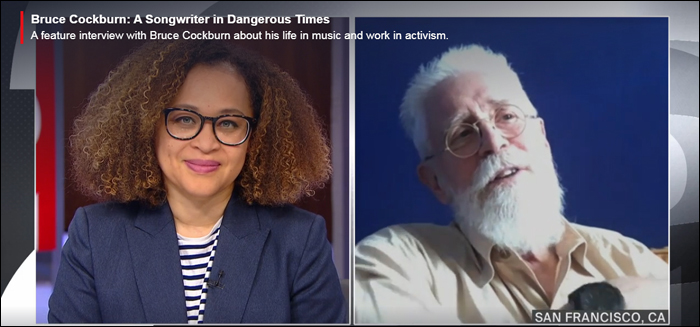 Bruce Cockburn: A Songwriter in Dangerous Times
The Agenda with Nam Kiwanuka
8 April 2022 - The Canadian music icon has been making music for most of his life, and there's no sign of his slowing down. In fact, Cockburn is about to embark on the Ontario leg of his cross Canada and the U.S. tour. This feature interview touches on his music, and activism - both in the climate crisis and anti-war movements.
Bruce Cockburn: A Songwriter in Dangerous Times - WATCH
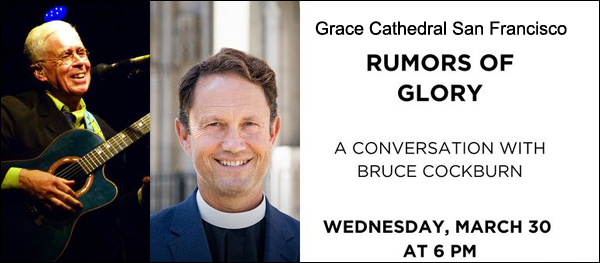 Grace Forum Online
with Bruce Cockburn: Rumours of Glory
by Dean Malcolm Clemens Young
31 March 2022 - Bruce Cockburn, the award-winning songwriter and pioneering guitarist, whose life and music has been shaped by politics, protest, romance and spiritual discovery, is revered by fans and fellow musicians alike as one of the most important songwriters of his generation. Best known for “If I Had a Rocket Launcher,” “Lovers in a Dangerous Time” and “Wondering Where the Lions Are,” he has released 35 albums spanning five decades that have sold over 11 million copies worldwide. For Cockburn, music has always been a key way to explore culture, politics and the nature of the spirit. As a long-time activist, he believes that we can, and should, be dedicated to our shared humanity, and to saving ourselves, each other and this earth – we just need to find the will. And that journey, for Cockburn, has been marked in music.
Each year the cathedral chooses a theme for inspiration and reflection, and in 2022 our theme is "connection". Join Dean Malcolm Clemens Young for a conversation with Cockburn about the connections between taking action, music and faith. ~ Grace Cathedral San Francisco
Grace Forum Online -video conversation
Bruce Cockburn: Musician-Philosopher - audio
by Hejira host Jeff Spitzer-Resnick - WORTFM.org
6 March 2022 - Hejira host Jeff Spitzer-Resnick had a chance to catch up with Bruce Cockburn, who is coming to Madison on March 12th, while he was on tour. AUDIO INTERVIEW here. Here is a lightly edited transcript of the interview, revealing a lot of this talented singer-songwriter’s philosophy.
JSR: I’m here with Bruce Cockburn who is on the road, I believe in Maine.
Bruce Cockburn: Yes, Waterville, Maine.
JSR: And you’re coming to Madison soon on the 12th. I look forward to going to your show, Bruce, and I have a unique opportunity to interview you. I’ve certainly been following your music for, I don’t think quite 50 years, but maybe 40 plus.
I was actually a little surprised that you’ve got a greatest hits album that goes back longer than 50 years. So, first of all, tell me a little bit about the tour where you’re in Maine now. What’s it looking like?
Bruce Cockburn: Well, Maine is full of snow and ice, and it’s overcast. I mean, I’m seeing it from the inside of a tour bus right now.
But the tour’s been going well, actually, we did a leg on the west coast in December just before Christmas and that worked out well. We’re maybe four or five shows into this run and it’s working out well to see people are really happy with being out and being able to sit in a room together.
I think it probably almost doesn’t matter who’s on stage. It’s like everybody feels good.
JSR: I think it matters a little bit. I certainly am somewhat choosy about who I go see, especially during the pandemic. One of the things that I’ve noticed in your music, in addition to just musically enjoying it, is that you tend to have a lot of political commentary.
What do you see as your role as a musician when it comes to the political world, if you will?
Bruce Cockburn: It is one aspect of the human world, and that’s what artists do: distill what it is to be a person in the world as it comes to that artist, to the individual. And then try and share it with people. I mean, I think that’s the job. So that includes the political very much because the minute you start doing any aspect of people getting along with each other, you’re involved in politics or our relationship to the planet. If you try to address environmental issues, it becomes political immediately because everyone has different kinds of vested interests, and everyone has different opinions about these things.
So, it’s just part of the gig.
JSR: That explains why you speak to politics a lot in your music, but you certainly have your own personal bent on politics. It’s just not politics in general. I don’t know if you have a label for it. I don’t like to label people at all, but certainly there is an emphasis on human rights, and I would say the underdog, but I’d love to hear your political philosophy that you imbue into your music.
Bruce Cockburn: Most of what shows up in my songs is a result of trying to understand what I experienced in spiritual terms with respect to stuff like human rights or any kind of moral perspective for me, because I’m told my faith tells me I’m supposed to love my neighbor.
My neighbor is suffering, and I do nothing about it? That’s hardly an expression of love. There’s a lot of things that are happening in the world that none of us as individuals can do very much about, but I think we’ve got to do what we can. And so, I have feelings about these things and the feelings trigger songs, and then I get invited to talk about this stuff.
It’s really something that I kind of fall into without really intending to. I don’t consider myself an expert on anything particular, other than maybe playing the guitar, but I pay attention, you know, I do pay attention to what’s going on and I do care. So, you know, that reflects itself in the content of my music.
JSR: You mentioned spirituality and I’ve also noticed how more than a lot of musicians, especially if they’re not labeled Christian music, that you do imbue some religion into your music. Is that part of the spirituality you were just mentioning?
Bruce Cockburn: Absolutely. It’s a world view. I mean, I can articulate this stuff the way I do now at the age I’m at. I didn’t always understand this starting out, for sure. I didn’t understand anything starting out. I just did what I did, but over the years, I’ve come to kind of understand that more, and I feel that my prime directive as a human is to have a relationship with the divine and that relationship should express itself in every aspect of life. It doesn’t always, because I get in the way or other things get in the way, but that’s the ideal. So, if I’m looking at a beautiful scene in nature, I’m grateful for that.
Or if I’m looking at, or am a witness to some beautiful thing that people do, I’m grateful for that. You know that springs from the gratitude part of it, it has to do with that relationship with God. So, you can call it lots of things. People have different takes on this stuff.
My framework happens to be a Christian one, but I don’t think that’s the only possible way of having that relationship.
JSR: You’ve probably been asked this before, but I’ve been wondering about it, frankly, ever since the song came out. So here you are a man who speaks a lot about love, a lot about justice in the world or identifying when there’s injustice. And then there’s “If I Had A Rocket Launcher.” Maybe things have changed as you’ve grown older, and they certainly have for me. How do you kind of blend that love and spirituality with what could arguably be interpreted as you know, I’m going to blow them all away?
Bruce Cockburn: Well, that would be a misinterpretation, although it’s an understandable one. What I was trying to get at with the song was a couple of things. I was writing straight from the heart when I wrote that, and the heart had been severely impacted by the experience of spending a short period of time with these refugees in the south of Mexico who were recounting to us the kinds of the things they had fled from and as a backdrop to those stories, which were horrendous, was the sound of the helicopter, the military, patrolling the border, which was just a hundred yards away. So, the combination of things is what produced the song, but the poignancy of these very desperate straits, no food, no shelter, or they had some shelter because they managed to build themselves shelter, but they had no food and no medicine. I met about 8,000 people – not personally, obviously, I was there with them – and I was very much disturbed by all of this and I felt that this is very relevant-a sense of outrage, and that sense of outrage is what I wanted to express.
I almost didn’t record the song. I wrote it and then I knew if I put this on the record, people are gonna misunderstand it. And of course, that happened, but at the same time you can’t self-censor. Self-censorship is not a worthy past-time. So I thought, well, I’m going to put it out there and we’ll see what happens.
But I used to go to great lengths to explain where the song came from when I was performing it to the point where people would complain about the talking I was doing, but I wanted people to understand that point and it goes back and forth. There are people who only hear the outrage, or the rage as it translates to them. We all carry bags of rage around with us from birth. So I think the song got a big audience because it tapped into that feeling. The people were actually listening to the lyrics and heard what was being said.
One of the first conversations I had about the song outside of my immediate circle of friends was with a guy named Charlie Clements, who was a Quaker who had spent time with the guerrilla movement in El Salvador. (He was) a doctor, and a buddy, but as a Quaker, he was committed to a peaceful approach to things. And I expressed uncertainty about that song with him. And he said “you just said what we all feel, who’ve seen this stuff.”
JSR: I really appreciate that helping me to better understand, and hopefully our listeners as well. Just one more topic. I noticed in your tour list that you’re spending a lot of time in a variety of towns, often smaller theaters and clubs, and looking forward to you being here at the Barrymore, but here we are on community radio. How do you see, in your long career, the role of community radio in getting out music such as yours?
Bruce Cockburn: Well, anybody who’s not readily defined as pop has a hard time getting on the radio. So, any radio that plays us is a wonderful thing in my view. It’s true, whether you’re talking about jazz artists or singer songwriters or, you know, people who have things to say through their words, that there’s community radio forum for that kind of stuff, that isn’t out there in most other contexts or formats.
So, God bless you guys.
JSR: Thank you very much for that!
~from WORTFM.org
Bruce Cockburn on getting busted in Paris, opening for Hendrix, and having his lyrics mangled by Jerry Garcia - audio interview
WAMC Northeast Public Radio | By Josh Landes
25 February 2022 - LISTEN • 7:41
Legendary Canadian singer-songwriter Bruce Cockburn performs at The Egg in Albany tonight and at the Academy of Music in Northampton Saturday. WAMC caught up with him before the show to talk about some of the unforgettable moments from his five decade career.
Born in Ottawa in May 1945, one of Cockburn’s defining musical experiences came when he traveled to Europe to busk on the streets of Paris in the mid-60s – which he describes as both fantastic and a bit fraught.
“I fell in with two guys, two other musicians, one of whom was a French guy who lived in Paris, a trumpet player, and a clarinet player who was an American on leave on leave from teaching English in Ethiopia with the Peace Corps," said Cockburn. "Those two guys had been doing it, been playing around and they, when we met up, it was like, Oh, we could use a guitar player. My guitar wasn't loud enough to compete with clarinet and trumpet, but somebody around had a six-string banjo that I was allowed to borrow and which was loud. We played kind of blues tunes, old Elvis songs, and trad jazz and whatever. And at that time, it was illegal to play on the street in Paris unless you had a license. And the only people who could get licenses were the basically the bums of Paris, the homeless folks, or very poor, native Parisians. So we were illegal doing this, and we got busted. They'd already been kicked out of every district in Paris except for Montmartre.”
When he returned to Canada, Cockburn fell in with the emergent psychedelic rock scene. His Toronto-based outfit Olivus shared the stage with some of the biggest names to tour North America in 1968.
“We opened for Cream and we opened for Jimi Hendrix," Cockburn told WAMC. "And we also opened for Wilson Pickett at one point. But the Jimi Hendrix one was the most memorable. That was in Montreal in an arena. What I mostly remember was this haze of smoke- Not coming from the smoke machines, although there were those as well. The whole place was kind of alive with pot smoke and Hendrix was amazing.”
At an after party, Cockburn and his friends had the chance to see a more intimate side of the late star.
“Hendrix walks in," he explained. "The whole place just stopped. There was a little stage setup with bands to play in so that the local hot musicians could kind of get up and jam with Hendrix or whatever. And so, you know, in walks Hendrix. He's standing there with us and everybody's staring at him and he looks around the room. He goes, 'I don't know what everybody is looking at, man. I just want to play some music.' He was totally, just like a total normal person. He went and played some music and it was great. And after a while I left. That was my adventure with Jimi Hendrix.”
In 1987, Cockburn released one of his most enduring anthems — the single “Waiting For A Miracle.”
“I wrote that song in Nicaragua. This was maybe my second or third time there. And had I met all these people that were working hard to- You have to kind of be thinking about what was going on in the era, because Nicaragua in those days was a hopeful place if you were not of a conservative mindset. If you were conservative politically, you didn't approve. And the US administration, the Reagan administration, really severely disapproved of what was going on in Nicaragua, because they'd overthrown a fascist dictator that was the friend of the United States. And he'd been replaced by a bunch of young lefties who were friendly with Cuba. So the official America didn't approve. Lots of Americans did approve, lots of Americans empathized with what was going on, because it really was a positive movement at that time. It stopped being that after a while, as will happen in history. But back then, you know, it was a lot of young people, mostly young people, really trying to make their country into a better place. And to some extent, succeeding at it, except that they were being made war upon by the US the whole time. So eventually, that wore them out.”
The song quickly worked its way into the repertoire of another North American musical legend – the Grateful Dead’s Jerry Garcia. “Waiting For A Miracle” became one of the few contemporary pieces in the Jerry Garcia Band songbook.
“Well, Jerry didn't sing my lyrics very much," chuckled Cockburn. "I mean, he did, sort of. But I thought the musical treatment of the song was really good, actually. I was really pleased with that. And I was a bit shocked when I heard him changing all my words. But then I realized that on the record that it's on, there's a Dylan song that follows, and he did the same thing with the Bob Dylan song. Then I realized he was just kind of spinning off everybody's lyrics in kind of his own way.”
They met just once before Garcia died in 1995.
“It was the the afternoon before they started a weeklong run of shows at Madison Square Garden in New York," said Cockburn. "And I happened to be in New York, and somebody said, 'Oh, you've got to come and meet Jerry,' because the song was out. I was taken backstage at Madison Square Garden, and we had to wait for a while because Jerry was meditating. He was in a tent at the back of the stage. And after a while, he came out, and he was really nice. He shook my hands, he said, 'Oh man, yeah, nice to meet you, it's a beautiful song, I hope I didn't screw lyrics up too much,' he says. I said, 'Well, actually, I was going to wait until the second time I met you before I brought that up.'”
With this tour branded as a half-centennial celebration of Cockburn’s career, he says that even going back to the first time he headlined one of Canada’s iconic music festivals in 1969, it’s been a miracle all along.
“Getting thrust into that headline spotlight at that Mariposa Folk Festival- I mean, I wasn't supposed to be the headliner," said Cockburn. "Neil Young was supposed to be the headliner. But Neil Young got sick and didn't show up. And so they had to put somebody in that slot, and there was me. And, you know, that's just fate. You could say fate with a big fat capital F. So, I didn't have anything to do with it. All I did was happen to be there. And, you know, most of what's happened to me has been like that.”
~ from www.wamc.org by Josh Landes
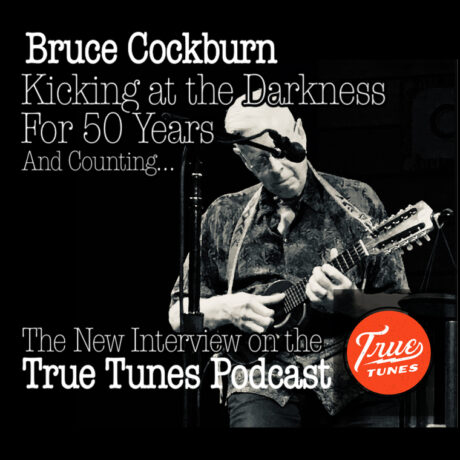 Bruce Cockburn: Kicking at the Darkness for 50 Years (and counting!)
True Tunes Podcast by John Joseph Thompson
9 February 2022 - "It all comes down to love and respect..." My conversation with Bruce premiers on the True Tunes Podcast this Sunday, 2/6, at 7pm on all podcast platforms. It's a doozy!
This is a very interesting and terrific interview with Bruce with lots of music... 2 hours!
Give it a listen https://truetunes.com/Cockburn50/
Soundspace interview with Bruce Cockburn
By ZAN AGZIGIAN
Spokane Public Radio
17 January 2022 - Join Zan as she speaks with Canadian guitar legend/singer/songwriter, Bruce Cockburn, about what it is like celebrating 50 years on the road, touring, what the road means to him, and thoughts on what the new year holds for us all, with sample tracks. (58 min)
LISTEN
Soundspace Interview with Bruce Cockburn (originally recorded Dec 13, 2021 and originally aired January 2, 2022).
Choices of rhetoric and choices of action
An interview with Bruce Cockburn about art and activism and a lifetime of kicking at the darkness
by Róisín West - Monitor Magazine
1 January 2022 - On the evening of June 26, 2002, activists and organizers from around the world settled into worn velvet seats of Calgary’s Uptown Cinema. This was the seventh day of non-violent protests against the G8 Kananaskis meetings, the first meetings of their kind to be held after 9/11. As the lights lowered, the concert organizer, Bourbon Tabernacle Choir’s Chris Brown, took to the stage. He was soon joined by the Brothers Creeggan of Barenaked Ladies fame and Bruce Cockburn. The Monitor recently reached out to Cockburn to discuss that concert and his lifetime of activism, catching up with him as he prepared to head out for his 2nd Attempt 50th anniversary Tour across the United States and Canada.
The Monitor: Music has always played a vital role in social justice movements. There are, of course, protest singers, like Pete Seeger and Joan Baez, whose craft is centred around activism. But other artists like yourself and Tracy Chapman tend to weave social justice issues in as part of a broader tapestry. I’m wondering if you agree with that assessment and how you situate social justice within the landscape of your work?
Bruce Cockburn: Yeah, I do agree with that. I have not felt obliged to present myself or to try to create songs or a body of work that is focused on any one particular issue. I've always seen what I do as being about life in the broadest sense, whatever that means. And life in the broadest sense for me includes a moral consideration. I was raised to care about what happens to people around me, and the world in general, and to pay attention to it. And on top of that, adding the spiritual values that I have, including the notion of loving my neighbour. Well, you know, you can't love your neighbour and ignore your own complicity in your neighbour's pain. So that's the starting point for my approach to those things, to songs that might be said to be about issues.
After that it's circumstantial. I wrote the songs about Central America, which are the most blatant statements of that aspect of what I do, because I was there. I experienced the things I experienced and heard from other people about the things they were experiencing firsthand. Those things had an impact.
You only write your own feelings like that. I feel like that's my job—to translate what I’ve experienced of life into something that's communicable to everybody and can be shared by everybody. I'm always going to be writing from my perspective. And I think that in the case of the instances of injustice that I've mentioned in songs, those feelings would have been shared by any thinking person or feeling person in those circumstances.
So I feel like there's something to share there [with people who] have not been in those circumstances or haven't been exposed to those things. The songs are a way of kind of exposing and pointing a finger: there's something you should look at.
I don't feel like it's my job to sell an idea to people, but I do feel that it's appropriate to try to be persuasive. And in suggesting that people would probably feel the way I do it, if they were confronted with these things.
M: In Rumours of Glory, you suggest that the song that will forever be most associated with you is “If I had a Rocket Launcher.” Why do you think it is such a memorable piece from a career that spans 50 years and 34 albums?
BC: When I say that, it's just based on the fact that that's what people ask for all the time and the one that people who don't really pay much attention to what I do associate with. So I mean, as opposed to Wondering Where the Lions Are, which was a bigger hit by quite a bit, actually back in its day, but very few people, especially people that don't have little kids know it.
But I hear far more, oh yeah, Bruce Cockburn, you're the guy who wrote the rocket launcher song, you know, that kind of thing.
So that's why I say that. Not because I think it's more memorable than others. But I think what people have responded to in it is that sense of outrage or the expression of rage that everybody feels. We all carry it with us. And so that gets a rise out of people, even if they've never paid any attention to what someone's actually talking about... I think that did expose the raw, kind of pain and anger. That's in that song. I think people have responded to that.
It's interesting that a guy who shoots up a mosque in Quebec can be called a terrorist. But that kind of terrorism is handled very differently... Islamic terrorists are not [treated] the same as homegrown, white honky terrorists because only one side gets extrapolated.
M: Virginia Woolf is famously quoted as saying “as a woman I have no country. As a woman, my country is the whole world.” When I listen to your body of work, I feel like this quote could be repurposed to read that, for you, as a musician “the whole world is your country” as you both draw on global musical traditions and demonstrate global solidarity in your lyrics and your politics. What drew you to push beyond traditional boundaries, and how do you hold on to that in a time when fear of the other seems to be reaching an all time high?
BC: Well, I don't find I have to expend effort to be either interested or to hold onto these things. I just want to know what's going on over a wide area. I'm interested in a lot of different things. And I read about those things, but I've also been lucky enough to be able to travel the way I have.
What impelled me to go to Central America in the first place was curiosity. I didn't go there looking for a cause to attach myself to. My brother Don was involved with solidarity work back then in El Salvador and he kept feeding me Central American things to read and what I read about the Nicaraguan revolution just made me want to go there and see what it looked like up close.
[Growing up], it felt like there was something really momentous about the success of the Cuban revolution and the overthrow of Batista and the Nicaraguan revolution felt momentous in the same way. Except the Nicaraguan revolution seemed to be free from what I was reading at the time of the abuses that the Cuban revolution carried with it. I forget which Sandinista I spoke to about this—it might have been Ortega himself—he said, each revolution, we learn from the one before. So the Russian revolution was different from the French revolution, and the Cuban revolution was different from the ones before, and the Nicaraguan revolution. You know, they're trying not to make the mistakes that they can see that have been previously made in circumstances like that. So there was a feeling that, had it been allowed to succeed, we'd be looking at a pretty different world, right?
Of course, it wasn’t allowed to. And Ortega has not carried on in the way that it looked like he was starting out.
M: The reason I wanted to talk to you for this issue of the Monitor was because of your performance at the Uptown Theatre in Calgary during the G8 demonstrations in 2002. I was listening to an episode of Nora Loreto and Sandy Hudson’s podcast recently and Nora was trying to explain to a listener who had submitted a question how different it was to protest right after 9/11. Because if you don't know, you don't know. And you performed at the solidarity concert in Calgary on that Wednesday night with Chris Brown and the Brothers Creeggan.
I was wondering if you could take us back to that concert, if you have any particular memories of how it felt to be in Calgary at that time, or how it felt to be a part of solidarity movements at that time.
BC: What I remember was a kind of heady atmosphere of adventure... that we were all out there making a statement, but there was this sinister side of it, that the event itself was moved out into the wilderness and heavily guarded. And there were all kinds of rumours. I don't know if they were true or not. The military guarding the conference had orders to shoot on site and that sort of thing. Nobody had put that to the test as far as I know, but they made it very hard for anyone protesting to be seen by any of the heads of state or their delegations that were present.
Those people were aware of what was going on of course, because they were watching the news as much as anybody else, I'm sure. But I thought that was a dark move to have made. It made certain kinds of practical sense from the government perspective. But it seemed to fly in the face of the rights we have to be heard.
I think in Canada—and this may be ignorance talking because I don't spend very much time in Canada these days—it seems to me, we were insulated to some extent from the worst effects of the anti-terror attitude that exists in the world. I think that you get a worse version of it in England and the U.S. and I'm sure in some other countries it's far worse, but it's still there.
It showed up when we were involved in the landmine issue. There was a campaign to ban landmines, and at the same time, there was a confrontation going on in BC, between the RCMP and [the Ts'peten Defenders at Gustafsen Lake]. They were in a confrontation without very much actual violence, but at one point the RCMP employed what they called an in-ground explosive device.
So basically they mined that protest camp’s access road and they're lucky they didn't kill anybody. They blew the real wheels off somebody’s truck.
It's a strange simile to use maybe, but one time I was being taken on a boat ride in a rainforest area of Australia. There were crocodiles, and we didn't see any, but at one point in this little tiny creek that we were in, a ripple went across the surface of the water in front of us. That was a crocodile under the water. It was big enough that exerting itself underwater, you could see the ripple on the surface, this kind of V-shaped ripple as if there was a boat there.
And to me, incidents like that landmine episode in BC are that ripple. The reason that we don't see as much of the worst effects of any terrorist policy in Canada is that we're lucky. And it doesn't come up very often. If it was more present in its negative effects if there was such a thing as terrorism that was more present in Canada we would see a lot more repression.
We don't get challenged a lot on things. It's interesting that a guy who shoots up a mosque in Quebec can be called a terrorist. But that kind of terrorism is handled very differently... Islamic terrorists are not [treated] the same as homegrown, white honky terrorists because only one side gets extrapolated.
“I think the job of us human beings is to maintain our commitment to whatever extent we can to as many good things as we can, regardless of where the pendulum is."
M: Are there other solidarity efforts in Canada and the U.S. that you have supported, and stand out in your memory, over the past twenty years?
BC: I think one of the most important things that I felt drawn into was the issues faced by Indigenous People in North America. I think that, and which, which are common, like across the whole continent.
I confess I'm kind of in the same boat, as I think a lot of white middle-class people are with these things, because I'm not in it every day. And because my focus has been, in the last decade, on my family.
It's always impressed me and it still does that the Indigenous groups that end up getting a voice are so restrained in their use of that voice, even now. I find that impressive and moving. And, I wonder how long we can expect that to last. As things get more kind of down to the wire, environmentally and socially, and this kind of very confrontational climate that we're all in, and there again, I mean, there's anti-terror mentality in action against Indigenous protest groups.
I mean, it's obscene, actually. I could say the RCMP, but I don't think it's just the RCMP in it. But the way that authority responds to even the slightest suggestion of things being disrupted is so heavy handed and so conspicuously racist it's very disturbing and it seems to me that we ought to be able to fix that easily, but we haven't and we don't.
M: Do you think that the role of artists and musicians in resistance movements has changed in the age of anti-terrorism?
BC: I think you have to assess who the artists think that their audiences are. Most of the time, when people take those political stances, they're playing to an audience. If you don't think anybody's listening to you, or if you think that you're going to drive away the audience you have, by making a particular statement, you're going to think pretty hard about that statement. The Van Morrisons and the Eric Claptons taking this strong anti-vaxxer stance, I mean, I have no reason to think they're not sincere in doing that, why would they not be? But I think they’re also interested in that audience and maybe only because they feel that's who they're communicating with.
To me, I don't think the role has changed that much. I think that it's everybody's job in society to take a stand on issues, especially on issues that affect everybody. We're all supposed to be paying attention. We're all supposed to take responsibility for what happens. An artist's position in things is such that you can make a point publicly and be heard. And therefore you should.
That's how I see it. And I don't think that's changed. I think the tolerance for outspokenness with respect to issues is a kind of whimsical thing, almost. It's kind of an unpredictable element because when a point of view is seen to be widely popular, then the media will be a willing participant in conveying that point of view from the artist to the public. When it's not, they won't.
So, that's kind of what it comes down to. I don't think it's about the artists. I think that when you don't hear these kinds of things—there was a period, a decade ago, where you didn't hear very much protesting coming from the artistic community. It's not because the artists weren't doing it, it's because the media weren't talking about it or weren’t covering it.
Fashions come and go, too. There are times that it's just not so fashionable for a young artist, for instance, to be thinking about those things. The eighties were like that where, oh, I don't want to talk about issues, you know, just want the money. And that was the prevailing attitude. But that was a reaction to there having been a degree of fashionable acceptance of protest before that. So it looks like the pendulum just keeps swinging back and forth.
I think the job of us human beings is to maintain our commitment to whatever extent we can to as many good things as we can, regardless of where the pendulum is.
M: What roles can artists and musicians play in undoing and repairing the harm that two decades of anti-terrorism legislation has brought to communities at home and abroad?
BC: I don't know, in the big picture, how we get out of it. I think somebody has to be, so somehow someone has to develop a voice and have it be heard. And I don't know how that's going to happen.
You look at someone like Greta Thunberg. We’re hearing her voice. I wonder, why are we hearing her voice, and not the voices of others who might be saying the same thing? Is it because she's the most effective of all the possibilities, or is it because it's good to have a mascot out there saying the things that we know should be said, but [to whom] we don't really have to pay that much attention? I'm a little afraid it’s the latter. But at the same time, it’s great that she's there, and that we’re at least hearing her voice. But I don't know how we get it.
I think on a personal level, the answer lies in trying to be as discerning as possible and paying attention to the impact of our own choices on others. So the choices of rhetoric and choices of action: it comes down to that.
When I go out the door in the morning, I want everybody I meet to have a good day and I do whatever I can to facilitate that. Mostly, what it means to me is that I'm polite to people and respectful as much as possible.
We're now comfortable insulting each other and, and, you know, behaving like a bunch of angry teenage boys, thoughtless and rude and lacking in judgment. I mean, I think that the whole society is being encouraged to behave that way. And so whatever we can do on a personal level to offset that is going to be a good thing.
And that's a moment by moment thing, really. We can have all the ideas we want about the big picture and we need some. We have to work on the big issues. But, it really comes down to how you treat the people you meet.
Bruce Cockburn was recently inducted into Canada's Walk of Fame. He is currently on his "Second Attempt" 50th Anniversary Tour across the United States and Canada
~from monitormag.ca - by Róisín West
 Canada's Walk of Fame interview
CBC Q w/ Tom Powers
13 December 2021 - After five decades in music, iconic Canadian singer-songwriter Bruce Cockburn has released a greatest hits collection, titled Greatest Hits (1970-2020). On top of that, he’s being inducted to Canada’s Walk of Fame this week. Cockburn returned to Q to discuss the honour with Tom Power and look back on his illustrious career.
LISTEN:
Walk of Fame interview - Tom Powers
21 December 2021: For those who missed it, here's the whole segment from Bruce Cockburn's induction into Canada's Walk of Fame.
Sirius - Bruce Cockburn induction speech
Saying Love Out Loud:
Legendary musician looks back with his release of ‘Bruce Cockburn – Greatest Hits’
By Lou Fancher
1 December 2021 - I was wrong. Having, in 2014, held Canadian singer/songwriter and guitarist Bruce Cockburn hostage in Berkeley’s Hillside Club during a nearly two-hour interview, previewed/attended his last Bay Area appearance in 2019, twice read cover-to-cover his 530-page memoir and found myself in a forever relationship with a Cockburn fan who, upon realizing he lacked one of the multi-award-winning artist’s 34 albums, was visibly distraught—I’d thought I’d heard every Cockburn story and tune there was to hear.
I told myself I’d tickled out the whys and wherefores behind poetic lyrics written with monk-like sparseness and music that embraces folk, jazz, blues, rock, world beat, Renaissance, Romantic and 21st-century classical-music styles. His work speaks to universal themes related to family, love, self-determination, spirituality and faith. I was “insider” enough to know Cockburn has, for five decades, been active and sings in bold protest to human-rights violations worldwide that include indigenous land exploitation, ecological devastation, corporate crimes, nuclear buildup, geopolitical and military conflicts, war and more. His albums have decorated Cockburn with 13 JUNO wins, two Hall of Fame inductions, multiple honorary Doctorates, positions such as Officer of The Order of Canada and a recent induction into Canada’s Walk of Fame.
So, on the occasion of his Dec. 3 double-album release of Bruce Cockburn – Greatest Hits (1970–2020), and in anticipation of his “second attempt” North American 50th Anniversary Concert Tour that was originally stalled by Covid-19 and includes live appearances in two shows Dec. 9-10 at Berkeley’s Freight & Salvage, it was natural to expect mere updates and well-trodden repeats.
Instead, in response to a question about experiences that most shook him up or tilted his career and altered or affirmed his relationship to poetry, words and songwriting, Bay Area–based Cockburn tells me a brand-spanking-new story about his dad. The near-tears choking sound that enters his throat fleetingly at the very end of the story is pure Cockburn: it’s a sonority that’s not performative, overly sentimental or self-indulgent. It’s the real deal, expressed in language composed with raw sounds and abstract symbols, but deeply human, like his music.
“I had an experience with my dad,” Cockburn says. “He was at home, in Ottawa, and I’m in Boston [attending Berklee College of Music], and he came down at the end of the term to pick me up. We were talking about what we were going to do over the summer. I told him I’d got a summer job offer, but I turned it down. This is the truth; a guy was a friend of one of my dorm mates. He’d come back from Vietnam, and he had a plan to go down to Central America and make a lot of money over the summer, running guns to Cuba. He wanted to know if I’d go with him and watch his back. With hindsight, that’s the most ridiculous thing. It would have been suicide. At the time, I just thought it was an interesting thing to be offered. It seemed like it was going to be lucrative, but then I thought, ‘No, I don’t want to do that.’ My dad, he was horrified that I’d even consider it—[I’d be] basically facilitating people being killed. My dad had been in the Canadian army and didn’t see action during World War II, but he understood what was being talked about far better than I did. My response to him was, ‘What do you care about what I do anyway?’ I was a typical teenager. There was silence. Then he said, ‘Well, a father loves his son.’ I could say nothing. It was the first time I’d ever heard my father say the word ‘love.’ Nobody in my family ever said they loved each other. We did love each other, but nobody expressed it.”
Cockburn says hearing his dad say “love” out loud shocked him. “I’ll never forget that feeling. To use a crass expression, I didn’t know whether to shit or go blind. I had no place to put that,” he says. “I’m glad to have heard that from him, because it’s the only time I did and even then, he couldn’t say, ‘Well, I love you.’ He didn’t have the language, which is why we didn’t talk about those things. But he got to say what he said, and I got to hear it. It was indirectly life changing. I couldn’t tell you the exact effect, but it had to have made a difference.”
Cockburn can’t—or won’t—pin down the difference made by this experience, but an outside observer could draw insight from his reticence. Cockburn has an edgy discomfort with words and their specificity. It strikes me that his lyrics are laid down as if they are secret scratchings that both point to, and cover up, the sacred truths buried within them. Even though his repertoire and his songwriting process depends on words, listeners must dig reflectively into their own hearts and minds to determine meanings and value.
All that makes Cockburn sound elusive or evasive or complicated, and although he expresses ambiguity when we talk about his albums, artistic process, music reviews and other matters, his life is largely relatable. He’s married to an attorney and grateful her steady work during the pandemic stabilized the family’s income. “Some of my income comes from royalties and other things, but the bulk comes from performing gigs,” he says. “Some of our friends are having much harder times. It’s inconvenient for everyone.” The couple also has a 10-year-old daughter. Cockburn says when she recently switched from him waking her up in the mornings, as was his custom, to now using a radio alarm, she told him, “I love music. I don’t know how I could live without music.” His response? “Hopefully you’ll never have to.” She studies guitar and piano, and despite not practicing, baffles him by improving. Which means he doesn’t worry about her music skills. Instead, he worries about her generation’s future.
“The pandemic’s not the only problem: That generation is facing the results of the whole 20th century and beyond,” he says. “They’re going to have quite a lot of trouble. We’re not setting a good precedent. Not in this country.” He names as his biggest concern the world’s dependence on oil. “It really started with the industrial revolution after World War II. Now it’s everything: it’s where we get our energy, our clothes, products in our homes. But [oil] is a finite supply, and it’s going away. We won’t get to Mars fast enough, and it’s unlikely Mars has oil, anyway. We’ll have to find an alternative. We need to go back to growing fibers to make clothes, which still happens somewhat; but increasingly, things are made out of polyester, nylon—and those are petroleum. I’m not trying to be a doomsayer, but the odds are we’ve created major problems that the next generation will have to deal with.”
We decided to lighten up and talk about his new CD. Curating the anniversary album and the set list for the tour, both spanning 50 years’ work, he says song selection took a mere 30 seconds. “It’s all singles that went to radio. There was no choosing involved.” Embarking on a solo tour was largely a matter of money and circumstance. “When we booked these shows everyone was enthusiastic, but nobody was sure if they would actually happen,” he says. “Nobody’s even sure now: We’re all acting like the shows are on. But who knows when there’ll be another lockdown? Fingers crossed!”
In the bank already are 30 songs written using what Cockburn calls “my standard fallback” approach. “I want to write about everything and anything that comes to mind,” he says. “There are things that come to you shaded, in a way that’s new to you. Encounters with art or a person can do that, too. I go around with the intention of being in a state of vigilance, waiting for those triggers. I write things down as I think of them. Sometimes a whole song is born quickly, and other times an idea seems good but has to wait decades for other elements to make it work. I go around harboring the intent.”
I ask him to jump onboard to comment on six tracks I’ve selected. About 1973’s All The Diamonds in the World, he says, “I think of it as marking the point I decided to self-identify as a Christian. The song for me belongs in a photo album commemorating that moment. I wrote it following the stress between me and my [ex-]wife. I found a degree of helplessness within myself to deal with the situation, the standard kind of stuff that happens between couples. I keenly felt my lack of self-sufficiency. I prayed, and the prayer was answered. It’s not written exactly about that, but it’s more a celebration of the fact the prayer was answered than about the issue itself. The setting is in a boat in the Stockholm archipelago. It was a beautiful day, and the sun sparkled on the water; it just set that song in motion. The feeling of what I’d experienced the night before, the prayer answered and the beauty of the day, just combined to produce that song.”
Rumours of Glory, written on the cusp of the 1980s, captured a scene in New York City’s East Village when the bleak, empty streets suddenly teemed with people leaving work. Twenty minutes later, everyone having dived underground into the subway system, the hubbub of life disappeared. The sunset cast the sky in pink; two contrails left by planes formed a cross in the sky. “It was too good to pass up,” he says.
In 1995, Pacing the Cage was a song a lot of people related to. “I certainly wasn’t thinking of this [Covid] trap when I wrote it, but it has resonance this time, for sure. It’s another song immediately triggered by a visual image,” he says. “I was living on a horse farm in Western Toronto. It was a situation that started out great, exciting; but it lost that luster in a big way. It’s not just about being in a domestic trap, but in yourself, in your habits and habits of mind. There’s a sense of suffocation that we all experience. The imagery; I turned into the driveway of the farm, and there was a sunset that looked like an angel weeping and holding a bloody sword. There was the song, right there. I didn’t have to make anything up. Seeing it: that’s the trick. It doesn’t feel like trickery; when it happens, it feels like a gift. Not everyone has it, nor do I, so when I get it, it’s precious.”
Anything Anytime Anywhere (1992) is a straight-ahead love song with unusual origins. “The title and phrase actually came from a want ad in Soldier of Fortune magazine,” he says. “The magazine is a kind of fashion magazine for mercenary wannabes. In the ’80s, when the U.S. government was telling us there were no wars in Central America, you could open up Soldier of Fortune and read accounts written by soldiers fighting there. It was enlightening in that sense. It was common to see ads for military people looking for work: they were willing to do anything, anytime, anywhere. In a love context, it felt like what you can ask: You can ask me for anything, anytime, anywhere.”
One song on the new CD is a happy accident. Instead of the 1973 solo version, a recording made in 1987 of a live concert has Cockburn singing “Mama Just Wants to Barrelhouse All Night Long” with the late Kathryn Moses. “Somebody goofed, and the record was mastered with that version,” he says. “We could have corrected it, but it seemed like it was meant to happen, because Kathy Moses died last year of cancer. It seemed fitting she be on the record. I’m glad the mistake was made.”
Cockburn says he hopes his music has and will always speak the truth and draw enough attention to become a medium for sharing, for human exchange—then backtracks with, “it’s safe to say it’s always the best I can do at the time.” He finds music reviews, even self-administered ones, troublesome. “Passing judgement—we all do it, I do it—but I don’t want to inflict it on anyone else,” he says. “It’s better to let people figure it out for themselves. Once in a while, over the centuries, I’ve actually read one or two reviews that taught me something. Mostly, they’re just a guy’s or a woman’s opinion, and I don’t even feel I was at the same show.”
While first discovering jazz, Cockburn bought albums based on DownBeat magazine reviews. Eventually, he realized he and the reviewers liked the albums, but for different reasons. “I also remember a big controversy in the ’60s in DownBeat magazine, about whether or not you could have jazz written in 3/4 time. The musicians are playing it, and it’s the reviewers who are going, ‘This isn’t jazz,’ and another saying, ‘Oh, yes it is.’ It was a stupid thing: If a guy is playing jazz in 3/4 time, what’s it to you? It’s an example of what’s wrong with the institution of reviewing. It’s all very subjective … so, actually, it’s nice not to be reviewed.”
We touch on four new songs produced during the pandemic. “Those songs I wanted to get out, because two of the four are particularly applicable to what I feel is going on,” he says. “I don’t talk about Covid; though one of the songs mentions Covid, in passing. One of them is called ‘Orders.’ The chorus is a list of all kinds of people and behaviors we may or may not approve of. The chorus goes: ‘Our orders said to love them all.’ Another song is called ‘Us All’: It’s a plea to be kind to each other. It seemed to me those songs should be out there being heard. The other new songs are more like all of the rest of the stuff I do. Just Cockburn songs.”
Hopefully, when he writes a few more—he has almost enough songs for a new CD—Cockburn’s next album will be accompanied by another never-before-heard story. A tale filled with mystery and ambiguity; love, pathos and pain; and words destined to be infused with melody.
~from Saying Love Outloud - Bruce Cockburn
Playlists of Bruce's covers compiled by True North
30 August 2021 - True North has just put up a great playlist of some of Bruce's covers. It ranges from kd Lang to Jerry Garcia and worth hearing. It's currently on both Spotify and Apple
Here's the links to get you there but of course you must be a subscriber to use it. ~ Bernie Finkelstein



 Cockburn's recording and distribution company.
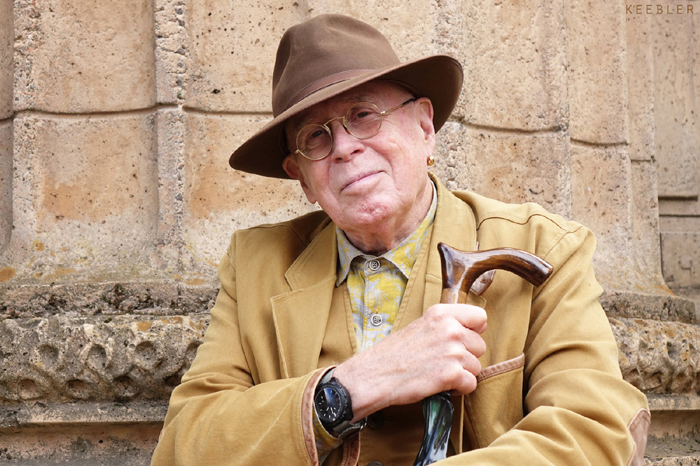
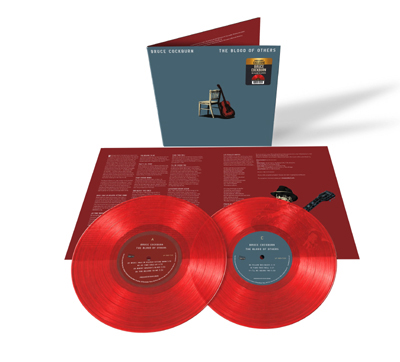
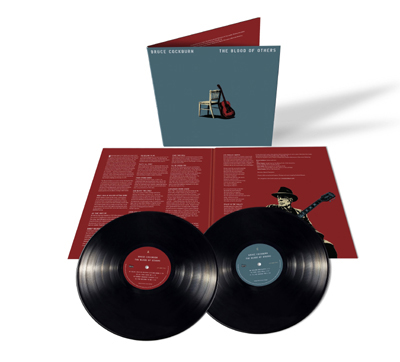
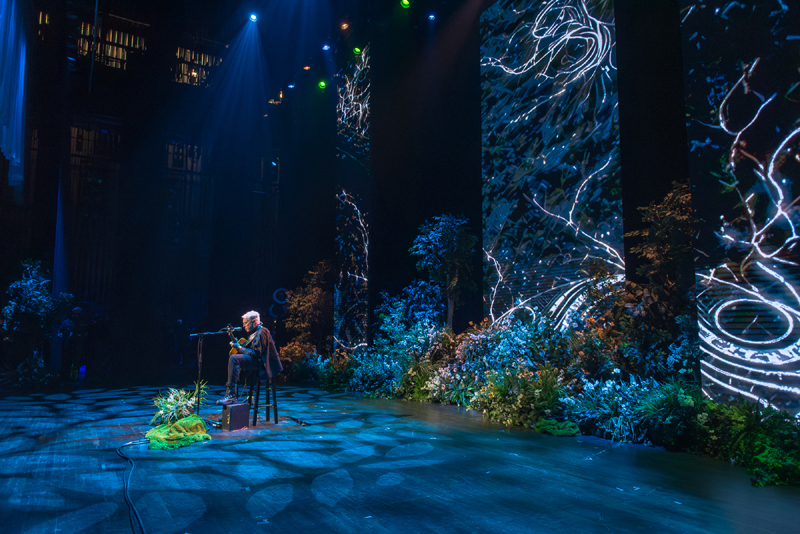 Legacy - a 90th birthday celebration for David Suzuki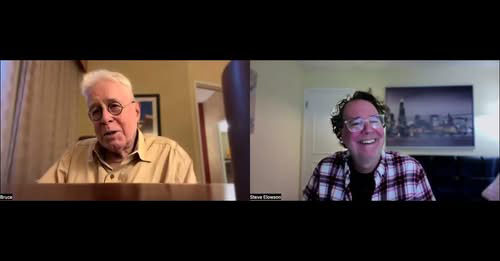
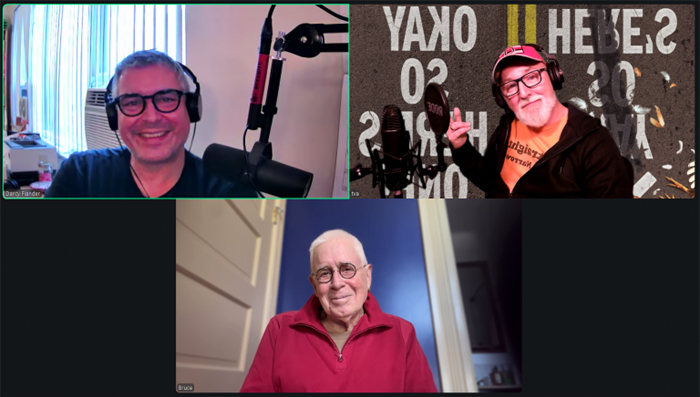

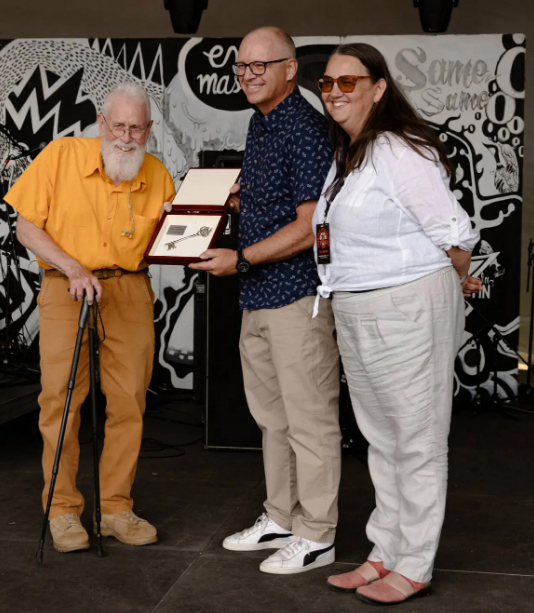
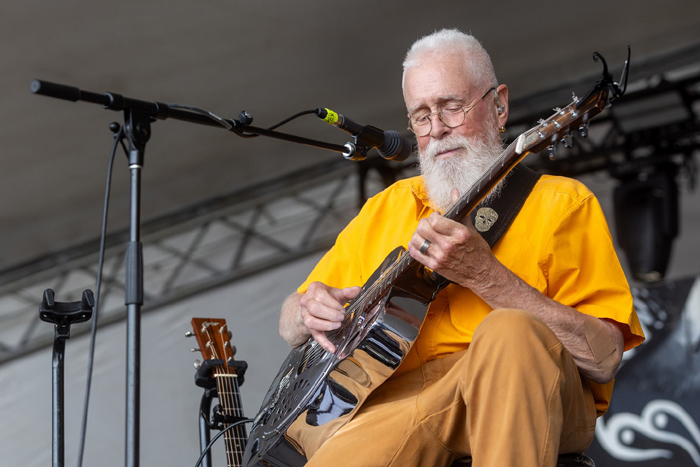
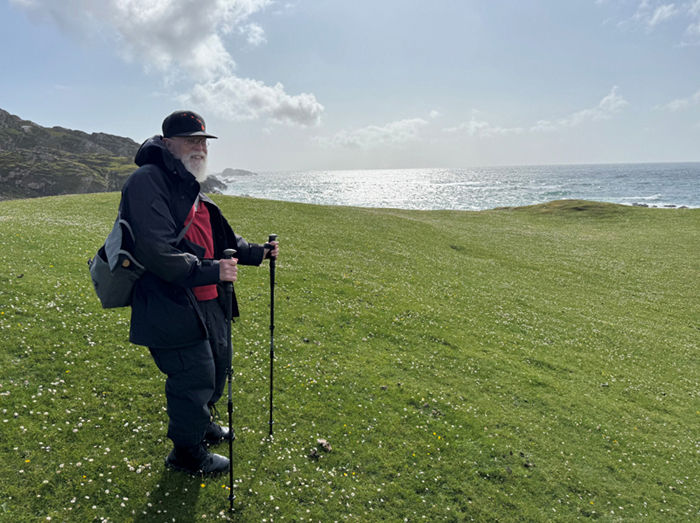
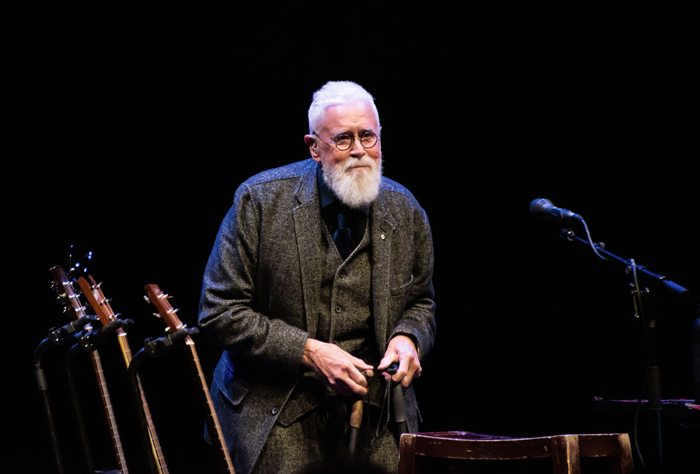
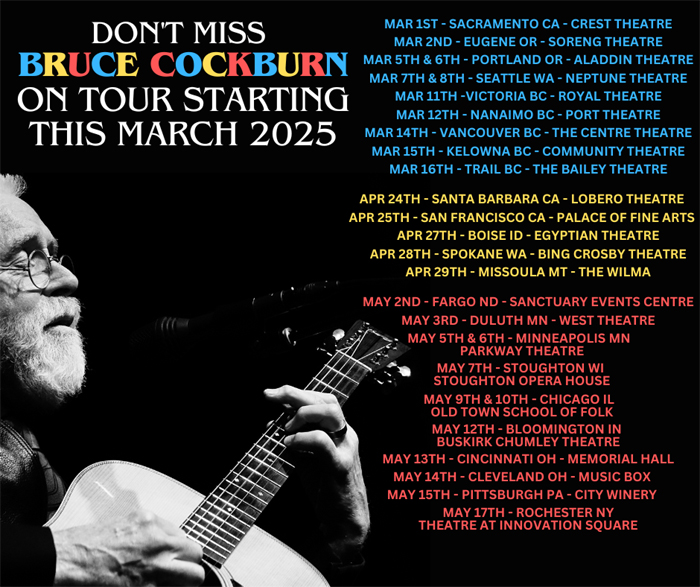

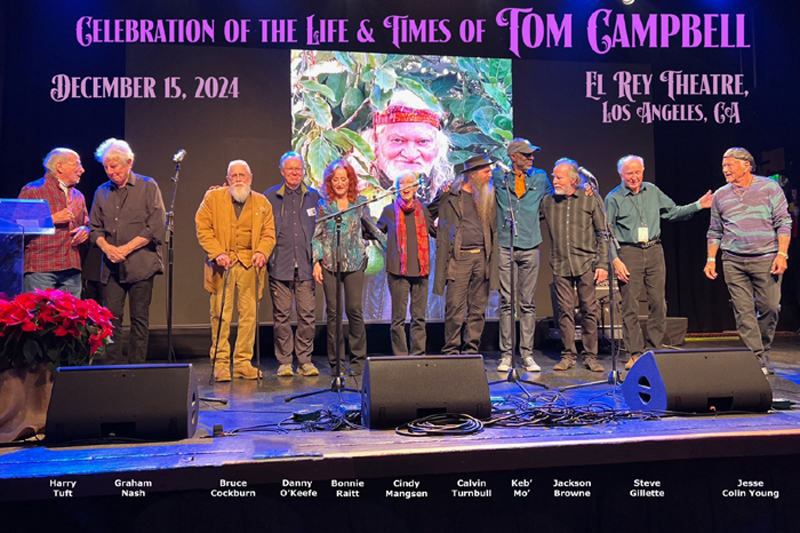
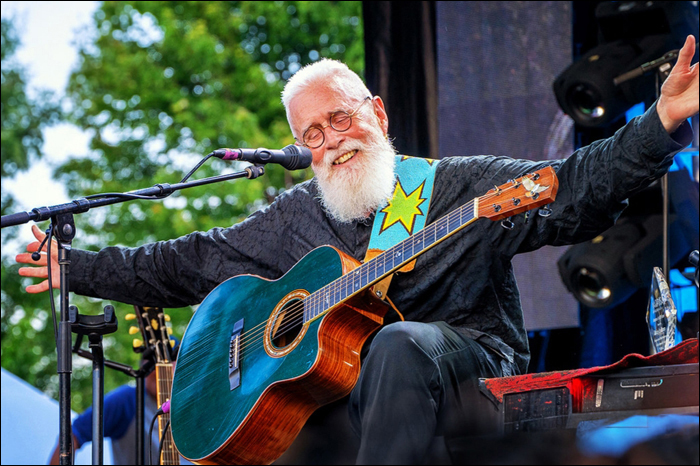

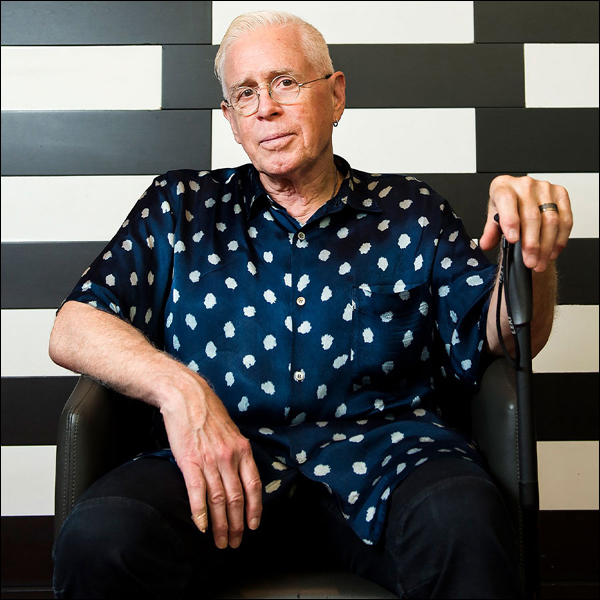
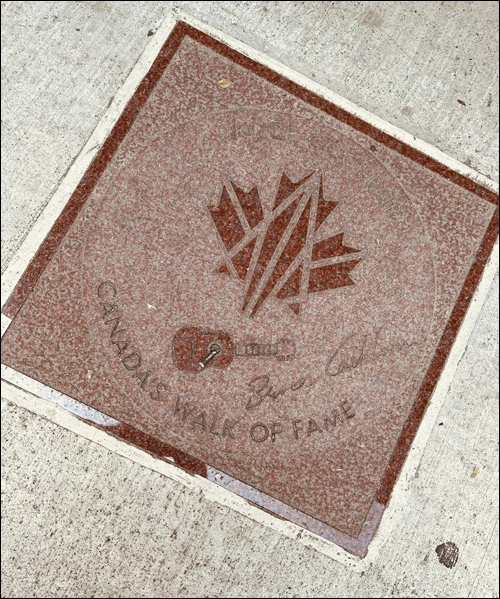
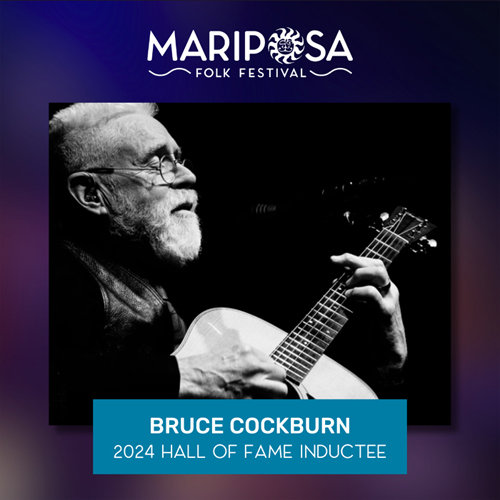
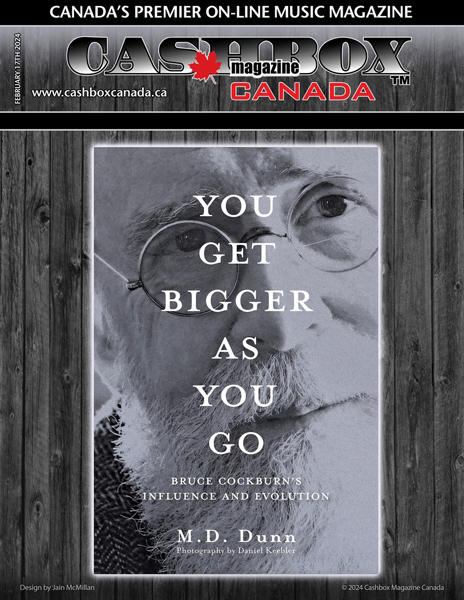 “You Get Bigger as you Go” by M.D. Dunn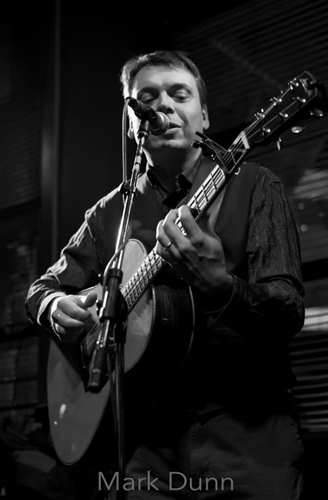
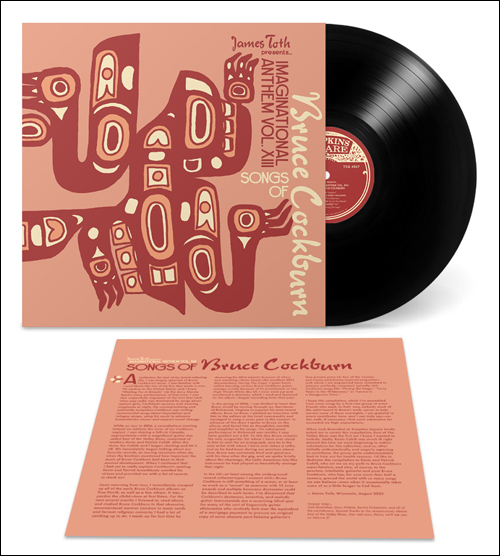 James Toth Presents… ‘Imaginational Anthem Vol. XIII – Songs of Bruce Cockburn’
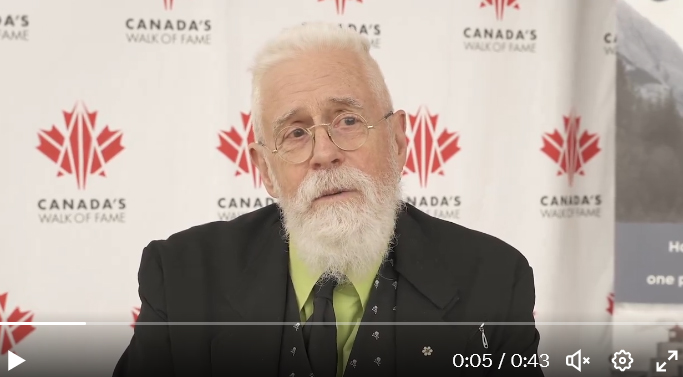 Canada’s Walk of Fame @CWOFame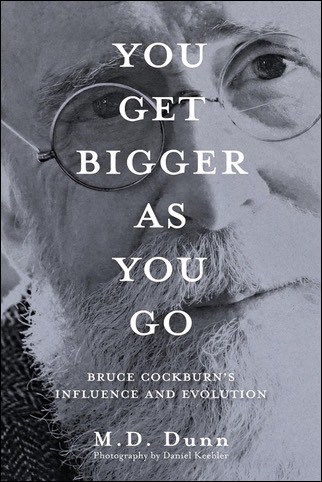
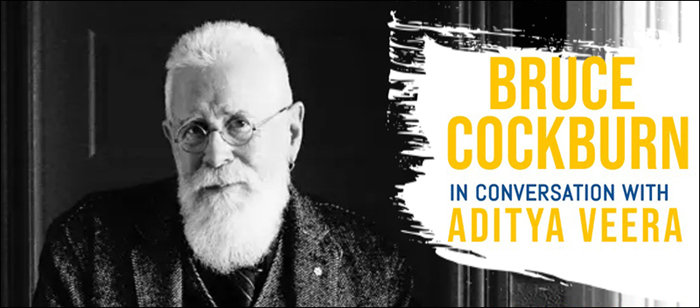 Stalwarts Of Music with Aditya Veera
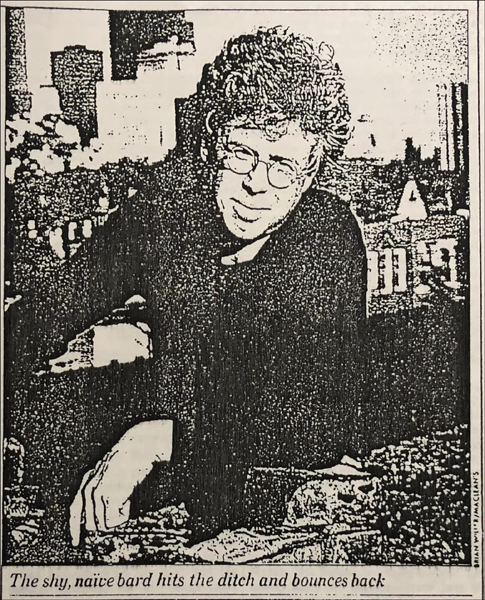 Murray's synopsis of "Dancing in the Jaws of Change" Maclean’s magazine, Sept 7, 1981. - A well written, incisive and comprehensive article on BC’s personal and music direction changes and reflections at the time, his Christian faith, the Canadian music culture and trying to make an international mark, and his young and early adult life. Comments by Bernie, Gene Martynec, Murray Mclauchlan, and band members Hugh Marsh, Dennis Pendrith and Kathryn Moses.
 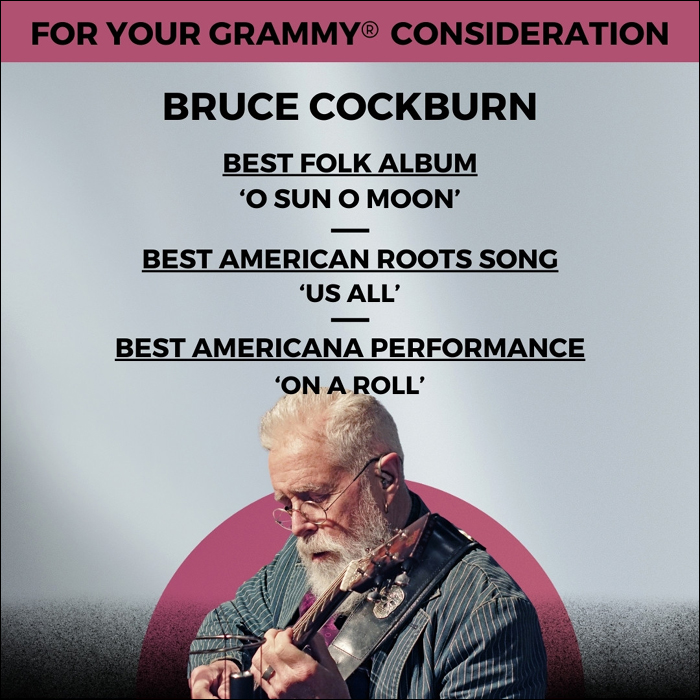 Grammy Consideration!
 Tracking the Doomsday Clock, period-proof soccer kits, Bruce Cockburn and Susan Aglukark | Episode 622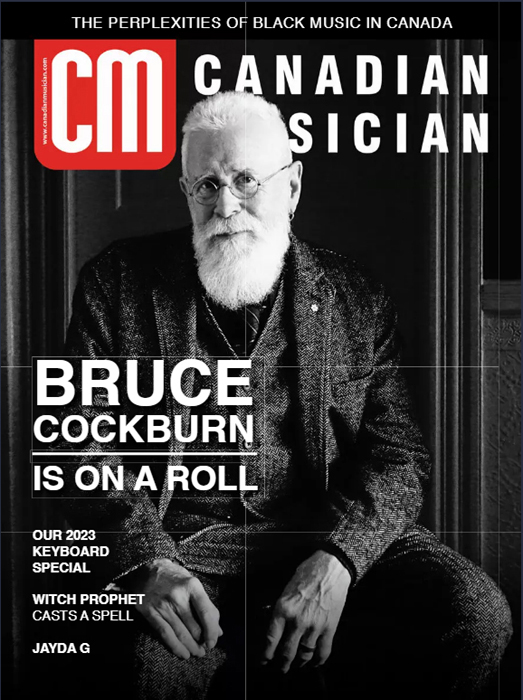
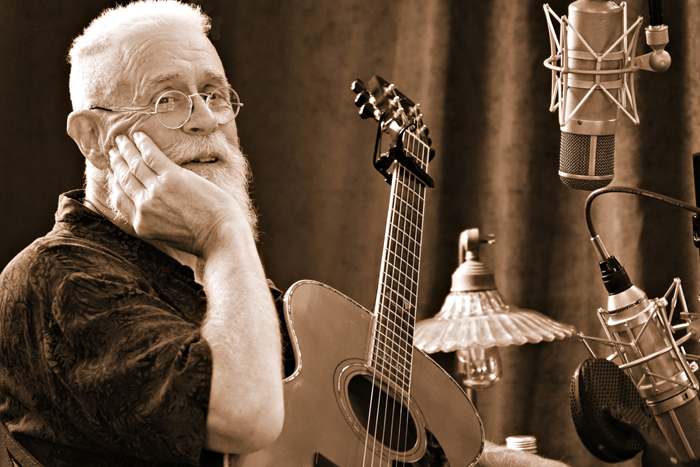 Bruce Cockburn on His Beginnings, Moving to the West Coast, New Album and More
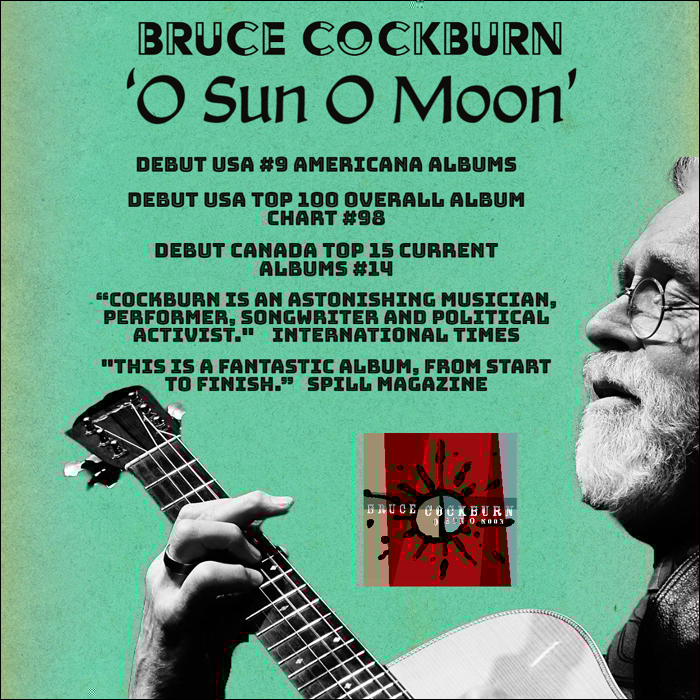 Album Review by spillmagazine.com